


What Is Forehead Wrinkle Botox — and Is It Right for You?
Title: Smooth Forehead Skin Post-Treatment; Creator: Aesthetic Photography Pro; Description: A close-up of a person with smooth, wrinkle-free forehead skin following a cosmetic procedure in May 2026; License: Creative Commons Attribution 4.0; Alt Text: Close-up of a smooth forehead after forehead wrinkle botox treatment; forehead lines; aging process; non-surgical; facial rejuvenation
Forehead wrinkle Botox is one of the most popular non-surgical cosmetic treatments in the world, with over 9 million botulinum toxin injections administered globally in 2022 alone.
Quick answer: Here’s what you need to know at a glance:
| Question | Answer |
|---|---|
| What does it treat? | Horizontal forehead lines and frown lines (the “11s”) |
| How does it work? | Relaxes the muscles that cause repeated creasing |
| When will I see results? | First changes in 3–7 days; full effect around 2 weeks |
| How long does it last? | Typically 3–6 months |
| Is it FDA approved? | Yes — for moderate to severe forehead lines in adults |
| Is it painful? | Most people feel only a minor pinch |
| Any downtime? | No — most people resume normal activity right away |
Forehead lines are often the first visible sign of aging. They form when the frontalis muscle — the large muscle across your forehead — repeatedly contracts as you raise your eyebrows or show expression. Over time, those creases get deeper and eventually stay visible even when your face is at rest.
Botox works by temporarily blocking the nerve signals that tell that muscle to contract. The result? Smoother skin, softer lines, and a more rested appearance — without surgery.
It’s a fast, well-studied treatment that fits easily into a busy schedule. And when done by an experienced injector, the results look natural, not frozen.
I’m Dr. Thomas Jeneby, an Ivy League-trained, board-certified plastic surgeon based in San Antonio with over two decades of experience performing cosmetic procedures — including forehead wrinkle Botox treatments for patients who want real, natural-looking results. In this guide, I’ll walk you through everything you need to know before booking your first (or next) appointment.
Understanding Forehead Wrinkle Botox and How It Works
To understand how forehead wrinkle Botox works its magic, we first have to look at the anatomy of the face. Your forehead isn’t just a flat surface; it’s a complex landscape of muscles that are constantly moving. Every time you’re surprised, worried, or even just concentrating, your muscles are hard at work.
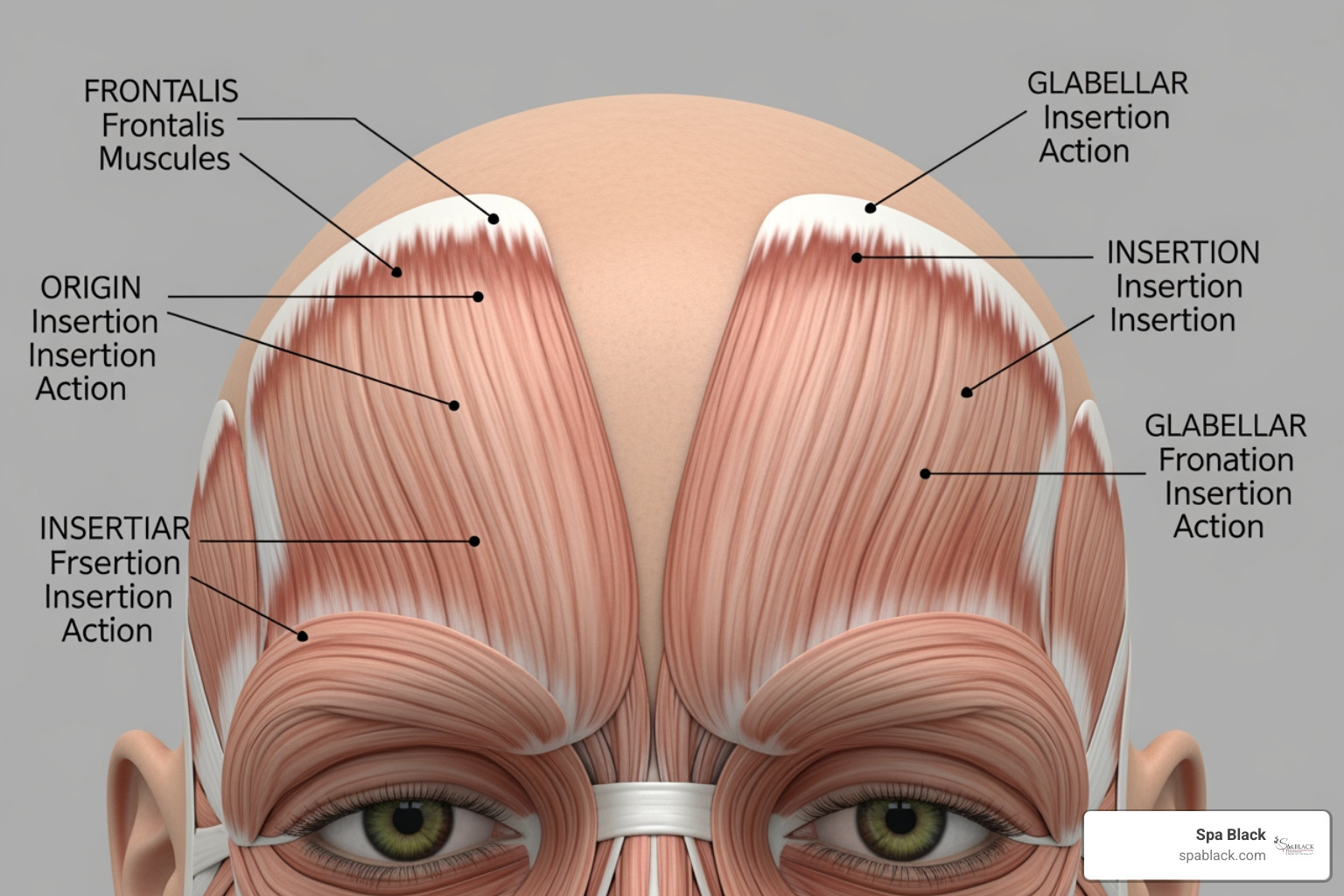
Title: Facial Muscle Anatomy; Creator: Medical Graphics Ltd; Description: Diagram showing the frontalis and glabellar muscles of the human forehead; License: Standard Commercial; Alt Text: Diagram of forehead muscles involved in wrinkle formation; frontalis muscle; acetylcholine; neurotoxin; Forehead – Wikipedia
The primary player here is the frontalis muscle. This is a large, thin muscle that spans the width of your forehead. Its main job is to lift your eyebrows. When it contracts, it pulls the skin upward, creating those horizontal lines we all know. Below that, between your eyebrows, lies the glabellar complex, which includes the procerus and corrugator muscles. These are the “frowning” muscles that create the vertical “11” lines.
Treating Dynamic Lines with Forehead Wrinkle Botox
In aesthetics, we categorize wrinkles into two types: dynamic and static.
- Dynamic wrinkles are the lines that appear when you make an expression. Think of them as the “memories of happy surprises” or the result of a particularly expressive conversation.
- Static wrinkles are the lines that remain etched in your skin even when your face is completely relaxed.
Forehead wrinkle Botox is the gold standard for treating dynamic lines. By addressing the muscle activity early, we can minimize lines and wrinkles with Botox Cosmetic before they become permanent fixtures on your face. Think of it like ironing a shirt; it’s much easier to smooth out a fresh crease than one that has been pressed in for years.
The Science of Muscle Relaxation
How does a tiny injection actually stop a muscle from moving? It all comes down to chemistry at the neuromuscular junction.
When your brain wants a muscle to move, it sends a signal via a neurotransmitter called acetylcholine. This chemical travels to the muscle and tells it to contract. Botox (botulinum toxin type A) acts as a high-tech “mail blocker.” It enters the nerve terminal and cleaves a protein called SNAP-25. Without this protein, the nerve cannot release acetylcholine.
Since the muscle never receives the “contract” message, it stays in a relaxed state. This relaxation allows the skin on top to smooth out. It’s a fascinating process that has been refined over decades of medical use. You can even find more technical definitions of the forehead and its structures in medical dictionaries, but the takeaway is simple: relaxed muscles equal smoother skin.
Key Injection Points and Treatment Expectations
When you come into Spa Black for a treatment, we don’t just start poking. Precision is everything. A “one-size-fits-all” approach is how people end up with “Spock brows” or a completely frozen look.
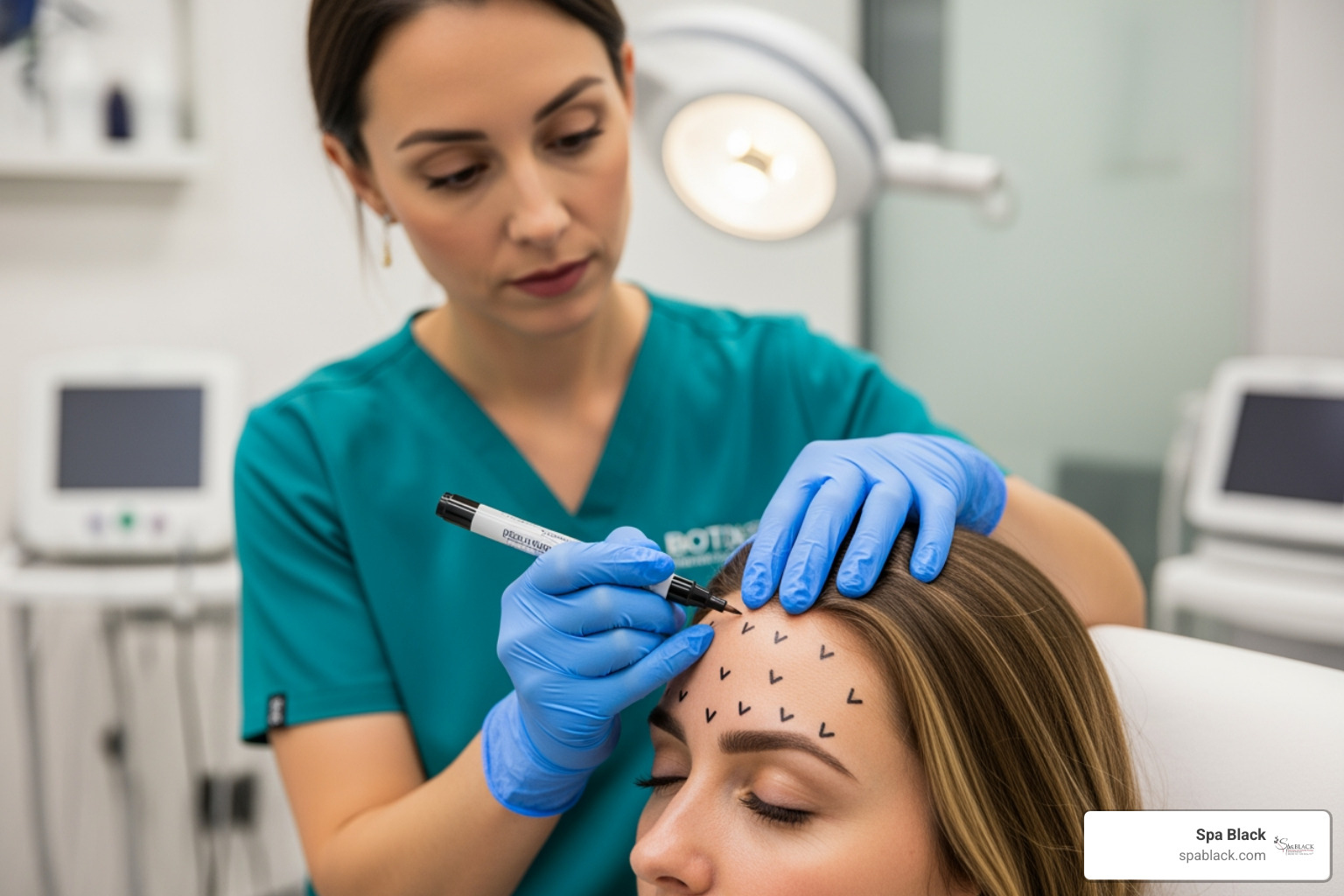
Title: Botox Injection Sites; Creator: Clinical Images; Description: A medical professional marking injection points on a patient’s forehead; License: Standard Commercial; Alt Text: Professional marking injection points for forehead Botox; glabellar complex; procerus; corrugator supercilii; What are the recommended areas for injecting Botox for forehead wrinkles?
For optimal results, we typically target several key areas:
- The Central Frontalis: To smooth those high horizontal lines.
- The Lateral Frontalis: To ensure the sides of the forehead match the center.
- The Glabellar Complex: To treat the “11” lines between the brows.
Determining Your Dosage
One of the most common questions we hear is, “How many units will I need?” The answer is highly personalized. We look at your muscle mass, the depth of your wrinkles, and your aesthetic goals.
On average, for horizontal forehead lines, we use between 10 and 30 units. For the frown lines (the 11s), it’s often around 20 units. Men typically require a higher dose (sometimes 10-20% more) because their facial muscles are generally stronger and thicker. We also consider age:
- Ages 25-35: Usually 10-15 units for prevention.
- Ages 36-50: Often 15-25 units to treat established lines.
- Ages 50+: May require 20-30 units or a combination of treatments.
We take the guesswork out of the process by mapping out how many Botox injections for the forehead are necessary for your specific anatomy.
The Consultation and Procedure
Your journey begins with a thorough consultation. We’ll review your medical history and analyze your facial movements. We want to see you frown, squint, and look surprised! This helps us see exactly where your muscles are strongest.
The actual procedure is remarkably quick — often referred to as a “lunchbreak” treatment because it takes about 10 to 15 minutes. We use a very fine-gauge needle, so most patients describe the sensation as a tiny “bee sting” or a quick pinch. If you’re nervous about needles, don’t worry! We can use topical numbing or ice packs to make the experience as comfortable as possible. If you’re wondering how many units of Botox you’ll need, we’ll give you a precise estimate before we begin.
Results, Longevity, and Achieving a Natural Look
Patience is a virtue, especially with forehead wrinkle Botox. Unlike dermal fillers, which provide instant volume, Botox needs time to work its way into the nerve endings.
Title: Before and After Botox Results; Creator: Spa Visuals; Description: Side-by-side comparison of forehead wrinkles before and 30 days after Botox treatment; License: Standard Commercial; Alt Text: Before and after comparison of forehead wrinkle botox results; 3-6 months; metabolism; conservative dosing; Botox Before and After Gallery
If you check our Botox Before and After Gallery, you’ll see the dramatic difference a few weeks can make. In clinical studies, 80% of adults saw significant improvement by day 30, and nearly 90% saw at least moderate improvement in their forehead lines.
Timeline for Visible Improvement
Here is what you can expect in the days following your visit:
- Days 1-3: You likely won’t see much change yet.
- Days 3-7: You’ll start to feel a slight “tightness” and notice that it’s harder to deeply furrow your brow.
- Day 14: This is the “sweet spot.” The full effect has taken hold, and your skin should look its smoothest.
We always recommend waiting a full two weeks before deciding if you need a “top-up.” Check out our first-timer’s guide for a deeper dive into what those first 14 days feel like.
Maintaining Facial Expression
The biggest fear most patients have is looking “frozen” or expressionless. At Spa Black, our philosophy is “less is more.” We want you to look like a refreshed version of yourself, not a different person.
By using strategic placement and carefully calculating Botox units for forehead lines, we can relax the muscles just enough to smooth the skin while still allowing you to raise your eyebrows and express emotion. Over time, consistent maintenance can actually “train” your muscles to relax, meaning you might need fewer units or less frequent visits in the future.
Safety, Side Effects, and Essential Aftercare
Botox is incredibly safe and has been FDA-approved for cosmetic use since 2002. However, like any medical procedure, there are potential side effects. The most common are mild bruising at the injection site, a temporary headache, or slight swelling that looks like a bug bite for about 20 minutes.
A rarer but more concerning side effect is ptosis (eyelid or brow drooping). This usually happens if the toxin migrates to an unintended muscle. This is why choosing an expert injector — like the team at Spa Black under my supervision — is so critical. We understand the precise anatomy required to treat forehead and 11 lines without affecting your eyelid position.
Post-Treatment Guidelines
What you do after your appointment is just as important as the injections themselves. To ensure the Botox stays exactly where we put it, follow these rules:
- Stay upright: Don’t lie down or take a nap for at least 4 hours after treatment.
- No “rub-a-dub-dub”: Avoid massaging or rubbing your forehead for 24 hours.
- Skip the gym: Avoid strenuous exercise and intense heat (like saunas) for 24 to 48 hours.
- Gentle cleansing: You can wash your face, but be very gentle and avoid harsh scrubs for the first day.
Following these post-treatment guidelines for forehead and frown lines will help you get the best possible result.
Choosing a Qualified Practitioner
In San Antonio, you have many options for Botox. However, your face is not the place to look for a “bargain-basement” deal. You want an injector with medical credentials, board certification, and a deep understanding of facial aesthetics.
At Spa Black, we pride ourselves on being a premier Botox San Antonio provider. Because our med spa is owned and operated by a plastic surgeon, you’re getting a level of anatomical expertise that you won’t find at a standard salon. We prioritize safety and natural outcomes above all else.
Comparing Botox to Dermal Fillers for Forehead Lines
Patients often confuse Botox with dermal fillers. While both are injectables, they solve different problems.
- Botox is a neuromodulator. It stops muscle movement to prevent and smooth wrinkles.
- Dermal Fillers (like Restylane) are made of hyaluronic acid. They add volume to “fill in” deep grooves or hollow areas.
If your lines only show up when you move, Botox is your answer. If you have deep furrows that are visible even when you’re sleeping, you might be a candidate to reduce lines with Dysport (a Botox alternative) or fillers.
When to Combine Treatments
Sometimes, a “dual approach” is the best way to achieve total rejuvenation. We call this a “liquid facelift.” We use Botox to relax the muscles and fillers to restore lost volume in the forehead or temples. We can even combine these with skin resurfacing treatments like lasers to improve the overall texture of the skin. During your consultation, we’ll determine how many units of Botox for the forehead you need and if fillers would help you reach your goals.
Frequently Asked Questions About Forehead Wrinkle Botox
Who is the ideal candidate for treatment?
Most healthy adults over the age of 18 who are bothered by forehead lines are great candidates. It’s particularly effective for those with moderate to severe dynamic wrinkles. However, we do not recommend Botox for individuals who are pregnant or nursing, or those with certain neuromuscular disorders like Myasthenia Gravis.
How Much Does Forehead Wrinkle Botox Cost?
Pricing for forehead wrinkle Botox is usually calculated “per unit.” In San Antonio, the price can vary based on the injector’s experience and the clinic’s overhead. While it might be tempting to go for the lowest price, you are paying for the skill of the person holding the needle. We provide transparent Botox cost information in San Antonio so you can plan your aesthetic journey with confidence.
Can Botox prevent new wrinkles from forming?
Absolutely! This is often called “Preventative Botox” or “Baby Botox.” By starting treatments in your late 20s or early 30s, you can prevent the constant creasing of the skin that leads to permanent static wrinkles. It’s a great way to preserve your natural collagen and keep your skin looking youthful for longer.
Conclusion
Forehead wrinkle Botox is more than just a beauty treatment; it’s a way to feel more confident and refreshed in your own skin. Whether you’re looking to erase deep-set lines or simply want to prevent them from forming, the team at Spa Black is here to help.
Under the expert guidance of Dr. Jeneby, we provide personalized, safe, and effective treatments tailored to your unique facial structure. Don’t let forehead lines tell a story you’re not ready to share. If you’re ready to see the difference for yourself, come visit us in San Antonio. We’ll help you figure out exactly how many units of Botox for the forehead will give you the smooth, natural look you deserve.