


A lot of people ask, “Can laser hair removal leave scars?” But the more useful question is usually this: are you seeing a true scar, a temporary dark mark, or an early burn that needs attention?
That gap matters. Many people search for laser hair removal scars after noticing redness, blotchiness, or a patch that looks darker than the surrounding skin, then assume the worst. In reality, not every post-treatment mark is a scar, and not every concerning reaction means permanent damage. At the same time, it's important not to dismiss symptoms that suggest a burn or deeper skin injury.
One person might notice flat brown discoloration on the bikini line and call it scarring. Another might develop a raised, firm patch after a blister and think it will fade like redness. Those are different problems, and they need different next steps. Clear answers start with understanding what the skin is doing.
That's also why broad reassurance like “scarring is rare” only helps so much. It's true that scarring is uncommon in well-run clinical practice, but risk isn't random. Skin tone, body location, recent tanning, device choice, and treatment settings all affect what happens next. If you're also trying to sort out whether professional treatment is worth it, Spa Black's guide to laser hair removal effectiveness gives helpful context on what this treatment is designed to do in the first place.
At Spa Black Med Spa in San Antonio, laser care happens under physician oversight, which matters because safety depends on judgment, not just access to a machine. A careful consultation should look at your skin type, hair characteristics, recent sun exposure, and how your skin tends to heal before treatment starts.
Many post-laser marks are temporary. True scars usually involve a change in texture, not just color.
The most important thing to understand is that laser hair removal scars are usually related to preventable thermal injury, not to the normal hair-reduction process itself. Once you know that, the topic becomes much less mysterious. You can judge what you're seeing more calmly, lower the chance of a bad reaction, and know when early treatment can make a real difference.
Table of Contents
- Introduction Do Laser Hair Removal Treatments Leave Scars
- Scars vs Dark Spots vs Burns How to Tell the Difference
- Who Is Most at Risk and Where Scars Are More Likely
- Prevention Best Practices Before During and After Treatment
- Treatment Options and Timelines for Scars and Pigment Changes
- When to Seek Professional Care at Spa Black Med Spa
Introduction Do Laser Hair Removal Treatments Leave Scars
Can laser hair removal leave a scar?
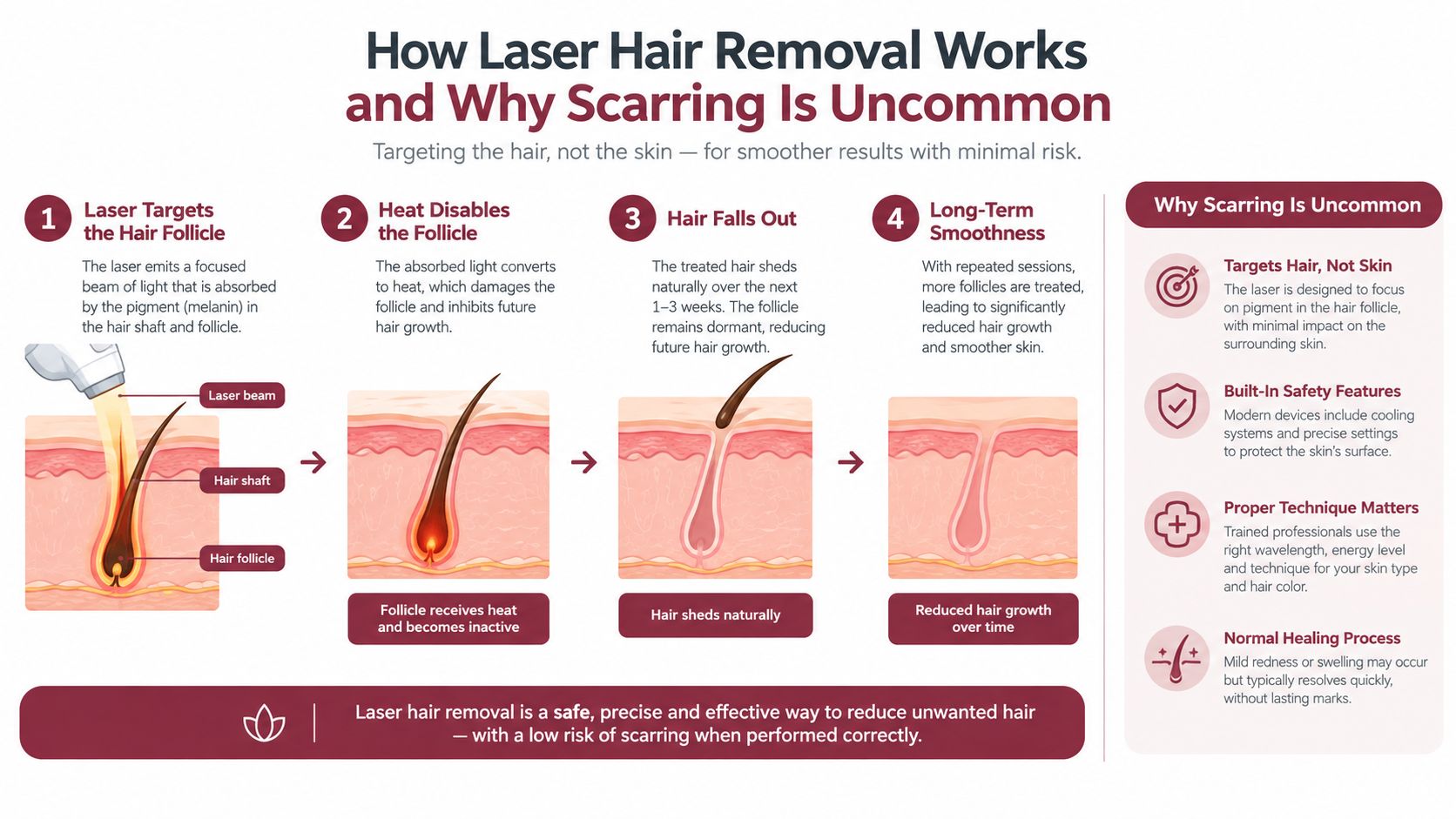
Yes. It can. But a true scar is uncommon when treatment settings are chosen carefully for the person, the body area, and the skin type being treated. In most cases, scarring after laser hair removal is linked to excess heat in the skin, then a burn, slow healing, or infection. It is not part of the intended hair-reduction process.
That first distinction helps people stay calm and accurate. Many marks called “scars” after laser treatment are something else, usually post-inflammatory hyperpigmentation, which is a flat dark spot, or a short-term burn reaction that heals without lasting texture change. A true scar usually changes how the skin feels as well as how it looks. The skin may become raised, thickened, shiny, indented, or uneven.
Laser hair removal works like aiming heat at the pigment in the hair shaft and follicle while limiting heat in the surrounding skin. If the wavelength, fluence, pulse duration, and cooling are matched well, the follicle takes most of that energy. If those choices are off, the epidermis can absorb too much heat, especially in skin with more surface pigment or in areas where the skin is thinner, curved, or exposed to friction.
A clinical overview of laser complications explains that scarring after laser procedures is usually associated with thermal injury, treatment that goes too deep, abnormal wound healing, or secondary infection in the NCBI review on laser complications. That is why safety depends on parameter control and clinical judgment, not on having a laser device available.
Risk is also not distributed evenly. Darker Fitzpatrick skin types have more epidermal melanin competing for laser energy, so device choice and settings matter more. Some body areas also deserve extra caution, including regions with thinner skin, sharper contours, recent sun exposure, or repeated rubbing from clothing. A review of hair-removal methods reported that darker skin types had more temporary pigment change with shorter-wavelength systems, while longer-wavelength Nd:YAG devices had a lower rate of that problem in that group in the 2006 review on laser and light-assisted hair removal.
At Spa Black Med Spa, that is the practical safety question behind consultation and treatment planning. The provider is deciding more than whether hair can be reduced. They are selecting settings based on your Fitzpatrick type, the treatment location, tanning history, hair characteristics, and how your skin tends to heal. If you want a clearer foundation before sorting through risk, Spa Black's guide to how laser hair removal works for long-term reduction explains the treatment goal in plain terms.
One simple rule helps. Smooth color change often points to pigment. Lasting texture change deserves prompt professional review.
Scars vs Dark Spots vs Burns How to Tell the Difference
Most confusion happens. People often use “scar” to describe any visible mark after treatment, but color change and texture change are not the same thing.
A dark spot can be upsetting and still not be a scar. A burn can look temporary at first and still become one if healing goes poorly. The details matter.
What a true scar usually means
A true scar changes the skin's texture. It may feel raised, firm, thickened, shiny, pitted, or indented. In laser hair removal, this kind of change usually points back to a deeper thermal injury rather than the intended follicle treatment.
By contrast, post-inflammatory hyperpigmentation, often shortened to PIH, is a color issue. The skin stays smooth but looks darker than before. It can show up after irritation or excess heat, especially in skin that produces pigment readily.
A burn reaction is more immediate. It often starts with unusual pain, strong redness, blistering, crusting, or raw skin. A burn doesn't always lead to a scar, but it's the main pathway by which scarring can happen.
Quick comparison
| Feature | True Scar | Post-Inflammatory Hyperpigmentation | Burn Reaction |
|---|---|---|---|
| Main change | Texture | Color | Acute skin injury |
| How it feels | Raised, firm, pitted, or indented | Usually smooth and flat | Tender, hot, painful, sometimes blistered |
| Typical appearance | Thickened or depressed area | Brown or darker patch after inflammation | Redness, blister, crust, or raw area |
| What it suggests | Deeper injury or abnormal healing | Pigment response after irritation | Thermal damage that may need prompt care |
| Urgency | Needs assessment if persistent | Often monitored with skin-safe care | Should be reported early, especially if blistering |
The easiest home check
Run clean fingertips lightly over the area. If it's flat but darker, that leans more toward PIH. If it's raised or indented, think scar. If it's actively painful, blistered, or crusting, treat it as a possible burn until a professional says otherwise.
If discoloration is your main concern, Spa Black's overview of how to treat skin discoloration may help you understand what tends to fade and what needs evaluation.
Smooth skin with uneven color is often pigment change. Uneven texture is more concerning for scarring.
Why the difference matters
These categories don't just sound different. They change what you should do next. PIH often improves with time, sun protection, and a careful treatment plan. Burns need early wound-focused care. Texture changes may need a scar strategy rather than pigment-focused products.
People lose time when they treat every mark the same way. A flat dark patch usually doesn't need panic. A blister that gets ignored because someone assumes it's “just irritation” is more likely to leave a lasting reminder.
Who Is Most at Risk and Where Scars Are More Likely
Could two people get the same laser treatment and have very different outcomes? Yes. Scar risk depends on how much heat the skin absorbs, how well that heat is controlled, and how the treated area heals afterward.
A useful way to frame it is this: a scar usually comes from deeper injury and altered texture, not just surface color change. The people and body areas with the highest risk are the ones where unwanted heat is easier to create or harder to recover from.
Fitzpatrick skin type changes the margin for error
Laser hair removal targets pigment in the hair follicle. Skin pigment can compete for that energy. The more epidermal melanin present, the more carefully a provider needs to choose wavelength, fluence, pulse duration, and cooling.
That does not mean Fitzpatrick IV to VI skin cannot be treated safely. It means the treatment window is tighter. Small setting errors matter more, and aggressive parameters are less forgiving.
For many patients, this is the difference between a temporary dark mark and a true scar. Flat discoloration after irritation often reflects PIH. Raised, indented, or thickened skin points to abnormal healing after deeper injury. Professional parameter control is what helps keep treatment in the follicle instead of spilling excess heat into surrounding skin.
At Spa Black Med Spa, that risk mapping matters in practical terms. Settings should match both the person and the body site treated that day, rather than copying the same approach from one area to another.
Some body areas are simply less forgiving
Body location affects scar risk because skin is not built the same everywhere. Lower legs, face, neck, groin, and upper thighs often need more caution for different reasons. A 2024 review found reported complications clustered most often on the lower limbs at 32.0%, face and neck at 23.3%, and genitalia and thighs at 22.3% in the 2024 review of laser hair removal complications by body site.
Why would that happen?
Lower legs can heal more slowly in some patients. Facial areas may have contour changes, denser visible inflammation, and more sun exposure after treatment. Groin and upper thigh areas deal with warmth, moisture, and rubbing from clothing, which can irritate already stressed skin. Thin or curved zones also make overlap errors easier if handpiece placement is not precise.
Common risk patterns clinicians watch for
Certain combinations deserve extra caution because they raise the odds of burns first, and scars only if healing goes off course.
Darker skin treated with overly aggressive settings
More surface pigment can absorb more heat, which raises the chance of epidermal injury before the follicle is safely targeted.Recently tanned skin
A tan adds competing pigment. That narrows the safety margin and can make a previously tolerated setting feel very different.Areas with friction, sweat, or occlusion
Bikini line, groin, and upper thighs may become more irritated during healing, especially if tight clothing keeps rubbing the area.Thin skin or curved anatomy
Bony, narrow, or contour-heavy areas can receive uneven energy if placement and overlap are not carefully controlled.
One body area does not predict another
A patient may do well on the underarms and still react more strongly on the lower legs or bikini area. That is not unusual. Each site has its own pigment density, skin thickness, hair pattern, healing environment, and exposure to friction or sun.
The practical takeaway is calm but important. Risk should be assessed like a map, not a label. Fitzpatrick type tells you part of the story. Body location tells you another part. Safe treatment decisions come from combining both, then adjusting parameters with enough restraint to prevent burns, reduce PIH, and lower the chance of true scarring.
Prevention Best Practices Before During and After Treatment
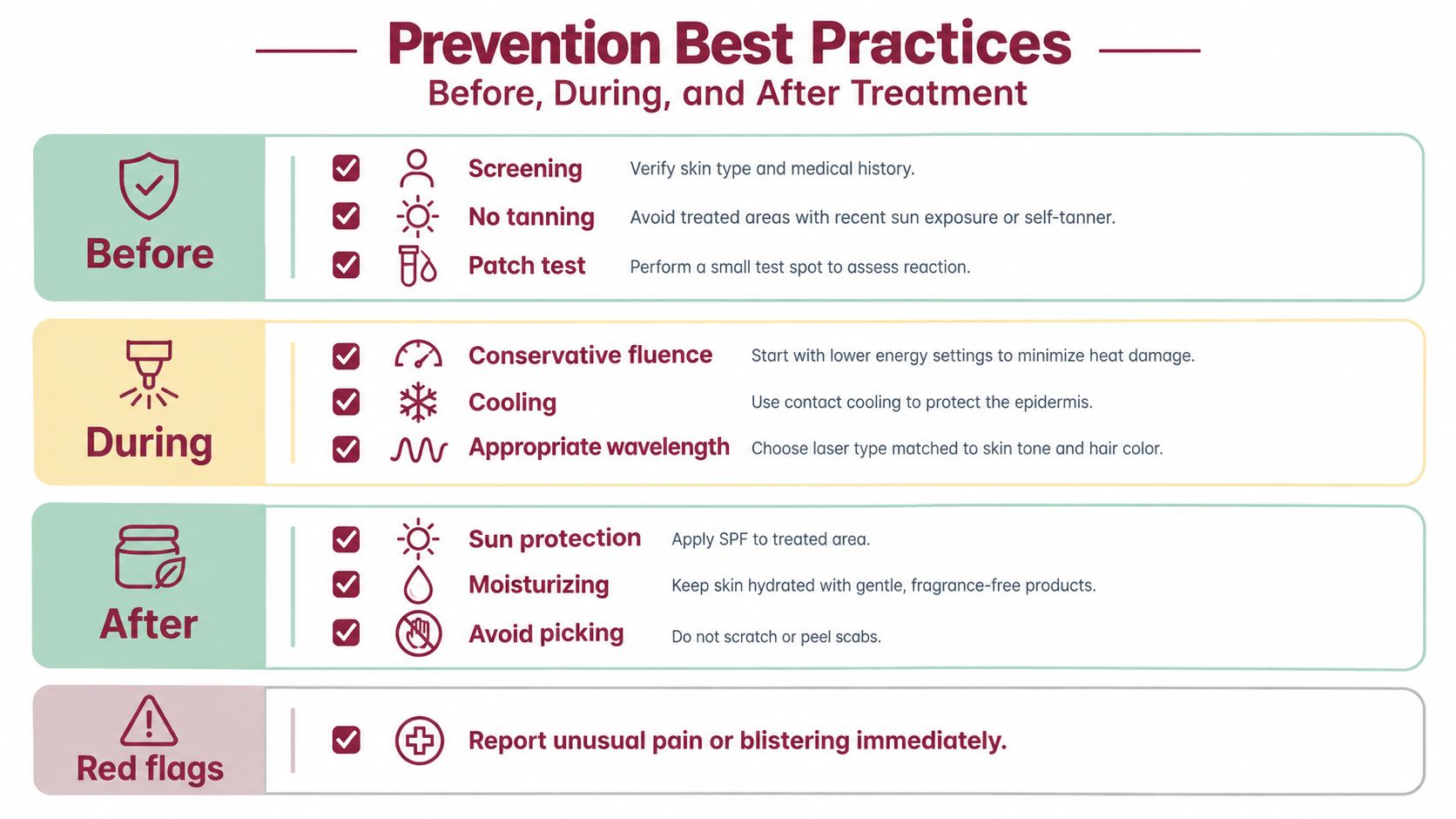
Prevention starts long before aftercare products enter the picture. The main job is controlling heat in the right place, at the right level, for the right skin.
That means screening, device choice, settings, cooling, and timing all matter. Aftercare helps, but it can't fully undo an avoidable burn.
Before the appointment
Start with candidacy, not convenience. A proper consultation should look at skin type, hair color, recent tanning, skin sensitivity, and whether the treatment area is irritated, inflamed, or healing from something else.
A clinical review on laser and energy-based complications recommends individualized laser settings, proper epidermal cooling, prompt wound care, and avoiding treatment on recently tanned or irritated skin, because excessive fluence, pulse stacking, or poor cooling can drive epidermal and dermal injury into scarring in the review of complications in dermatologic laser and energy-based devices.
During the session
Professional judgment matters most. The person treating you needs to balance energy high enough to affect the follicle with enough caution to protect the surrounding skin.
Key prevention habits include:
Conservative settings when risk is higher
Darker skin, tanned skin, and higher-risk body areas often call for more restraint, not a one-size-fits-all approach.Cooling that protects the epidermis
Cooling isn't a luxury step. It lowers the chance that surface skin will absorb enough heat to get injured.No pulse stacking over the same spot
Repeated heat in one area can push a tolerable treatment into a burn.Wavelength choice matched to skin tone
Some wavelengths spare epidermal melanin better than others, which matters for safety.
One practical option for people seeking a professionally evaluated plan is Spa Black, where laser hair removal is offered as part of a broader physician-overseen med spa setting in San Antonio.

After treatment
Aftercare is simpler than people think, but it still matters.
Protect the area from sun
Freshly treated skin is more vulnerable to pigment problems if it gets extra UV exposure.Keep products gentle
Fragrance, scrubs, and harsh actives can add irritation to skin that's already been heated.Report blistering early
The faster a burn is recognized, the better the chance of smooth healing.
If the skin looks more injured each day instead of calmer each day, don't wait it out on your own.
A good prevention mindset is mechanical, not magical. If settings, skin condition, and cooling are right, the risk stays low. If those factors are off, aftercare alone won't fully compensate.
Treatment Options and Timelines for Scars and Pigment Changes
What helps a laser hair removal mark improve faster. Treating the right problem first.
A flat brown or gray patch usually follows a different path than a raised, firm, or indented area. Pigment change behaves like leftover ink after inflammation. A true scar is a texture change in the skin's structure itself. That difference guides both timing and treatment.
The first checkpoint is simple. Is the skin still healing from an active injury, or has it already closed and settled? If there is blistering, open skin, or crusting, the priority is protecting the skin barrier and avoiding anything that adds friction, heat, or irritation. Early over-treatment can turn a limited injury into a longer recovery.

If the issue is pigment change
Post-inflammatory hyperpigmentation often fades, but it rarely disappears overnight. The skin needs time to calm down and replace discolored cells through normal turnover.
Helpful steps usually include:
Daily sun protection
UV exposure can keep pigment active and make a flat mark last longer.Gentle skin care
Harsh scrubs, strong acids, and aggressive home treatments can keep inflammation going.Reassessment after the skin settles
A dark patch that is flat and gradually lightening usually needs patience more than procedures.
This is especially important for patients with medium to deep skin tones, since Fitzpatrick IV to VI skin is more prone to lingering pigment shifts even when no scar forms. On darker skin, a mark can look alarming while still being temporary.
If the issue is a true scar
A real scar means the skin feels different, not just looks different. It may become raised, thickened, indented, or persistently firm. Early care often starts once the skin surface has closed.
Common options may include:
- Silicone gel or silicone sheeting to support flatter, smoother healing
- Topical or injected steroid treatment when a clinician sees signs of hypertrophic scar formation
- Scar-directed procedures later on if texture remains after the remodeling phase
Severe burns are more likely to leave thicker scars than mild surface irritation. In other words, depth matters. A brief pigment change is one problem. A deeper heat injury that disrupts the skin's architecture is another.
What timelines usually look like
Recovery is not one clock. It is closer to a series of phases.
Days to a few weeks
Active burn care, barrier support, and close observation if the skin was blistered or crustedSeveral weeks to a few months
Pigment changes may begin to fade, while early scar texture becomes easier to identify once inflammation dropsMonths rather than days
Established scars continue remodeling slowly, and treatment decisions become clearer after the skin declares what it is doing
That waiting period can be frustrating, but it prevents the common mistake of treating a temporary dark mark as if it were a permanent scar.
If texture change does persist, collagen-remodeling treatments may be considered after a professional exam. Procedures used for RF microneedling for acne scars help show how texture-focused treatment is approached, but a post-laser mark still needs its own diagnosis before any procedure is chosen.
At Spa Black Med Spa, the treatment decision should connect directly back to what likely caused the mark in the first place. If parameter control, cooling, body location, and skin type suggest a pigment-only reaction, the plan is usually conservative. If the pattern looks more like a true burn with evolving scar tissue, the plan shifts toward scar prevention and closer follow-up.
The goal is steady healing with the least aggressive treatment that fits the actual problem.
When to Seek Professional Care at Spa Black Med Spa
Some reactions can be watched. Others shouldn't.
Redness and follicle-centered swelling are common short-term responses after laser hair removal. What deserves prompt professional attention is something different: blistering, crusting, spreading redness, worsening pain, drainage, signs of infection, or a patch that becomes raised, indented, or persistently firm.
Don't wait on these signs
Get evaluated sooner if you notice:
- Blisters or open skin
- Pain that's intensifying instead of easing
- Crusting with significant tenderness
- Drainage, warmth, or other signs of infection
- A lasting texture change rather than simple color change
Those findings don't automatically mean permanent scarring, but they do mean the skin needs a closer look.
What an evaluation should include
At Spa Black in San Antonio, a professional assessment should include the treatment history, the body area involved, your skin's current appearance, how long the reaction has been present, and whether the issue looks more like pigment change, active burn healing, or evolving scar tissue.
That kind of visit is also where next steps become more specific. Some people need reassurance and monitoring. Others need wound-focused care, scar-prevention support, or a separate consultation for future corrective treatment. Medical evaluation is what turns uncertainty into a plan.
If you're unsure whether to wait or book, use a simple standard: if the area seems to be healing smoothly and staying flat, observation may be reasonable. If it looks progressively more injured or more textured, it's time to have someone assess it under physician oversight.
If you're concerned about possible laser hair removal scars, Spa Black offers physician-overseen evaluation, laser hair removal treatment planning, and follow-up guidance designed to sort out burns, pigment change, and true scar risk with clarity. To learn more about services or request a consultation in San Antonio, visit Spa Black.