


You notice it in ordinary moments: the jawline looks softer in side-profile photos, the skin under the chin seems less firm, or makeup settles differently across early crepey areas. You may want to improve that looseness without jumping straight to surgery, but you also don't want a treatment described as a “non-surgical facelift” to promise more than it can deliver.
Morpheus8 for skin tightening is best understood as a controlled remodeling treatment. It combines microneedling with radiofrequency energy to support collagen renewal, improve texture, and create a degree of thermal contraction. It isn't designed to reposition descended facial tissue or remove excess skin, so results vary by anatomy, skin quality, treatment settings, and the starting degree of laxity.
Table of Contents
- Introduction to Morpheus8 for Skin Tightening at Spa Black
- How Morpheus8 RF Microneedling Supports Tighter Skin
- Who Morpheus8 Helps Most and When to Consider Alternatives
- What Happens During Your Morpheus8 Treatment Visit
- Recovery Timeline Results and How Long Benefits Last
- Morpheus8 Compared to Other Skin Tightening Options
- Safety Considerations and Is Morpheus8 Right for You at Spa Black
Introduction to Morpheus8 for Skin Tightening at Spa Black
A person with early lower-face laxity may still have relatively good skin quality. The concern might be a slightly blurred jawline, fine lines, mild neck looseness, or skin that feels less resilient than it once did. In that situation, Morpheus8 may be considered as a non-surgical option that works gradually rather than producing an instant lift.
Spa Black in San Antonio offers Morpheus8 as part of its radiofrequency microneedling services. The treatment combines tiny needles with RF energy to support skin tightening, texture improvement, and collagen remodeling, as described on the Spa Black Morpheus8 service page. A consultation is still necessary because the same complaint, such as “sagging skin,” can come from different causes.
A useful distinction is skin quality versus tissue position. Morpheus8 can help remodel the skin and may support mild-to-moderate laxity. It doesn't replace a facelift, neck lift, or another operation that physically repositions deeper tissue and removes redundant skin. Someone with early looseness may appreciate gradual firming, while someone with pronounced jowling or substantial neck laxity may need a different conversation.
The realistic outcome
Think of the treatment as renovating the skin's support structure, not pulling a loose fabric upward with a hidden string. Radiofrequency heat creates controlled thermal effects, and the healing response develops over time as collagen and elastin remodel. That means a treatment plan should focus on measured improvement, not a guaranteed transformation.
Published evidence supports measurable rejuvenation outcomes. In a prospective, evaluator-blinded study of 25 patients, sessions performed every 6 to 8 weeks produced mean wrinkle reductions of 25.3% in the infraorbital area and 37.3% in crow's feet, with no severe adverse events reported in that study. All patients experienced only transient redness and swelling that resolved within days, according to the PubMed-indexed clinical study.
The most useful question isn't just, “Will Morpheus8 tighten my skin?” It's, “Is my main concern mild laxity and skin quality, or is it deeper tissue descent?” That answer helps determine whether RF microneedling belongs in your plan.
How Morpheus8 RF Microneedling Supports Tighter Skin
Morpheus8 combines microneedling and radiofrequency energy in one fractional treatment. The needles create controlled micro-injuries, while RF energy heats selected tissue depths. Together, these effects encourage the body to repair and remodel the treated area.
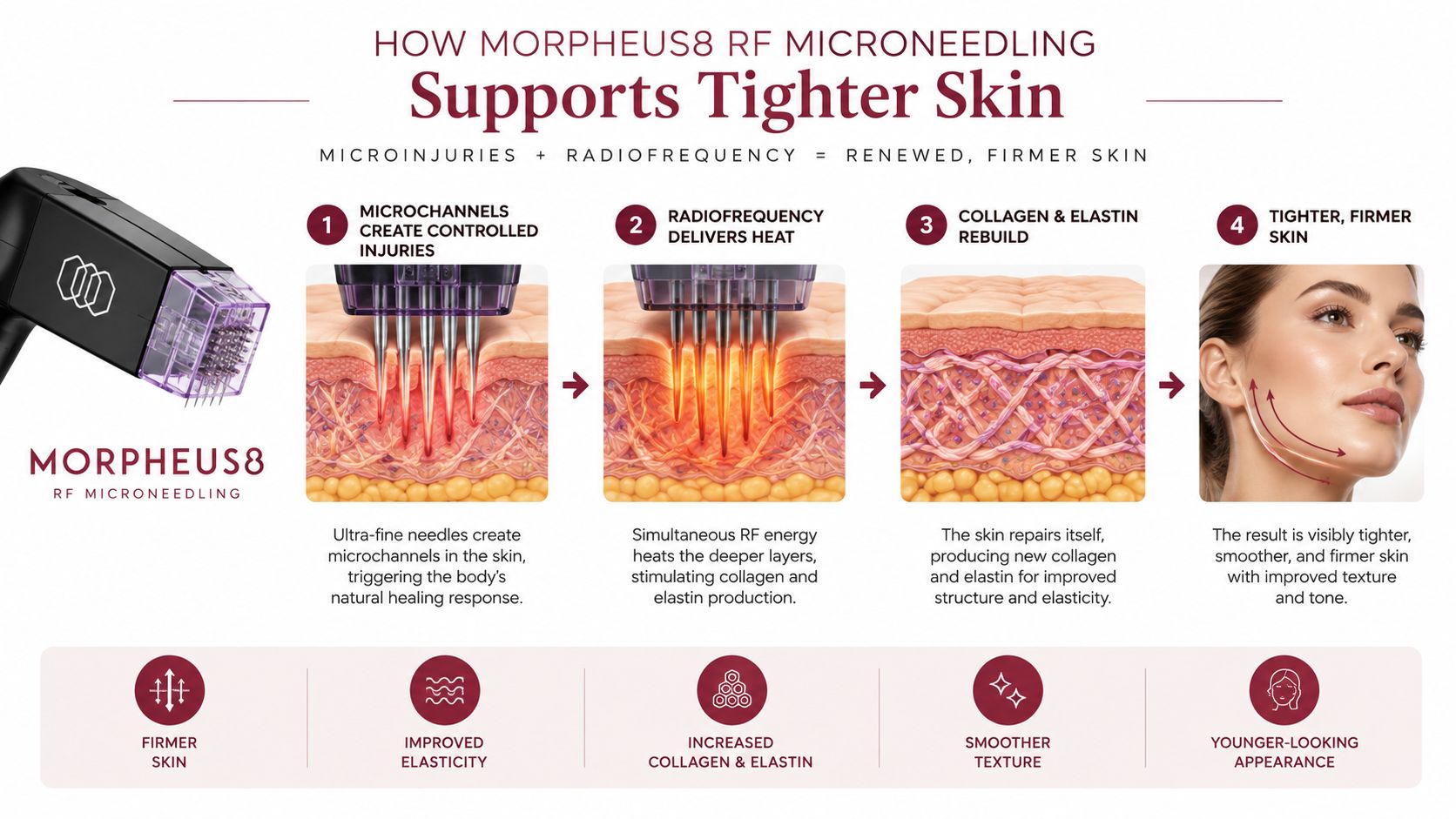
Why the needles matter
Traditional microneedling mainly creates tiny channels in the skin to stimulate repair and improve surface texture. Morpheus8 adds RF energy through the needle tips, allowing heat to reach the dermis and, with deeper settings, tissue beneath the dermis. The treatment remains fractional, meaning it treats targeted columns rather than heating every part of the skin continuously.
That controlled pattern matters. It gives the body specific areas to repair while leaving surrounding tissue available to support healing. The result isn't an instant facelift. It's a planned thermal injury followed by gradual remodeling.
Why depth changes the goal
Morpheus8 can deliver energy to depths of up to 8 mm for coagulation and heating and up to 7 mm for ablation, according to the cited clinical discussion in the Journal of Cosmetic Dermatology review. Deeper placement can address more than superficial roughness because the provider can target dermal laxity and subdermal soft-tissue contraction.
A simple analogy is a loose woven fabric. Surface treatment may smooth the visible threads, but controlled heat placed deeper can affect the fibers supporting the fabric. Histologic discussion in the same review describes immediate shortening of fibrous septal network fibers, followed by a three-dimensional “shrink-wrap” effect, soft-tissue contraction, and skin thickening. The review describes total tightening effects of roughly 40% to 70% when fiber contraction and secondary dermal contraction are combined.
Those figures describe a histologic tightening effect, not a guaranteed visible lift for every patient. The visible result depends on anatomy, laxity, tissue thickness, settings, and treatment planning.
Practical rule: Deeper energy can expand the treatment goal, but it also makes depth selection and provider judgment more important.
What the treatment is actually trying to remodel
The core objective is collagen remodeling and controlled thermal contraction. Morpheus8 is positioned for mild-to-moderate laxity, texture concerns, and selected scar-related changes. It isn't a volumetric lifting procedure, and it doesn't recreate lost facial volume or reposition the deeper structures responsible for significant jowls.
If your primary concern involves acne-scar texture as well as firmness, you can review Spa Black's information about RF microneedling for acne scars. The same platform may be adapted to different goals, but treatment depth, energy, and passes should be selected for the specific area rather than copied from a standard template.
Who Morpheus8 Helps Most and When to Consider Alternatives
Morpheus8 tends to make the most sense when the concern is early or moderate looseness combined with a skin-quality issue. A person may have fine lines, rough texture, enlarged pores, atrophic acne scars, or early crepey skin along with a gradual loss of firmness.
The lower face, jawline, neck, and selected body areas may be considered, but the appropriate plan depends on tissue thickness and the degree of laxity. The treatment can support collagen remodeling in the skin envelope, while deeper settings may address subdermal contraction. It still won't remove excess skin.

A practical self-assessment
Ask yourself what you see when your face is relaxed, rather than judging the result immediately after a treatment or while making an exaggerated expression.
- Mild laxity: The skin looks softer or less firm, but the amount of excess tissue is limited. Morpheus8 may be a reasonable option to discuss.
- Texture-first concerns: Fine lines, roughness, pores, or acne-scar irregularity are often better aligned with collagen remodeling than with surgical lifting.
- Deeper jowling: If tissue has clearly descended along the jawline, energy-based tightening may produce less change than you want.
- Significant neck laxity: A heavy or very loose neck may involve deeper structures and redundant skin, which a non-surgical device can't reposition or remove.
A surgical procedure may outperform energy-based tightening when the main problem is tissue position, not skin quality. Morpheus8 may still have a role in a broader aesthetic plan, but it shouldn't be presented as an equivalent substitute for surgery.
Skin tone and medical history
Radiofrequency microneedling can be used across darker skin phototypes, and independent review literature describes the modality as suitable for combination treatment and a broad range of skin tones. That doesn't mean every setting is appropriate for every complexion. Thermal injury can still trigger pigmentary changes, especially when energy is placed too close to the epidermis or when ultraviolet exposure follows treatment.
Medical history also matters. An active skin infection, a tendency toward abnormal scarring, certain medications, healing problems, and implanted electronic devices may affect candidacy. Pregnancy and other health circumstances may require postponement or additional medical review. A provider should assess those factors before recommending treatment.
What Happens During Your Morpheus8 Treatment Visit
A Morpheus8 appointment starts with a candidacy discussion, not with the handpiece. The provider should examine the area, clarify whether your main goal is firmness, texture, scars, or a combination, and review medical history, medications, skin tone, prior procedures, and any future surgical plans.
Preparation then focuses on the condition of the skin. Your provider may ask you to pause selected irritating products, avoid treating over compromised skin, and follow sun-protection guidance. Arriving with clean skin helps the team evaluate the treatment area and prepare it appropriately.
Numbing and treatment planning
A topical numbing product is commonly used to improve comfort, but Morpheus8 should not be described as painless. Sensations can include pressure, prickling, and warmth. Comfort varies with the treatment area, depth, energy, and individual sensitivity.
The provider then selects the depth and energy for each area. Published device guidance commonly describes facial settings around 1 to 4 mm, while deeper body settings may extend to approximately 7 to 8 mm, depending on the applicator and treatment objective, as outlined in this Morpheus8 treatment guide. A thinner facial area shouldn't automatically receive the same settings as thicker body tissue.
Depth is a treatment decision, not a badge of intensity. The deepest available setting isn't automatically the safest or most effective choice.
The treatment pass
Once the skin is prepared and numb, the provider moves the handpiece across the planned zones. The device creates fractional micro-injuries and delivers RF energy at the selected depth. The treatment is usually performed in a deliberate pattern so the provider can control coverage, passes, and energy distribution.
Clinical and practitioner guidance commonly describes Morpheus8 as a short series of about 3 sessions spaced 4 to 6 weeks apart, although milder concerns may respond to 1 to 2 sessions and more significant laxity or scarring may require additional visits, according to this clinical treatment guidance. Those figures describe common planning patterns, not a promise.

Immediately afterward, the skin may feel warm or sunburned and may appear red or swollen. Your provider should explain what is expected, what aftercare to use, and which signs require a call to the practice.
Recovery Timeline Results and How Long Benefits Last
Morpheus8 results are easy to misunderstand because recovery and remodeling happen on different clocks. Redness and swelling reflect the immediate inflammatory response. Tightening develops later as the body repairs the treated tissue and produces new structural proteins.
During the first few days, redness, warmth, swelling, sensitivity, and pinpoint marks may occur. In the prospective clinical study cited earlier, redness and swelling were transient and resolved within days, with no severe adverse events reported among the patients studied. Individual recovery can differ according to treatment intensity, area, skin sensitivity, and aftercare.
What changes when
Early visible changes may appear within 2 to 6 weeks, but those changes shouldn't be mistaken for the final result. Independent review literature describes the earliest visible effects around 1 month, with the largest improvement around 3 months, and some improvement continuing through 7 months. The same review notes that dermal remodeling and neocollagenesis can continue even 6 months after treatment.
The main collagen-remodeling benefit is often assessed around 8 to 12 weeks. That timing explains why a mirror check a few days after treatment can be misleading. Swelling may temporarily make skin look fuller or tighter, while the genuine remodeling effect takes longer to mature.

Planning a series
A common plan involves about 3 sessions spaced 4 to 6 weeks apart, but the final evaluation should account for the entire course rather than just the first appointment. Each session builds on a healing process that needs time to develop. A person with mild laxity may need less treatment than someone addressing substantial textural irregularity or scarring.
For a fair assessment, compare photographs under consistent lighting and evaluate progress at staged points, especially around 3 to 6 months. Maintenance may matter because collagen remodeling doesn't stop the natural aging process. Sun exposure, skincare habits, age, weight changes, anatomy, and the extent of the original laxity can all influence how long the improvement remains visible.
Morpheus8 doesn't promise permanent results. Its value comes from gradual structural improvement, not from freezing the skin in place.
Morpheus8 Compared to Other Skin Tightening Options
Choosing a treatment starts with the concern. A device that improves deeper laxity may not be the strongest option for surface pigment or dramatic resurfacing, while a treatment designed for texture may not provide meaningful contraction. The comparison below is intentionally qualitative because downtime and outcomes vary by settings, area, skin condition, and provider technique.
| Treatment | Primary Mechanism | Best For | Typical Downtime |
|---|---|---|---|
| Morpheus8 | Fractional RF microneedling with adjustable needle depth and controlled thermal remodeling | Mild-to-moderate laxity with texture, fine lines, or selected scars | Short recovery commonly involving temporary redness and swelling |
| Agnes RF | Targeted radiofrequency delivery through a specialized treatment approach | Selected localized skin or contour concerns after candidacy review | Varies by area and treatment intensity |
| TightLase | Non-ablative laser-based heating | Patients prioritizing gradual firming with minimal surface disruption | Often limited, but depends on settings and individual response |
| Venus Legacy | Non-invasive radiofrequency-based heating and contour support | General firmness and selected body or facial concerns | Typically limited, subject to treatment response |
| CO2 laser therapy | Ablative resurfacing that removes controlled layers of skin and stimulates remodeling | More prominent texture, lines, and surface damage when downtime is acceptable | More substantial healing than non-ablative approaches |
| Surgical facelift or neck lift | Physical repositioning of deeper tissue and removal of redundant skin | Significant jowling, advanced laxity, or structural descent | Surgical recovery and medical aftercare |
Matching the tool to the problem
Morpheus8 is a middle-ground option for someone who wants more than a surface-only treatment but isn't seeking surgery. It may fit mild laxity with texture concerns, particularly when gradual improvement and a shorter recovery are priorities.
Ablative resurfacing may be more appropriate when the dominant problem is surface damage rather than tissue looseness. Conversely, surgery may be the more effective path when the face or neck has substantial excess skin or descended tissue. Non-surgical treatments shouldn't be described as producing the same result as a facelift.
Spa Black's broader overview of skin tightening procedures can help you compare treatment categories before a consultation. The decision should follow an assessment of anatomy, skin quality, downtime tolerance, and the result you want.
Safety Considerations and Is Morpheus8 Right for You at Spa Black
Morpheus8 is a medical procedure, not a risk-free facial. The FDA safety communication reports serious adverse events associated with certain uses of RF microneedling, including burns, scarring, fat loss, nerve damage, pigmentary change, and disfigurement. A 2026 FDA database analysis identified 114 reports with 224 events, including textural changes at 25.0%, pigmentary alteration at 18.3%, fat loss at 11.6%, burns at 6.3%, and pain at 5.4%, as described in the FDA safety communication on RF microneedling risks.
These reports don't establish the risk for every treatment or every provider, and the FDA's evaluation remains an important part of the safety discussion. They do show why depth, energy, number of passes, anatomy, and operator training require careful attention.
Higher-risk situations
Darker skin tones may carry a greater concern for post-inflammatory hyperpigmentation after inflammatory or thermal treatment. The cited review notes that pigmentary change may worsen when thermal energy is placed too close to the epidermis or when ultraviolet exposure follows treatment. Conservative planning and consistent sun protection matter.
A provider should also review active infections, healing disorders, abnormal scarring history, medications, pregnancy, implanted electronic devices, and prior energy-based treatments. If you're considering a future facelift, disclose prior RF microneedling because a 2026 scoping review warned that treatment before elective facelift surgery may interfere with optimal surgical results through excessive tightening, scarring, and dermal damage, as reported in this clinical review summary.
What to bring to a consultation
Bring a list of current medications and skincare products, details about prior procedures, information about pigmentary reactions or abnormal scars, and a clear description of the change you want. Ask what area will be treated, what depth and energy are planned, how many sessions may be appropriate, and what complications require follow-up.
Morpheus8 may support gradual tightening, but it doesn't replace a facelift, guarantee scar removal, or create permanent results. A medical evaluation at Spa Black in San Antonio can help determine whether your concern is appropriate for RF microneedling or whether another approach may better match your anatomy.
Spa Black offers Morpheus8 consultations for patients in San Antonio who want to discuss gradual skin tightening, collagen remodeling, and texture improvement without overstating what the treatment can do. Visit Spa Black to learn more and request a consultation focused on your skin, your goals, and an appropriate treatment plan.