



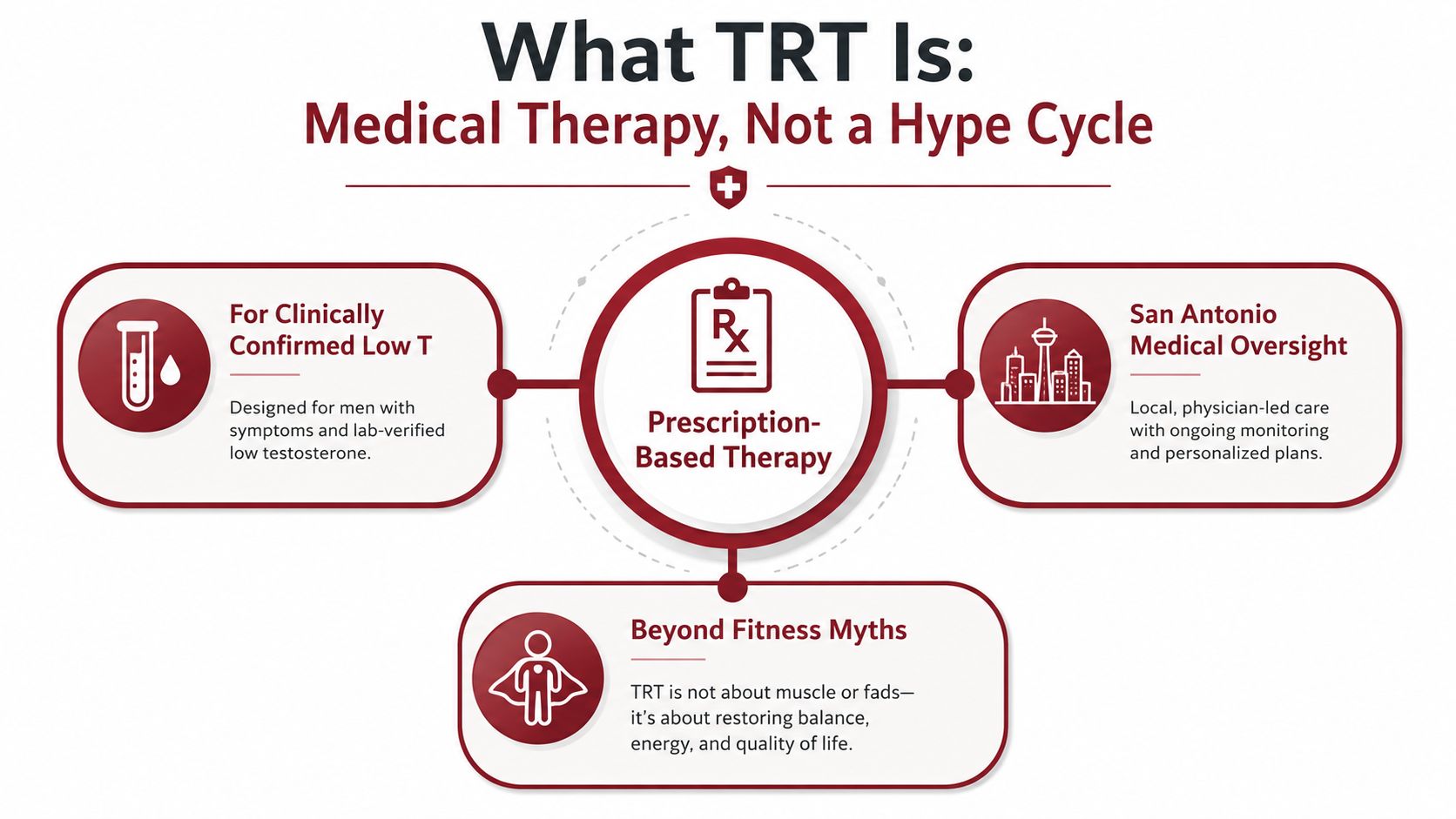
TRT is a prescription-based medical therapy for men with clinically low testosterone, and it only makes sense after labs confirm the diagnosis. In San Antonio, that matters because the city has both dedicated hormone clinics and physician-supervised med-spa options, so the key question is less “Is TRT available?” and more “Is it being evaluated and monitored the right way?”
A man in his 40s can feel foggy, tired, and less like himself for reasons that have nothing to do with testosterone. The safest TRT plans start with symptoms, confirm the hormone problem, and then build a follow-up process around labs, not guesses.
Table of Contents
- What TRT Means and Why It Matters in San Antonio
- Understanding Low Testosterone and Who Is a Candidate
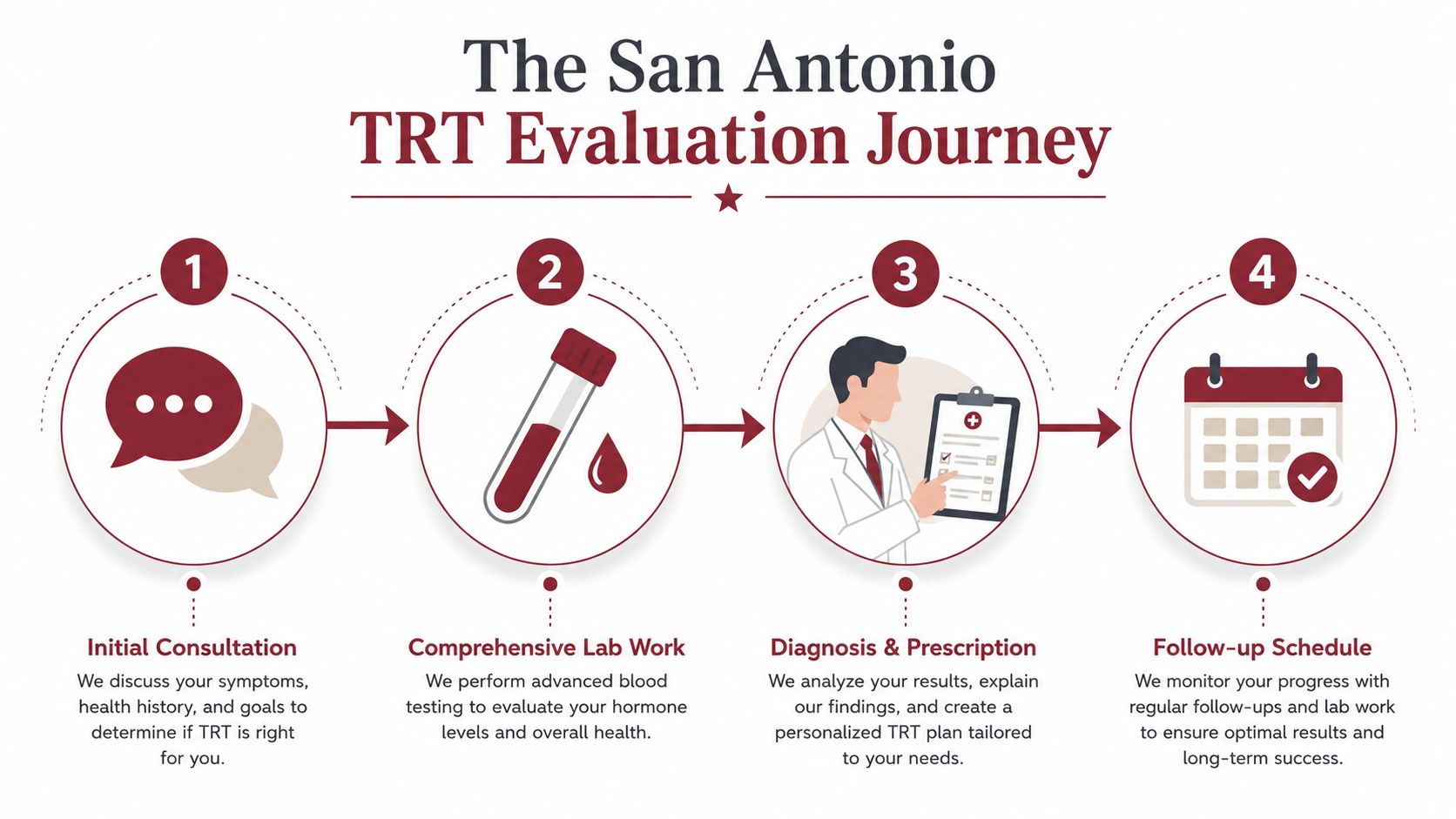
- The Medical Evaluation and Lab Work That Comes First
- Delivery Methods and How Protocols Are Built
- Benefits, Risks, and What the Evidence Shows
- A Realistic First-Year Timeline on TRT
- How to Choose a Safe TRT Provider in San Antonio
- Costs, Financing, and Local Next Steps With Spa Black
What TRT Means and Why It Matters in San Antonio
A lot of men start looking into TRT after months of feeling drained, flat, or off in a way they cannot quite name. Testosterone replacement therapy is a medical treatment for men with confirmed low testosterone and symptoms that justify care.
That distinction matters in a city like San Antonio. The U.S. market for testosterone therapy expanded sharply in the early 2010s, and a PubMed-indexed study found treatment frequency rose from 8.3% in 2009 to 24% in 2012 in men undergoing testosterone therapy, which is nearly a 3-fold increase in just three years (PubMed study). San Antonio's scale also helps explain why the category stayed visible, since the city had 1.43 million people in 2020 and ranks as the 7th-most populous city in the United States and the 2nd-largest in Texas.
Why symptoms alone are not enough
Fatigue, low libido, and brain fog can also appear with sleep apnea, depression, stress, thyroid problems, and medication effects. That is why a credible TRT plan starts with a diagnosis, not a guess.
Practical rule: if a clinic talks only about “low energy” and never mentions blood work, it is not doing real hormone medicine.
Over-the-counter “boosters” belong in a different category. They may be marketed as masculine support, but they are not the same as a physician-directed protocol that checks testosterone levels, monitors PSA, and follows the patient over time.
For readers comparing hormone care models in San Antonio, the structure matters. A well-run TRT workflow should feel like outpatient medicine, not a one-click purchase. Spa Black's hormone therapy page fits into that broader med-spa setting through its physician-supervised model, and you can see how it is positioned within the practice's bioidentical hormone care at Spa Black's hormone replacement therapy overview.
Understanding Low Testosterone and Who Is a Candidate
Think of testosterone like a thermostat, not a light switch. When the body's regulation runs too low for too long, men can feel the effects across energy, mood, sex drive, and body composition. That state is usually referred to as hypogonadism, and the cause matters as much as the symptom list.
Primary and secondary causes are not the same
In primary hypogonadism, the testes are underperforming. In secondary hypogonadism, the signaling from the brain is the issue, so the body isn't asking for enough testosterone production in the first place. Those two patterns can lead to similar symptoms, but they don't always mean the same treatment path.
Age by itself is not a reason to start TRT. A man can be older and still have acceptable hormone function, while another man can be younger and still need a workup because something else is suppressing testosterone. Obesity, diabetes, and some medications can all complicate the picture, which is why candidacy needs a real conversation instead of a checkbox.
Common symptoms that should prompt testing include persistent fatigue, lower libido, erectile changes, reduced muscle mass, mood shifts, and brain fog. Some men also notice body composition changes or less drive in daily life, but those symptoms can overlap with other problems, so they need context rather than assumptions. For a plain-language symptom guide, see the hormonal imbalance overview at Spa Black.
Good screening question: are the symptoms persistent, paired with lab confirmation, and significant enough to justify long-term monitoring?
Why the cause affects the treatment plan
A good clinician doesn't just ask, “Do you feel tired?” They ask what changed, when it changed, and whether the pattern points toward hormone deficiency or another issue that needs different care. That's especially important because TRT is usually a chronic therapy, not a short corrective burst.
If a man's symptoms fit, the next step is labs. If they don't, the better move is to keep looking rather than forcing testosterone into a problem it won't solve.
The Medical Evaluation and Lab Work That Comes First
A credible TRT workup has a rhythm to it. In San Antonio clinics, that often starts with a simple intake form, moves into a symptom questionnaire, then proceeds to blood work and a follow-up visit where the results are explained in plain language. One local clinic describes a stepwise intake where patients submit their name, age, and email, then complete a questionnaire to assess eligibility and low-testosterone symptoms.
What the lab visit should reveal
The purpose of testing is to see whether symptoms line up with a hormone problem and whether treatment can be monitored safely. That means the lab visit should answer two questions at once: is testosterone low, and are there any baseline issues that make therapy riskier?
A thoughtful lab panel commonly includes total testosterone, free testosterone, LH, FSH, SHBG, estradiol, hematocrit, CBC, PSA, and lipids, with many practices also adding a metabolic panel. Morning testing matters because testosterone levels are higher earlier in the day, and repeat testing is often used so a single low result does not drive a lifelong decision.
| Lab area | Why it matters |
|---|---|
| Testosterone levels | Confirms whether the hormone level is truly low |
| LH and FSH | Helps sort out primary versus secondary causes |
| CBC and hematocrit | Checks for blood thickening risk during treatment |
| PSA | Establishes a prostate baseline before therapy |
| Lipids and metabolic markers | Adds context for overall health and monitoring |
Borderline results need caution. A single low number can reflect poor sleep, illness, stress, or timing, so experienced clinicians usually want the whole pattern, not just one lab printout.
Red flag: same-day TRT prescriptions with no repeat testing and no discussion of baseline risks.
For readers trying to understand what a serious blood work set should include, the most useful companion piece is this essential TRT blood analysis. It helps show why the lab list is longer than one testosterone number.
Delivery Methods and How Protocols Are Built
A man may walk into a San Antonio TRT visit expecting one simple prescription, then discover that the decision is the delivery method. TRT can be given by injections, subcutaneous pellets, transdermal gels or patches, and oral formulations, and each route changes how the hormone is absorbed, how steady the levels stay, and how often follow-up is needed (clinical review). The prescription is only one part of the plan.
The route changes the experience
Different delivery methods behave differently in the body. Injections and pellets usually create more peak-to-trough variability than transdermal options, which can affect symptom consistency, hematocrit rise, and how often dose changes are needed. Steadier delivery can feel more even across the day, while other routes produce a stronger rise and then a gradual fall (clinical review).
That difference matters in daily life. A gel may be easier to use each day, but absorption can vary with routine and skin factors. Injections can be efficient, yet they still depend on a consistent schedule and a plan for lab checks. For a patient, the right route often comes down to what can be followed safely week after week, not what sounds simplest in the abstract.
How a protocol is built
A clinician starts with a baseline level, chooses a route, and then adjusts based on symptoms and repeat labs. The aim is not to drive testosterone as high as possible. The aim is to find a level that improves symptoms while keeping monitoring practical and safe.
The process works in a simple sequence:
- Start with the diagnosis, not the marketing.
- Choose a delivery route that fits the patient's life.
- Recheck labs after the body has had time to respond.
- Adjust only if the data support it.
For readers who want to see why repeat testing matters, the most helpful companion is the essential TRT blood analysis. It shows why a serious TRT workup looks at more than one testosterone number.
Practical rule: the best route is the one the patient can follow safely, not the one that sounds most impressive on a website.
If a clinic cannot explain how it titrates dose, tracks side effects, and plans follow-up, that is a warning sign. TRT works best when the plan is built around adherence and monitoring, which is the kind of workflow a med-spa setting like Spa Black should be able to describe clearly.
Benefits, Risks, and What the Evidence Shows
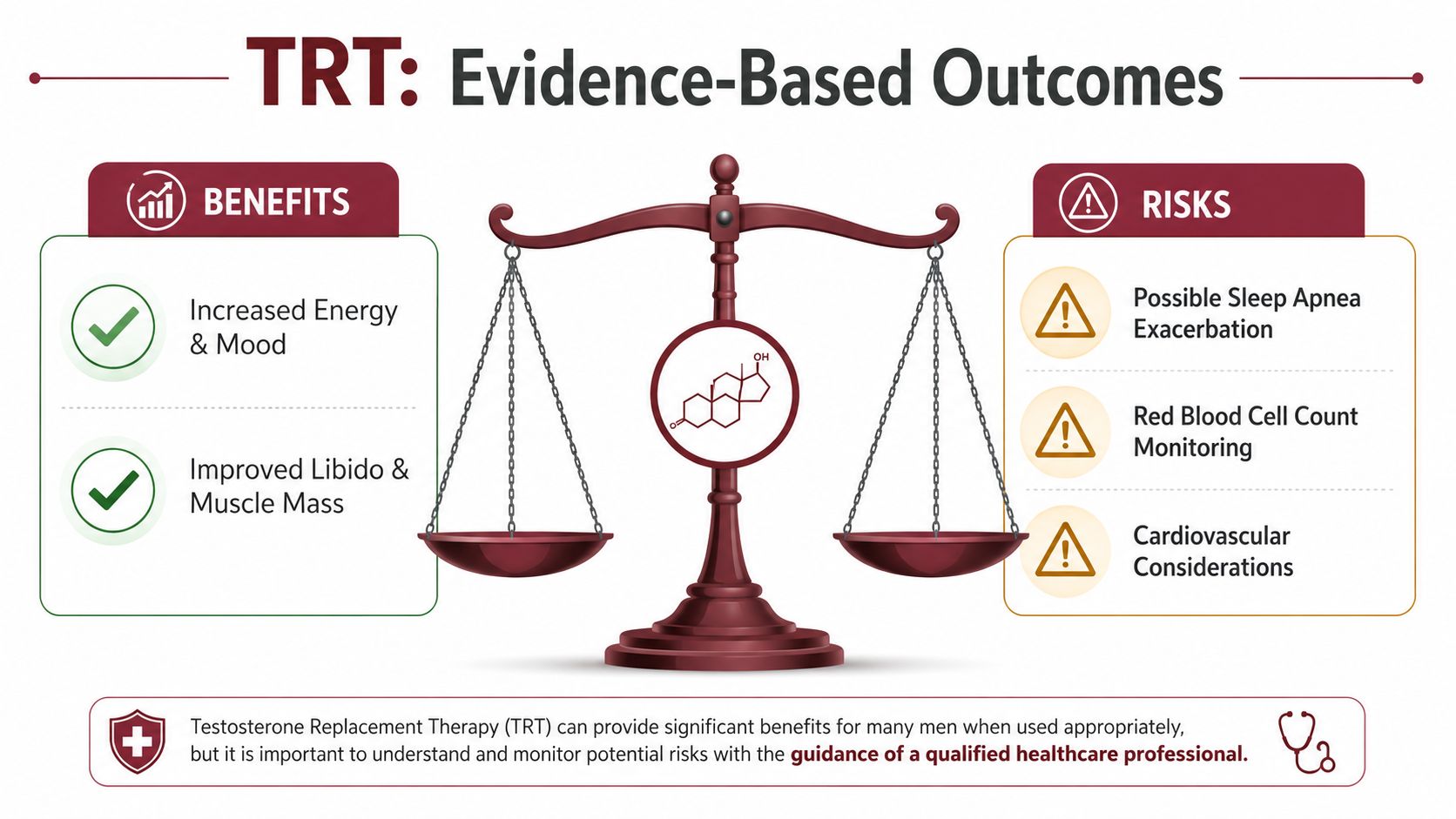
The benefits men usually care about are familiar. TRT can help improve energy, libido, muscle mass, and mood when low testosterone is the core problem, but it does not fix everything by itself. Sleep, nutrition, mental health care, and exercise still matter, because hormone therapy works best as part of a larger plan.
A simple way to picture it is this. TRT can correct a missing input, but it cannot replace the rest of the system that supports health. If fatigue, low drive, or poor recovery come from several causes, testosterone may help, but only one part of the picture will change.
The cardiovascular evidence is reassuring, not magical
The strongest large trial on this topic is TRAVERSE, which enrolled 5,198 men with hypogonadism and preexisting cardiovascular disease or multiple risk factors. Over a mean 22-month follow-up, the primary major adverse cardiovascular event occurred in 7.0% of the testosterone group versus 7.3% of placebo, with a hazard ratio of 0.96 and a noninferiority finding (TRAVERSE trial).
That matters because it suggests that, in appropriately selected men who are monitored clinically, TRT did not show an excess short-term major cardiovascular risk signal versus placebo. It still is not risk-free. Clinicians need to keep track of hematocrit, PSA, blood pressure, and symptoms, because TRT can raise red blood cell production and affect prostate-related markers even when the cardiovascular signal is neutral.
What safe oversight looks like
Expert discussion from AUA 2024 also emphasized that testosterone therapy can raise PSA, increase red blood cell production, and worsen sleep apnea, which is why monitoring thresholds matter (AUA 2024 discussion). The practical urology referral thresholds cited there include a PSA above 4.0 ng/mL, a PSA increase above 1.4 ng/mL within 12 months, a PSA velocity above 0.4 ng/mL per year after the first 6 months, an abnormal digital rectal exam, or an IPSS/AUA symptom score above 19.
Bottom line: TRT should be evaluated as monitored chronic medicine, not as an anti-aging slogan.
That distinction matters when readers compare clinics in San Antonio. A med-spa setting like Spa Black can fit into a proper TRT workflow if it treats therapy as a monitored medical plan, with follow-up, lab review, and symptom checks built in. If the follow-up is thin, the therapy is not being managed carefully enough.
A Realistic First-Year Timeline on TRT
A sensible first year doesn't feel rushed. It starts with baseline labs and a diagnosis, then moves into treatment, then uses repeat visits to see whether the body is responding as expected.
The first checkpoint usually comes around six to twelve weeks after starting, when the clinician checks symptom change and repeat labs. That's where dose changes are considered, especially if the patient feels no better or if labs suggest the route or dose needs adjustment.
What a patient should track
Patients usually do better when they pay attention to the same few signals each month rather than trying to judge everything at once. The practical ones are energy, sleep, libido, mood, and strength. Fertility questions and sleep-apnea screening matter early too, because they can change whether TRT is even the right long-term path.
By about three months, most well-run practices want a clearer picture of symptom response. By six months, a fuller lab review often includes hematocrit and PSA, since those are two of the markers that can change during treatment. Around twelve months, the clinician should be looking at the whole picture again, not just the latest testosterone number.
A clean way to think about the cadence
- Before starting: confirm the diagnosis and document baseline labs.
- After starting: check response and side effects after enough time has passed for change to show up.
- Mid-year: revisit safety markers and symptom trends.
- At one year: decide whether the current plan still fits.
That timeline is what separates structured hormone care from casual prescribing. A good patient doesn't need constant reassurance. He needs a clinic that follows the plan consistently and explains what each checkpoint means.
How to Choose a Safe TRT Provider in San Antonio
A patient can make the wrong choice by moving too fast. A safe TRT clinic should resemble a medical practice and not a checkout funnel.
What to verify before you book
Start with licensed prescribers and clear medical oversight. In a med-spa setting, that should mean physician direction, not a vague promise that someone “reviews everything.” Then ask whether the clinic uses baseline and follow-up labs before and during treatment. The staff should also be able to explain how they monitor PSA, hematocrit, symptoms, and side effects in plain language.
A strong provider should also discuss fertility and sleep-apnea risk without brushing those topics aside. TRT can still be appropriate while requiring caution, and men deserve a discussion of what treatment may change over time.
Red flags that should slow you down
- No labs before prescription.
- Identical dosing for every patient.
- No follow-up schedule.
- No mention of hematocrit or PSA monitoring.
- Marketing that skips the diagnosis and jumps straight to the shot.
A verifiable local presence helps too. For example, a reputable San Antonio TRT clinic will have a published address and phone number, which shows a real-world footprint patients can check before they book. Hard contact details do not prove quality by themselves, but they do show the kind of local accessibility patients should expect from an established clinic.
Good sign: the provider can explain why you need follow-up, not just why you need treatment.
That standard applies whether you are seeing a hormone clinic or a physician-supervised med spa. The setting matters less than the workflow. For patients who want to understand how a med spa organizes treatment access and recurring visits, Spa Black's medical spa treatment financing information is one place to review how care and payment structure can fit together. If you are comparing practices, it also helps to consider the digital side of care. Clear appointment access, patient education, and easy booking reduce friction around repeat visits. A practice with a helpful online presence, such as X8 Web Design San Antonio, can make that part of the experience easier to evaluate, but the medical workflow still comes first.
Costs, Financing, and Local Next Steps With Spa Black
TRT in San Antonio usually involves more than one line item. Patients should plan for the initial evaluation, the lab work, the medication itself, and ongoing monitoring, and those pieces can be billed separately depending on the clinic. Insurance coverage is often limited when the concern is age-related decline, so many men use out-of-pocket payment, financing, health savings, or membership-style programs.
For patients who want a smoother payment structure, a financing page can help show how a med spa organizes treatment access and recurring visits. Spa Black's own medical spa treatment financing information is a useful place to see how a San Antonio practice can bundle care without losing the medical side of the process.
Where Spa Black fits
Spa Black in San Antonio sits in the physician-supervised med-spa category, which means hormone care can be discussed alongside wellness services, semaglutide weight loss, IV therapy, and other men's-focused options under the same practice umbrella. That matters for patients who want one place to ask about follow-up, convenience, and long-term maintenance rather than hopping between disconnected offices.
If you're comparing practices, it also helps to think about the digital side of care. Clear appointment access, patient education, and easy booking matter because they reduce friction around repeat visits. A good local resource on that front is X8 Web Design San Antonio, which reflects how a practice's online presence can support real-world scheduling and patient communication.
What to ask on your first visit
Bring questions about the lab timeline, fertility, PSA, hematocrit, and how often the clinic expects follow-up. Ask who reviews your results, what happens if a marker changes, and whether the same person manages dose adjustments over time.
If you want to explore TRT in a San Antonio setting with physician oversight, online booking, and a broader wellness framework, start with a consultation and make sure the clinic talks through testing before treatment. The right first appointment should feel measured, clear, and medically grounded.
If you're ready to talk through TRT the right way, Spa Black can help you start with a proper consultation, lab review, and a monitoring plan that fits your goals. Visit Spa Black to learn how its San Antonio team approaches hormone therapy, then bring your questions about testing, follow-up, and long-term care to your first visit.