



You're standing in front of the mirror, tugging at the waistband, and the same question comes back again. These marks on the hips, abdomen, breasts, or thighs aren't dangerous, but they're hard to ignore, and the marketing around laser skin resurfacing stretch marks often makes the fix sound cleaner than real life ever is.
The clinical version is more useful. Laser care can improve stretch marks, soften texture, and make them blend better with surrounding skin, but it usually doesn't erase them. In practice, the best results come from matching the device to the age, color, depth, and location of the marks, then treating the process as a series of milestones rather than a one-time procedure.
Table of Contents
- What Laser Stretch Mark Care Looks Like
- Why Stretch Marks Form and Why Lasers Help
- The Main Laser and Energy Devices Used for Stretch Marks
- Realistic Results and How Many Sessions to Expect
- Who Makes a Good Candidate for Stretch Mark Laser Treatment
- Downtime, Risks, and Cost Trade-Offs Across Devices
- A Realistic Patient Journey Through Spa Black
- Combining Treatments and Planning for Long-Term Maintenance
What Laser Stretch Mark Care Looks Like
A patient walks into Spa Black in San Antonio after months of covering her abdomen and hips, and the first question is usually simple, can this be fixed fast? The honest answer is that stretch-mark laser care is a process, not a single reveal. The marks can improve, but the treatment has to respect how deep the change sits in the skin.
What patients usually expect versus what happens
A common mental picture is a surface treatment that “removes” the line. That is not what happens in the room. Stretch marks are structural changes in the dermis, so the goal is to stimulate controlled repair, then wait for the skin to remodel.
In a well-planned series, the clinician chooses the device based on whether the marks are newer and red, or older and white, then sets expectations around gradual change. That is why people who do well with laser skin resurfacing stretch marks tend to be the ones who can commit to follow-up and recovery between visits.
Practical rule: if a treatment promise sounds like instant erasure, it is overselling the biology.
The process usually starts with a consult, not a procedure. Skin tone, tanning history, pregnancy history, prior scarring, and body location all matter before a device is chosen. That is the difference between a generic cosmetic promise and a protocol that fits the patient.
The right mental model
Stretch-mark laser care is better visualized as a series of measurable improvements rather than a one-time fix. A session may change redness first, then texture later, then overall blending over time. That is slower than a headline, but it is how stable cosmetic improvement usually happens.
For readers comparing options, this guide covers the biology, the device families, realistic results, candidacy, downtime, and the long-term maintenance mindset that keeps expectations grounded.
Why Stretch Marks Form and Why Lasers Help
Stretch marks, or striae distensae, form when skin is asked to expand faster than the dermis can keep pace. Clinically, that matters because they are common in the same groups that often ask about cosmetic treatment, including pregnancy-related changes and other periods of rapid stretching. A recent evidence review placed the overall incidence at 56%, and a meta-analysis noted that about 90% of pregnant women experience them. Evidence review and treatment data on striae distensae
Early marks and mature marks are not the same problem
Striae rubrae are the newer red or purple marks. They still have more active vascular change, so energy-based treatment can often influence them more visibly. Striae albae are older, white, atrophic marks, and they behave more like settled scars.
That distinction changes planning in the treatment room. Newer marks usually have more responsive tissue because the process is still evolving, while mature marks need more remodeling before the texture and color begin to blend.
Why energy devices can help
Laser therapy does not erase a stretch mark. It creates a controlled injury that pushes the skin into repair, and that repair response is what improves the look of the tissue over time. In the early stage, treatment can address the vascular component. Later, the response shifts toward collagen production, elastin restoration, and epidermal thickening, which is why repeated sessions can soften the edges and reduce contrast. Mechanism of early striae and remodeling

Clinical takeaway: newer red marks usually give the clearest early response, but older white marks can still improve when the device and settings match the tissue.
That is why laser skin resurfacing stretch marks works through guided remodeling rather than removal. The skin is being pushed to build better structure, and that process depends on timing, spacing, and follow-up. For readers who want a broader procedural context, the ultimate laser and resurfacing guide and Spa Black's Fotona SP Dynamis laser treatment options in San Antonio are useful references for how clinicians think about energy choice and treatment planning.
The Main Laser and Energy Devices Used for Stretch Marks
The device choice changes the whole experience. At Spa Black, the practical conversation usually starts with whether the mark needs deeper resurfacing, gentler fractional treatment, vascular-focused light, or collagen-stimulating energy. That's why the same patient might be a good candidate for one device family on the abdomen and a different one on the chest or thighs.

Fractional CO2 and non-ablative fractional systems
Fractional CO2 is the more aggressive end of resurfacing. It creates tiny columns of injury that can drive a stronger healing response, which is useful when the goal is to improve deeper texture. Published regimens commonly use 10,600-nm fractional CO2 systems in a series of sessions spaced about four weeks apart, and one cited trial used 40–50 mJ with 75–100 spots/cm². Fractional laser review
Non-ablative fractional devices are gentler. They don't remove the top layer the way ablative resurfacing does, so the downtime trend is usually lighter, while the remodeling effect builds gradually. A systematic review describes the 1540-nm non-ablative fractional laser as a common first-line option in striae care. Systematic review of striae distensae
Pico, IPL, Nd:YAG, plasma pen, and RF microneedling
Pico laser is often considered when pigment and texture both matter, especially if the clinician wants a precise, lower-heat approach. IPL photofacials are more of a color-management tool, useful when residual redness is part of the visual problem. Nd:YAG platforms, including Fotona SP Dynamis, fit into a broader energy-based plan where controlled heating can support tissue tightening and surface improvement. Spa Black lists the Fotona SP Dynamis laser and also features Reducing stretch marks with Fotona SP Dynamis laser as part of its treatment ecosystem.
PlasmaMD Pen sits in the resurfacing conversation as another way to create a controlled tissue response, while RF microneedling combines needles with radiofrequency energy to stimulate collagen remodeling. The common thread is that all of these are trying to improve structure, not fade color.
For readers who want a broader technical refresher on resurfacing categories, Skin Perfection's ultimate laser and resurfacing guide is a useful external overview.
Where Spa Black fits
Spa Black's menu includes DOT Fractional CO2 therapy for skin rejuvenation, and stretch marks are among the treated concerns. It also offers stretch-mark focused care with Fotona SP Dynamis. In practice, that means one clinic can map a patient's marks to a device path without forcing every stretch mark into the same box.
Realistic Results and How Many Sessions to Expect
Patients usually ask for a number before they ask for an explanation. The clearest answer is that stretch-mark laser care tends to move in visible milestones, not through one dramatic finish. In a review, after the second treatment the laser group reached a 70.6% reduction in severity versus 47% with a trichloroacetic acid peel, and after the third session the reduction reached 88.3% versus 52.9%. Clinical review of fractional laser outcomes
What the broader evidence says
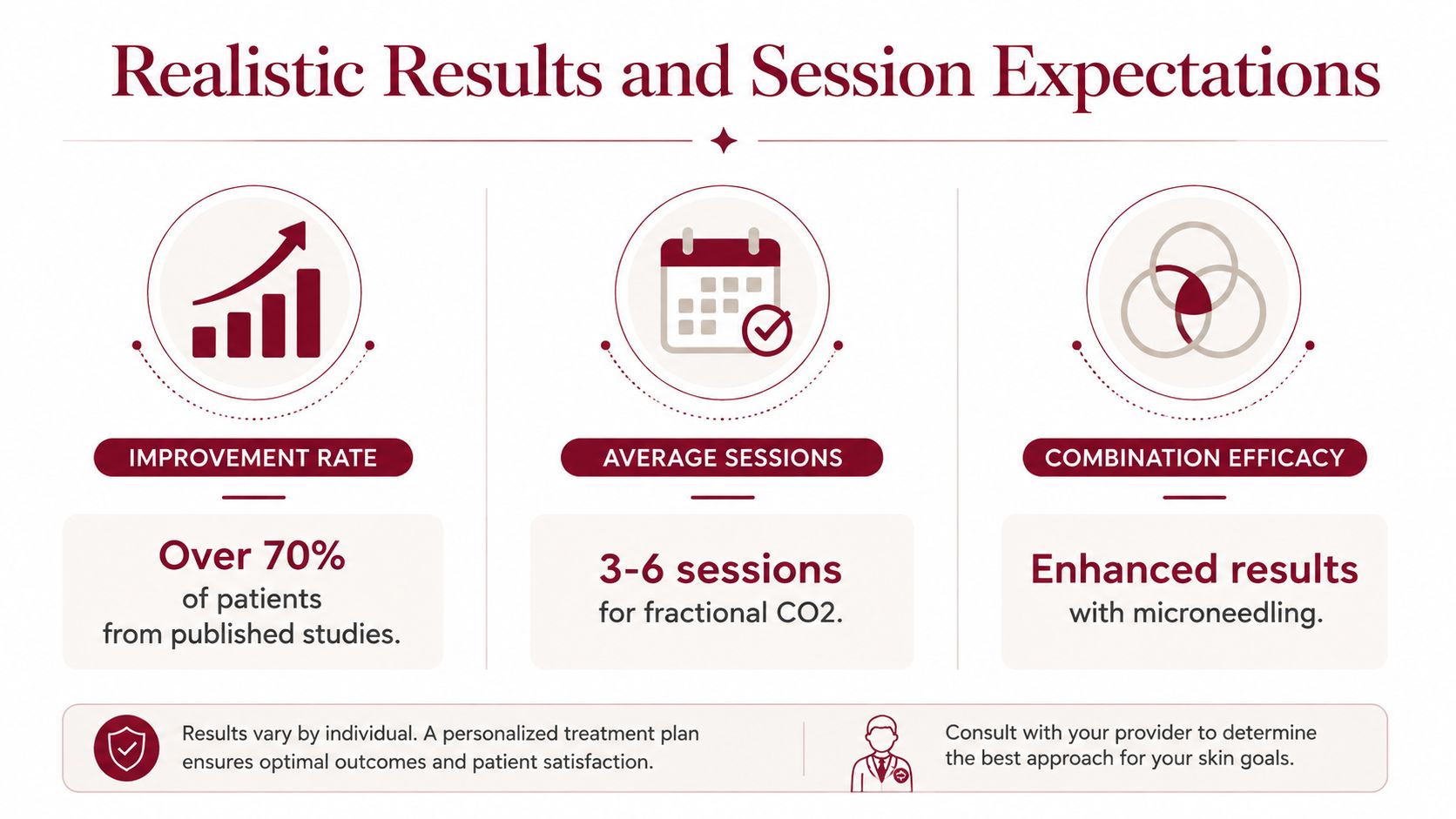
Treatment studies also show that fractional CO2 laser and microneedling both improved appearance in over 70% of patients, though CO2 carried more post-inflammatory hyperpigmentation, with a relative risk of 8.37 compared with microneedling. That trade-off is why stronger energy is not automatically the better choice for every patient. Evidence review on striae treatments
A separate study reported the mean surface area of striae falling from 154.2 ± 21.7 mm² at baseline to 76.2 ± 14.5 mm² after the third fractional CO2 session. Another prospective study found a 19.1% average reduction in striae volume at 16 weeks, and 28% of participants achieved more than 75% improvement after an average of 1.8 sessions. Clinical review of fractional laser outcomes
What that means in real life
The American Society for Dermatologic Surgery says laser and light therapy for stretch marks can take up to 20 sessions over several weeks and usually yields about 20% to 60% improvement in appearance. It also describes results as permanent, though maintenance treatments may still be needed. ASDS stretch-mark laser guidance
A practical benchmark from a systematic review is 6 to 8 sessions at 4-week intervals for durable improvement with 1540-nm non-ablative fractional laser. That is a realistic planning number when the goal is steady blending rather than dramatic downtime-heavy resurfacing. Systematic review of striae distensae
The patient path usually starts with a consult, then a first session that sets the baseline, then a few follow-up visits where we judge texture, color, and tolerance before adjusting energy or spacing. Red and purple marks often show earlier color change, while white, mature marks usually ask for more patience because the main target is collagen remodeling and edge softening.
Spa Black's menu includes DOT Fractional CO2 therapy for skin rejuvenation, and stretch marks are among the treated concerns. It also offers stretch-mark focused care with Fotona SP Dynamis, plus other energy-based options such as pico, IPL, Nd:YAG, plasma pen, and RF microneedling depending on the skin and the mark. In practice, that means one clinic can map a patient's marks to a device path without forcing every stretch mark into the same box.
Bottom line: laser skin resurfacing stretch marks usually works best as a series, and the best series is the one the patient can complete.
Who Makes a Good Candidate for Stretch Mark Laser Treatment
Candidacy starts with the marks themselves. A consult usually looks at age, color, texture, body location, skin tone, tanning habits, pregnancy history, and any tendency toward keloid scarring before a device is picked. Those details matter because the same settings that help one patient can trigger pigment issues in another.
The marks, the skin, and the timing
Red or purple marks are generally more responsive early because the vascular component is still active. White, mature marks can still improve, but the conversation shifts toward texture blending and collagen remodeling rather than color change.
Skin tone changes the risk profile. Some complexions can handle fractional energy well, while others need more conservative settings to reduce the chance of post-inflammatory hyperpigmentation. Recent tanning also matters, because newly pigmented skin absorbs energy differently and can react unpredictably.
Questions a patient should bring to a consult
- How old are the marks? Newer and older lesions usually need different strategies.
- What color are they now? Red, purple, white, or silver changes the target.
- Have you been tanning recently? That can change safety and timing.
- Was there pregnancy, rapid weight change, or muscle gain involved? The cause helps frame the likely response.
- Do you scar easily or form keloids? That affects device choice and aggressiveness.
If the marks are still changing after pregnancy or weight fluctuation, a clinician may wait before treating or may choose a gentler route. If the patient has a history of poor pigment recovery, the plan should be conservative from the start. The consult is where the realistic version of laser skin resurfacing stretch marks becomes specific, because the device only makes sense after the skin story is clear.
Downtime, Risks, and Cost Trade-Offs Across Devices
Recovery time is where treatment plans become real. Ablative fractional CO2 usually brings several days of redness, swelling, and peeling. Non-ablative fractional and pico options usually mean less interruption to daily life. RF microneedling often sits between those two on recovery, which is why many patients ask about it when they want visible change without a longer reset.
Side effects and why device choice matters
The main side effect to watch is post-inflammatory hyperpigmentation, especially in patients prone to pigment change. That concern is stronger with more aggressive energy settings and with skin that has already been stressed by sun, irritation, or recent tanning.
Redness can linger, and rare scarring is possible with any energy-based procedure if the device, settings, or aftercare are off. Patients with darker skin tones, recent tanning, or a history of reactive healing usually need a more conservative plan. The practical point is simple, safer settings matter more than chasing a fast response.
A quick trade-off table
| Device | Typical Downtime | Sessions for Visible Change | Best Fit For |
|---|---|---|---|
| Fractional CO2 | More redness, swelling, and peeling | Often a short series, sometimes fewer sessions with stronger settings | Deeper texture and mature marks |
| Non-ablative fractional | Usually shorter social downtime | Commonly several sessions | Patients prioritizing recovery balance |
| Pico laser | Typically lighter recovery | Series-based improvement | Texture with pigment-sensitive planning |
| IPL photofacial | Minimal to light downtime | Repeated visits for color management | Residual redness |
| RF microneedling | Moderate downtime | Multi-session plans | Collagen support with a balanced recovery profile |
Each device family has a different place on the Spa Black menu and a different recovery profile. Fractional CO2 is usually the most noticeable reset, while pico, IPL, Nd:YAG, plasma pen, and RF microneedling sit on a broader spectrum of gentler correction, color management, and collagen support. The right choice depends on whether the patient is trying to soften color, improve texture, or build change over several visits.
Cost and planning reality
Cosmetic stretch-mark treatment is usually self-pay, and insurance rarely covers it. That makes the decision less about whether a device sounds impressive and more about how many visits, how much recovery, and how much visible change a patient can justify in everyday life. Spa Black's fractional CO2 laser skin resurfacing is one example of how a clinic can frame that trade-off around a specific resurfacing path instead of a vague promise.
Practical rule: the cheapest plan on paper can get expensive if it requires more recovery than your schedule can absorb.
A Realistic Patient Journey Through Spa Black
A representative patient in San Antonio comes in after pregnancy with abdominal striae that are lighter in the center and still a bit pink at the edges. She doesn't want perfection, she wants the marks to stop pulling focus every time she gets dressed. That's a normal reason to seek treatment, and it's also the kind of case where the consultation has to be precise.
From consult to first session
The clinician examines the marks, reviews skin tone, checks for recent sun exposure, and asks about pregnancy timing and any history of pigment change. If the fit is right, the plan is mapped to a fractional device, pre-treatment instructions are reviewed, and the patient is told to keep the area out of the sun.
The first session usually feels like heat and snap sensations, then a few days of redness and roughness. She may notice tiny crusting or a sandpapery texture before the skin settles. That early recovery phase is normal, and it's why social calendar planning matters as much as the device itself.
Between visits
Visible change doesn't show up in one clean jump. The patient may notice the marks look a little softer, a little less shiny, or a little less obvious in certain lighting before she sees major texture change. That's the milestone-based rhythm that makes this treatment feel slower than advertising, but more believable than a one-off promise.
A typical patient also learns how to work treatment into life rather than the other way around. Weekends, work travel, pool time, and sun exposure all affect timing. Spa Black's booking flow and membership structure can make repeated visits easier to plan, but the success of the series still depends on spacing and aftercare.
The internal course correction
A clinician may switch energy level, adjust the device, or add a complementary modality if redness, texture, or pigment dominate the picture. That flexibility matters because stretch marks don't all behave the same, even on the same body. Fotona SP Dynamis stretch-mark care at Spa Black shows how a treatment path can stay specific without becoming rigid.
By the end of a well-run series, the patient usually sees better blending, less visual contrast, and a calmer relationship with the treated area. That's the outcome people can feel in daily life.
Combining Treatments and Planning for Long-Term Maintenance
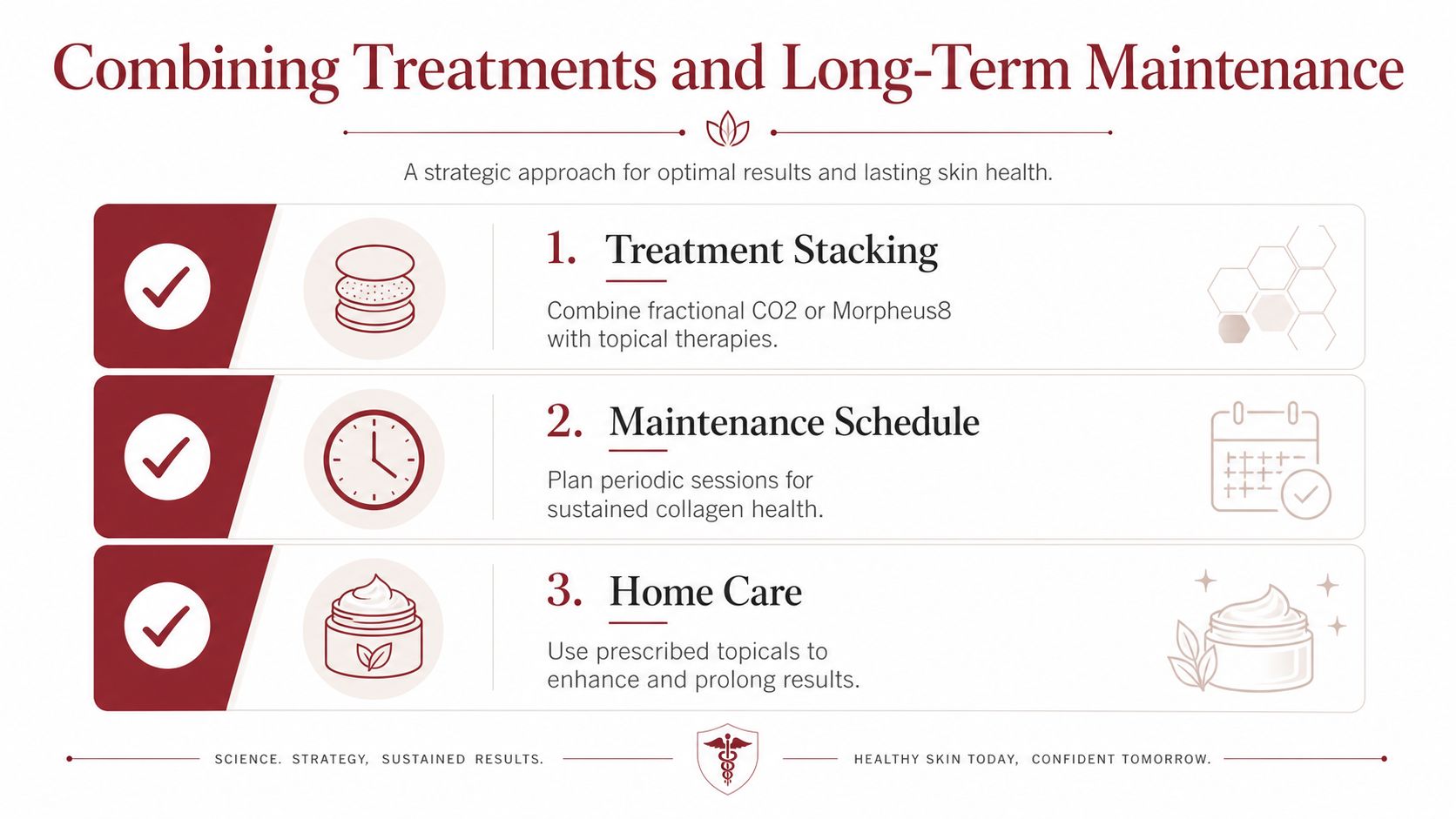
A patient who expects one laser visit to finish the job usually ends up disappointed. Stretch-mark care works better when it is approached as ongoing skin management rather than a single event. Fractional CO2, Morpheus8, IPL, and other collagen-stimulating options can be paired with topical skincare, while Nd:YAG, plasma pen, and RF microneedling may fit better when the goal is to address texture, tone, or residual color in stages. At Spa Black, that kind of planning lets the device choice match the mark, then match the next milestone when the skin response becomes clearer.
What maintenance means
Maintenance is mostly about protecting the gains and deciding when the next step is worth doing. Sun protection matters because treated skin can pigment unevenly if it keeps getting exposed, and some patients benefit from occasional touch-up sessions when the skin changes again with time, pregnancy, or weight fluctuation.
The practical version usually includes a few parts:
- Treatment stacking: pair a resurfacing or energy device with topical support when one approach is not enough on its own.
- Maintenance scheduling: return for touch-ups only when the skin response, downtime, and calendar line up.
- Home care: use provider-recommended skincare to support recovery and keep the surface calm.
That approach also leaves room for timing. A patient who is healing well may stay on the same plan, while a patient whose redness fades faster than texture improves may need a different device mix at the next visit. In real treatment rooms, that kind of adjustment is normal.
The honest endpoint
No non-surgical plan can promise total removal, and it should not pretend to. The better outcome is meaningful improvement, gradual blending, and a plan that can be repeated without creating unnecessary irritation or downtime.
Spa Black offers consult-based laser and energy treatments that can be matched to stretch marks, along with the follow-up structure needed to keep the plan realistic. If you are in San Antonio and want to talk through what your marks might respond to, visit Spa Black and book a consult so a clinician can map the right device, timing, and recovery plan for your skin.