


The most popular advice about the difference between pico laser and Nd:YAG laser is also the least useful: newer must be better. A picosecond device can be an excellent choice, but it doesn't automatically replace an established Q-switched Nd:YAG platform. The right decision depends on pulse duration, wavelength, skin type, lesion depth, treatment goal, pain tolerance, and budget.
There's another source of confusion. “Pico laser” describes how quickly a pulse is delivered, while “Nd:YAG” usually identifies a laser platform and wavelength family. In practice, the meaningful comparison is often picosecond Nd:YAG versus nanosecond Q-switched Nd:YAG, not two completely unrelated machines.
| Feature | Picosecond Nd:YAG | Nanosecond Q-switched Nd:YAG |
|---|---|---|
| Pulse duration | Common dermatology systems operate around 300 to 900 picoseconds, or trillionths of a second, as described in this review of picosecond laser technology | Q-switched systems use nanosecond-scale pulses, or billionths of a second, as outlined in clinical laser literature |
| Common wavelengths | 1064 nm and frequency-doubled 532 nm, with some systems offering additional wavelengths, according to a fractional picosecond laser review | Commonly 1064 nm and 532 nm |
| Main energy effect | Stronger photoacoustic and mechanical fragmentation with less heat diffusion | Greater reliance on photothermal modulation |
| Typical discussion points | Pigment, tattoos, texture, pores, wrinkles, and fractional rejuvenation | Tattoos, pigmentation, melasma, and established pigment-focused treatments |
| Skin-of-color considerations | May reduce heat spread, but pigment complications remain possible | The 1064 nm wavelength has a long history of use across darker skin types when carefully selected |
| Is one universally better? | No. Benefit depends on the indication and settings | No. It remains practical for many appropriately selected treatments |
Table of Contents
- Rethinking the Laser Technology Upgrade Myth
- The Physics of Pulse Duration and Energy Delivery
- Comparing Clinical Applications and Efficacy
- Navigating Skin Types and Wavelength Safety
- Evaluating Sessions, Downtime, and Patient Comfort
- Making an Indication-Specific Treatment Choice
- Planning Your Consultation at Spa Black
Rethinking the Laser Technology Upgrade Myth
A newer laser doesn't make an older laser obsolete. That matters because many patients arrive expecting a simple upgrade path, as though every concern should automatically be treated with picosecond technology. The evidence supports a more careful conclusion. Picosecond Nd:YAG systems can offer a meaningful mechanical advantage, but their superiority isn't universal across tattoos, melasma, or rejuvenation. A recent review of picosecond versus nanosecond tattoo treatment describes similar clearance in some comparisons, with possible advantages in sessions or fluence in selected cases, while also noting inconsistent superiority across studies.
The first question in consultation shouldn't be, “Which machine is newest?” It should be, “What are we treating, how deep is it, and what skin is around it?” A straightforward superficial pigment concern may respond well to a conservative nanosecond Q-switched approach. A mixed-depth lesion, resistant tattoo, or texture-focused treatment may justify the precision and mechanical fragmentation associated with a picosecond system.
The comparison is usually narrower than people think
Nd:YAG refers most often to the 1064 nm wavelength and its laser platform, while Q-switched describes a method of producing short pulses. Pico describes pulse duration. A picosecond Nd:YAG laser is still an Nd:YAG laser. It delivers energy in a much shorter pulse.
That distinction prevents a common marketing mistake. A clinic may present “pico versus Nd:YAG” as a contest between old and new technology, but the clinical choice is usually between different pulse durations delivered through related Nd:YAG systems. The treatment plan, not the label, determines whether the mechanical difference matters.
Practical rule: If a provider recommends a laser only because it's newer, ask what specific advantage it offers for your pigment, tattoo ink, skin type, or texture concern.
For patients comparing options in San Antonio, Spa Black's Pico Laser treatment information can be a starting point for understanding how picosecond treatment fits into a broader aesthetic plan. It shouldn't replace a skin assessment, because the same device can be used differently for different diagnoses.
Where the older platform still makes sense
A nanosecond Q-switched Nd:YAG laser remains a practical workhorse. It has an established clinical history and can be cost-effective when the treatment target is relatively straightforward. Choosing it isn't settling for inferior care. It may be the more sensible option when a patient values a conservative approach, has a simple epidermal pigment concern, or wants to control session cost.
The honest answer to “Which is better?” is therefore conditional. Pico may be worth the premium when its shorter pulse and delivery pattern solve a specific problem. Nd:YAG may remain the better fit when its established performance, wavelength flexibility, and practical economics align with the diagnosis.
The Physics of Pulse Duration and Energy Delivery
The simplest way to understand these lasers is to compare how long they deliver energy. Nanoseconds are billionths of a second. Picoseconds are trillionths of a second. A conventional long-pulsed Nd:YAG treatment can use pulses in the millisecond range, which is much longer than either platform discussed for pigment fragmentation. A review of dermatology picosecond systems and long-pulsed Nd:YAG devices describes common picosecond systems operating around 300 to 900 ps, while a clinical report described long-pulsed 1064 nm Nd:YAG durations from 0.25 to 300 ms.
The shorter the pulse, the more rapidly the device deposits energy into the target. That changes the balance between mechanical force and heat. A picosecond pulse can generate laser-induced optical breakdown and photoacoustic fragmentation, producing pressure waves that disrupt pigment or tattoo particles. A Q-switched Nd:YAG pulse remains short, but its nanosecond delivery relies more heavily on photothermal modulation, where heat contributes more substantially to the target response.
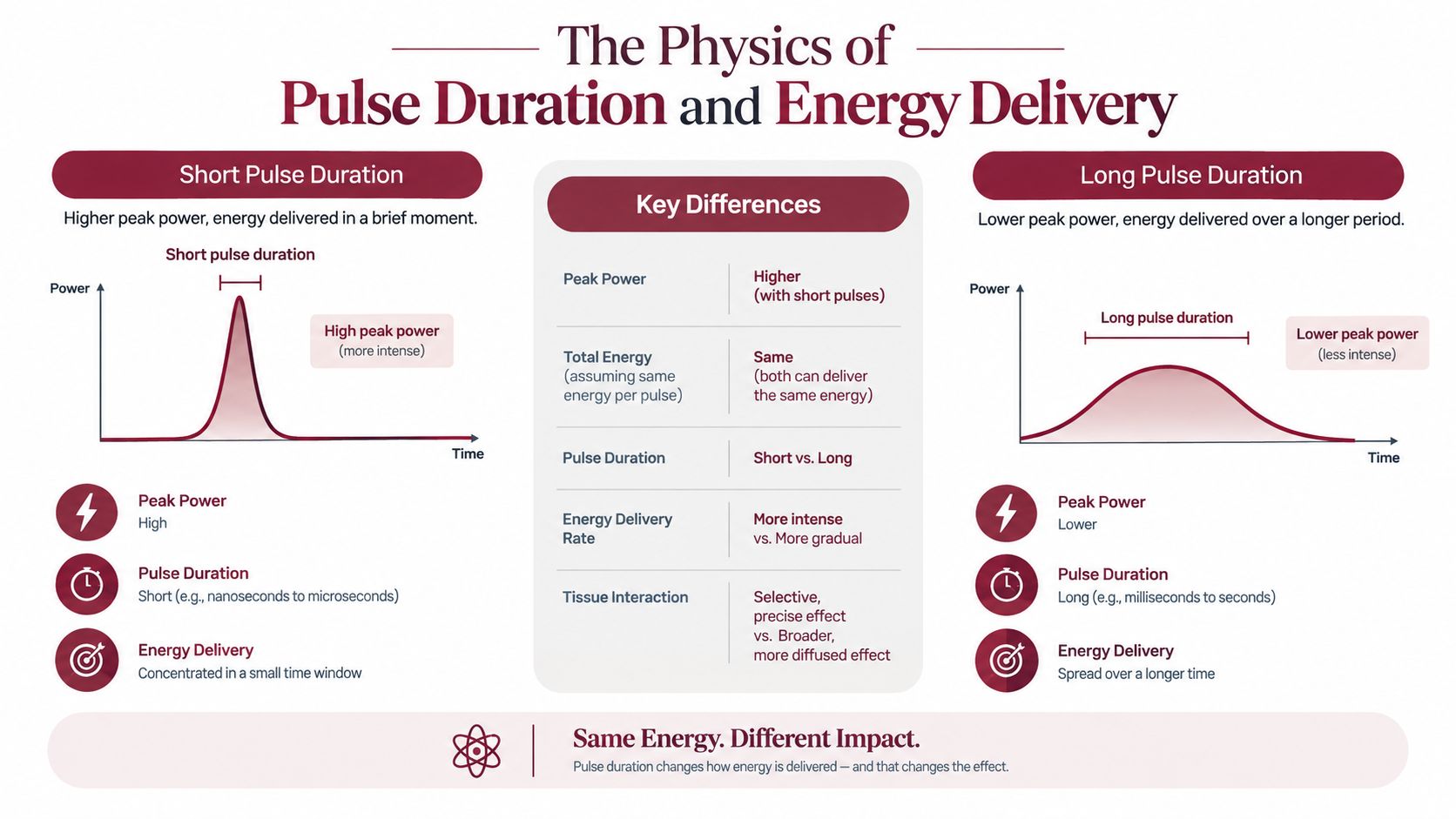
Mechanical fragmentation versus thermal influence
Think of pigment as a collection of particles embedded in tissue. The picosecond approach aims to create a sharper mechanical event around those particles, breaking them apart while limiting the time available for heat to spread into nearby tissue. That doesn't mean the treatment produces no heat or no inflammation. It means the energy profile is shifted toward a photoacoustic effect.
A nanosecond Q-switched treatment also targets pigment selectively, but the longer pulse gives heat a larger role. For some indications, that is entirely appropriate. The device has been used for tattoo removal, pigmentation, melasma, and rejuvenation, and treatment parameters can be adjusted according to wavelength, fluence, spot size, and skin phototype.
Why the wavelength still matters
Pulse duration is only half of the decision. Wavelength determines which colors and depths the laser can address. The 1064 nm wavelength penetrates and has relatively lower superficial melanin absorption than shorter wavelengths, while 532 nm interacts more superficially and is useful for selected lighter-colored targets. A PubMed study of 1064 nm YAG pulses and pigmented skin reported 10 to 12 ns pulses at 1064 nm and compared threshold responses at 1064, 532, and 355 nm.
That's why a provider shouldn't describe a pico treatment as one uniform experience. A 1064 nm picosecond treatment and a 532 nm picosecond treatment differ in penetration, target selection, and skin safety considerations. The same principle applies to Q-switched Nd:YAG.
Comparing Clinical Applications and Efficacy
The most useful comparison starts with the treatment goal. Tattoo ink, melasma, and facial texture don't respond to laser energy in exactly the same way, so a device that performs well for one indication may not be the clear choice for another.
Tattoo removal
Picosecond Nd:YAG systems can create stronger mechanical fragmentation, which may help with selected tattoo inks or stubborn pigment. A 2026 review found that picosecond Nd:YAG systems may achieve similar clearance with fewer sessions or lower fluence in some circumstances, but it did not establish consistent superiority over nanosecond Q-switched Nd:YAG across all studies, particularly when follow-up was short or treatment courses were limited. Read the review's discussion of indication-specific evidence.
The practical implication is important. A patient shouldn't be promised fewer appointments solely because the device is labeled pico. Ink color, depth, density, age, location, skin type, and treatment settings still influence the course. The provider also needs to choose a wavelength that matches the ink while protecting surrounding skin.
For patients researching the process in more detail, Spa Black's San Antonio laser tattoo removal guide can help frame the questions to bring to a consultation.
Melasma and pigment disorders
Picosecond 1064 nm Nd:YAG treatment is promising for melasma, but melasma is not a simple stain that can be erased permanently with one aggressive session. Clinical literature has reported 37% blinded-image improvement at three months and 27% at eight months after treatment for facial melasma in one quantified outcome set. The FDA-cleared 1064 nm picosecond Nd:YAG documentation and supporting clinical information illustrate the type of measured result associated with this platform.
Q-switched Nd:YAG remains an established comparator for melasma management and has been used for more than a decade. In practice, the important variables include whether pigment is epidermal, dermal, or mixed, whether the patient has a history of post-inflammatory pigment change, and whether the treatment plan includes conservative settings and consistent aftercare.
Texture and rejuvenation
For wrinkles, pores, and texture, the distinction becomes less dramatic. A split-face comparative study found that both fractional picosecond Nd:YAG and Q-switched Nd:YAG approaches produced similar improvements in wrinkles, pores, texture counts, and global aesthetic scores. The picosecond side may stimulate more collagen, but the study also associated it with higher pain scores. Review the split-face comparison of fractional picosecond and Q-switched Nd:YAG treatment.
| Treatment goal | Picosecond Nd:YAG | Nanosecond Q-switched Nd:YAG |
|---|---|---|
| Tattoo removal | May fragment selected tattoo particles mechanically and may help reduce fluence or sessions in some cases, but consistent superiority isn't established | Established option with predictable clinical use and wavelength flexibility |
| Melasma | Promising for selected patients, including some darker skin types, with quantified improvement reported in clinical literature | Long-established comparator, especially when conservative pigment management is appropriate |
| Facial rejuvenation | Can improve wrinkles, pores, and texture, with possible additional collagen stimulation | Can also improve these measures, with similar outcomes reported in comparative work |
| Straightforward epidermal pigment | May be unnecessary if a conservative nanosecond approach fits the diagnosis | Often practical and cost-conscious when the target is superficial and well defined |
Neither platform wins every category. The diagnosis determines the value of the technology.
Navigating Skin Types and Wavelength Safety
Laser safety changes with skin phototype. Fitzpatrick classification, which ranges from I through VI, helps a provider estimate how much surrounding melanin may absorb laser energy. It isn't the only factor, but it's central to selecting wavelength, fluence, spot size, cooling, and treatment spacing.
The 1064 nm Nd:YAG wavelength is the workhorse for darker skin types because it penetrates and is favored for broader safety across Fitzpatrick I through VI. In FDA-cleared labeling, a 1064 nm picosecond Nd:YAG system is indicated for tattoo removal across Fitzpatrick I through VI, while its 532 nm mode is indicated for lighter-colored inks in Fitzpatrick I through III. The FDA-cleared labeling provides these wavelength and skin-type indications.
Match the wavelength to the target
For tattoo removal, independent clinical guidance describes 532 nm for red, yellow, and orange inks in Fitzpatrick I through III, while 1064 nm addresses black, brown, green, blue, and purple inks across Fitzpatrick I through VI. The same guidance explains that 1064 nm penetrates more with less surface interaction, making it the more conservative wavelength for darker skin types IV through VI. Read the wavelength and ink-color guidance for tattoo laser selection.
That doesn't mean 532 nm is automatically unsafe, or that 1064 nm is automatically safe. The provider must assess the target, surrounding skin, prior treatment history, tanning, medications, and tendency toward pigmentary complications.
Pico changes the risk profile, not the need for caution
Shorter pulses can reduce heat diffusion, which may help limit inflammatory side effects in some darker skin types. But pico isn't risk-free. Recent literature identifies pigmentary complications as dominant adverse events across laser tattoo and pigment treatments, with hypopigmentation commonly reported around 10% to 25% and hyperpigmentation around 5% to 15%. Review the reported adverse-event ranges and skin-phototype risk discussion.
Those figures shouldn't be treated as a personal forecast. They come from clinical literature across treatments and populations, not a guarantee of what will happen to one patient. They do reinforce a practical point: darker skin can respond well to laser treatment, but the provider needs to prioritize conservative settings and careful follow-up.
For patients comparing a broader San Antonio laser menu, Spa Black's Fotona SP Dynamis Laser information shows why wavelength and treatment purpose must be discussed together rather than reduced to a device name.
Evaluating Sessions, Downtime, and Patient Comfort
Patients often focus on one question: “How many sessions will I need?” That's understandable, but a responsible provider can't answer from the word pico alone. Tattoo clearance depends on ink characteristics, depth, color, density, location, skin phototype, and how the tissue responds between treatments. The evidence suggests that picosecond Nd:YAG may reduce sessions or fluence for selected tattoos, yet consistent superiority over nanosecond Q-switched Nd:YAG hasn't been demonstrated across all studies. The 2026 review discusses this limitation in treatment-course comparisons.
The same caution applies to pigment. Melasma may improve, but it can recur or fluctuate because the underlying condition is influenced by more than visible pigment alone. A plan that uses lower energy, appropriate spacing, sun protection, and realistic follow-up may outperform an aggressive approach that creates inflammation and triggers new discoloration.
Pain isn't always lower with pico
Picosecond treatment is frequently marketed as more comfortable because the pulse is shorter and heat diffusion may be reduced. Yet comparative fractional rejuvenation research found that both picosecond and Q-switched Nd:YAG treatments improved wrinkles, pores, and texture, while the picosecond side could produce higher pain scores and possibly more collagen stimulation. See the split-face comparative study.
That result is a useful corrective. Comfort depends on the handpiece, spot size, fluence, treatment area, diagnosis, cooling, and the patient's sensitivity. A shorter pulse doesn't guarantee a painless appointment.
Downtime is treatment-specific
Recovery varies according to the target and intensity rather than the marketing category. A pigment-focused treatment may produce temporary redness or swelling, while a fractional rejuvenation protocol may create a more noticeable recovery period. Patients with a history of post-inflammatory hyperpigmentation should ask how the clinic plans to manage inflammation and when they should expect the skin to return to baseline.
Ask for a range, not a promise: A good consultation separates immediate redness, visible pigment change, social downtime, and the time required before the next treatment.
Cost also belongs in this discussion. If pico technology carries a higher per-session fee, the patient needs to understand whether its potential advantage is likely to offset that premium for the specific indication. A less expensive, well-selected Q-switched treatment can be the more rational choice when the expected outcomes are comparable.
Making an Indication-Specific Treatment Choice
A useful decision matrix begins with the lesion, not the machine. Ask four questions: What is the target? How deep is it? What is the patient's skin phototype? What trade-off matters most, speed, cost, comfort, or pigment safety?
A conservative nanosecond Q-switched Nd:YAG approach remains highly practical for some straightforward epidermal pigmentation. It has an established track record, can be adjusted carefully, and may avoid paying a premium for mechanical fragmentation that doesn't materially change the outcome.
Picosecond technology becomes more compelling when the target is stubborn, mixed-depth, or mechanically difficult to fragment. It may also appeal to patients pursuing fractional rejuvenation for texture, pores, and wrinkles, particularly when the provider believes its energy profile offers a meaningful benefit. That's a clinical judgment, not a universal rule.
What modern pico platforms can add
Picosecond Nd:YAG devices commonly include 1064 nm and 532 nm outputs, and some systems can provide 730 nm and 785 nm options through a laser-pumped handpiece. A microlens array can create high-intensity tissue-damage zones while leaving nearby tissue less affected, with one review describing a 4 mm spot size for certain 532 nm and 1064 nm fractional modes. Review the wavelength and microlens-array configurations described in fractional picosecond treatment literature.
That versatility can help a trained provider tailor treatment, but more options don't remove the need for diagnosis. A device with several wavelengths can still be used poorly if the operator chooses the wrong target or settings.

For a vascular concern, pigment concern, tattoo, or texture issue, the consultation should identify the chromophore, depth, surrounding skin, and acceptable risk. The best laser is the one that matches those variables, not the one with the newest brochure.
Planning Your Consultation at Spa Black
A thorough consultation at Spa Black in San Antonio should begin with the skin, not the sales pitch. The provider needs to identify the concern, review medical history and prior procedures, assess Fitzpatrick phototype, look at the depth and color of the lesion, and ask about tanning, medications, and previous pigmentary reactions.
The conversation should also clarify the proposed wavelength and pulse duration. For example, ask whether the plan uses 1064 nm or 532 nm, why that wavelength fits the target, whether a picosecond or nanosecond delivery is more appropriate, and how the provider will adjust treatment for your skin tone.

Before booking, ask practical questions:
- Treatment plan: What diagnosis are you treating, and what result is realistic?
- Wavelength choice: Why is this wavelength safer or more effective for my skin type and target?
- Treatment course: What factors could change the number or spacing of sessions?
- Recovery: What redness, swelling, darkening, lightening, or peeling should I expect?
- Aftercare: Which products, sun-protection measures, and follow-up instructions reduce pigmentary risk?
Spa Black offers Pico Laser Treatment within a broader non-surgical aesthetic setting, so the consultation can focus on whether picosecond treatment fits the concern rather than assuming every patient needs the same platform. The goal is a measured plan that accounts for skin type, lesion depth, wavelength, pulse duration, comfort, cost, and recovery.
Visit Spa Black to discuss Pico Laser treatment and other laser options with a team that can match the approach to your skin type and treatment goal. Book a consultation in San Antonio to review wavelength selection, expected recovery, and the trade-offs between picosecond and Nd:YAG treatment before choosing a device.