


Morpheus8 results commonly remain visible for approximately 6 to 12 months, although the evidence does not establish a fixed expiration date for every patient. The first 1 to 3 months are mainly a remodeling period, while the visible outcome can continue changing as collagen and elastin reorganize.
That distinction matters because “how long does Morpheus8 last” isn't answered by one permanent number. The treatment can create gradual improvement in skin texture, acne scars, and mild laxity, but the timeline depends on the area treated, the protocol, your skin, and the ongoing effects of aging.
Table of Contents
- How Long Morpheus8 Results Actually Last
- Why Results Keep Changing After Each Session
- Patient Factors That Shape How Long Results Last
- How Treatment Depth, Sessions, and Energy Influence Duration
- What to Expect Across Face, Neck, Body, and Acne Scars
- Building a Maintenance Rhythm That Fits Your Skin
- Common Misconceptions About Morpheus8 Longevity
- Planning Your Own Morpheus8 Timeline at Spa Black
How Long Morpheus8 Results Actually Last
Peer-reviewed evidence supports describing Morpheus8 results as commonly visible for roughly 6 to 12 months, not as lasting for a guaranteed number of years. A broader review of radiofrequency microneedling studies found follow-up periods ranging from 1 to 12 months, with most evaluations occurring at 3 to 6 months. The same review noted that evidence beyond one year remains limited, so a responsible provider shouldn't promise a fixed long-term duration. The available clinical review supports a measured, time-based explanation rather than a permanent-results claim.
Many patients also continue to see change for several months after their last session. A 2021 peer-reviewed review described dermal remodeling and new collagen formation after radiofrequency microneedling as “slow and progressive,” with improvement continuing for as long as 6 months after treatment. In practical terms, the result you see shortly after a session isn't necessarily the final result.
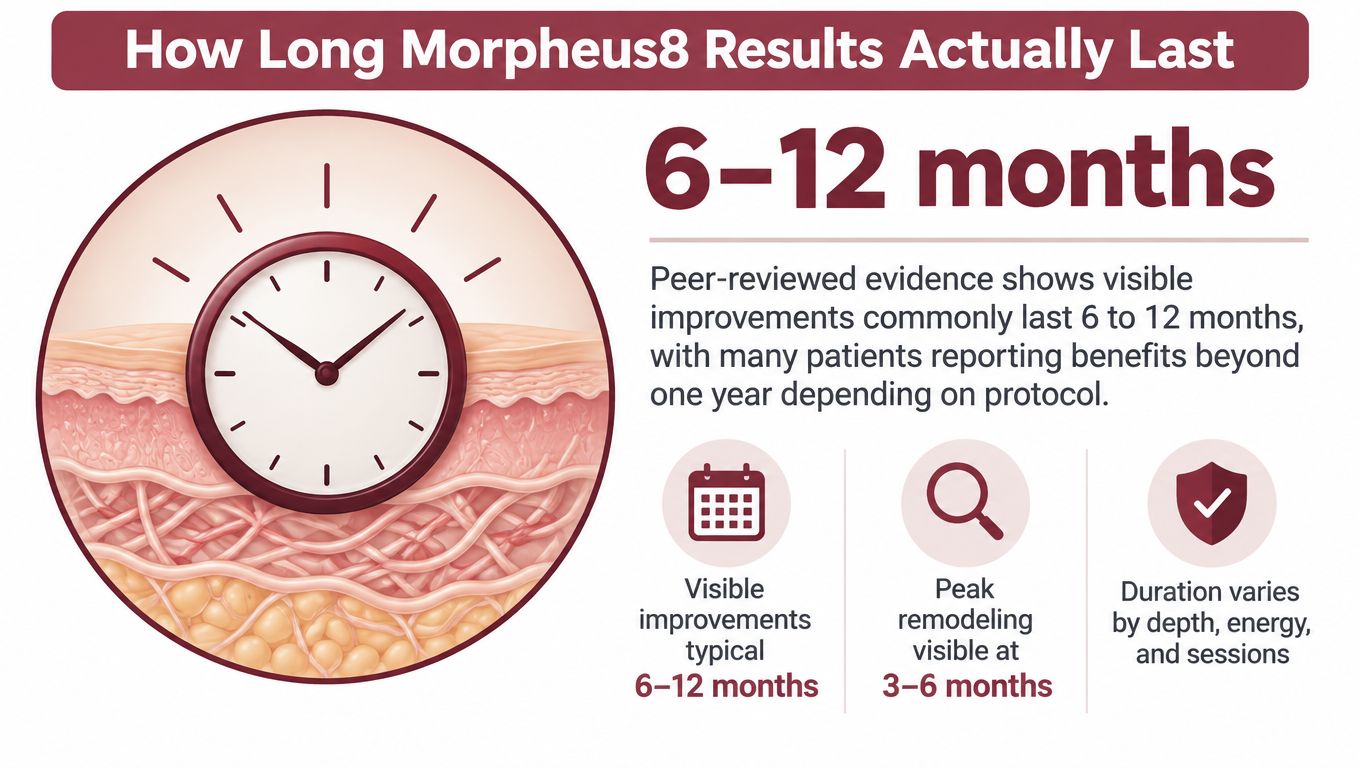
Three time horizons explain the answer
Think of Morpheus8 longevity in three connected windows:
- Remodeling window: During the first 1 to 3 months, the skin is responding to controlled treatment and building structural change.
- Evidence window: Published studies most often assess results around 3 to 6 months, with available evidence suggesting effects may remain demonstrable for approximately 6 to 12 months.
- Maintenance window: After that, aging, sun exposure, weight changes, and individual biology continue to influence the appearance of the skin.
Maintenance doesn't automatically mean the treatment failed. It may reflect the fact that collagen remodeling and natural aging continue at the same time. A consultation should focus on whether the skin still meets your goals, rather than treating a particular month as an expiration date.
Practical rule: Judge the outcome after the skin has had time to remodel, then decide whether maintenance supports your goals.
Why Results Keep Changing After Each Session
Morpheus8 combines microneedling with radiofrequency energy. Fine needles enter selected skin layers, while radiofrequency creates controlled heat at targeted depths. That combination produces a carefully controlled injury response, which encourages the skin to reorganize collagen and elastin over time.
The process isn't like applying a temporary coating to the surface. Immediately after treatment, collagen fibers can partially denature and the dermis can contract. Later, the healing response supports additional collagen and elastin formation. In a clinical evaluation of microneedle fractional radiofrequency, increased collagen and elastin were documented at the four-month follow-up. At that visit, 53.3% of participants were rated by independent dermatologists as very much improved, and 86.7% considered their results satisfactory. The clinical evaluation helps explain why a later assessment can look more meaningful than an early one.
A slow-developing result
A useful analogy is a photograph that develops gradually rather than an instant print. The treatment starts the process, but the body handles much of the remodeling afterward. Early swelling, redness, or temporary tightening can also make the first impression difficult to interpret.
That explains why a one-month check-in may feel underwhelming for someone expecting a finished result. By a later three- or six-month assessment, the skin may show clearer changes in firmness or texture. Improvement can also feel uneven. One area may respond sooner while another continues remodeling, especially when the provider treats different concerns at different depths.
This variation doesn't automatically signal failure. Skin doesn't rebuild itself in a perfectly synchronized pattern, and the final appearance depends on the original concern, the treatment settings, and the body's healing response.
A useful question isn't “Why don't I look finished yet?” It's “Has enough time passed to evaluate the remodeling?”
Patient Factors That Shape How Long Results Last
Two people can receive similar radiofrequency microneedling and experience different-looking longevity. The difference may come from the condition being treated, the skin's baseline structure, or habits that influence collagen breakdown.
Published evidence identifies several variables that can affect durability, including age, laxity or scarring, sun exposure, smoking, skincare, weight change, hormonal status, and whether someone completes a recommended series instead of receiving one isolated session. A recent systematic review supports treating these as modifiers, not as a formula that predicts an exact result.
Use this checklist before your consultation
- Age and skin quality: Skin with more advanced collagen loss may need a more deliberate plan, and the effects of continuing aging remain relevant after treatment.
- Baseline laxity or scarring: Mild laxity, texture irregularity, and acne scarring don't respond in identical ways. A scar-focused plan may use a different depth and follow-up strategy than a tightening-focused plan.
- Sun exposure: Ultraviolet exposure contributes to ongoing photoaging, which can work against efforts to preserve smoother, firmer-looking skin.
- Smoking: Smoking can affect the skin's repair environment and may make it harder to maintain improvements.
- Weight stability: Significant weight change can alter skin tension and may change the appearance of treated areas even when the original remodeling response was appropriate.
- Hormonal status: Hormonal changes can influence skin quality and elasticity, so the same protocol may not produce the same experience at every stage of life.
- Daily skincare: Consistent skincare and sun protection support the condition of the skin, but they can't freeze the aging process or guarantee a particular duration.
- Treatment completion: A provider may recommend a series because one isolated session and a planned series don't create the same treatment context.
The practical takeaway is simple. Your result isn't determined by the device alone. The provider's plan, your starting point, and what happens to your skin afterward all contribute to how long improvement remains noticeable.
How Treatment Depth, Sessions, and Energy Influence Duration
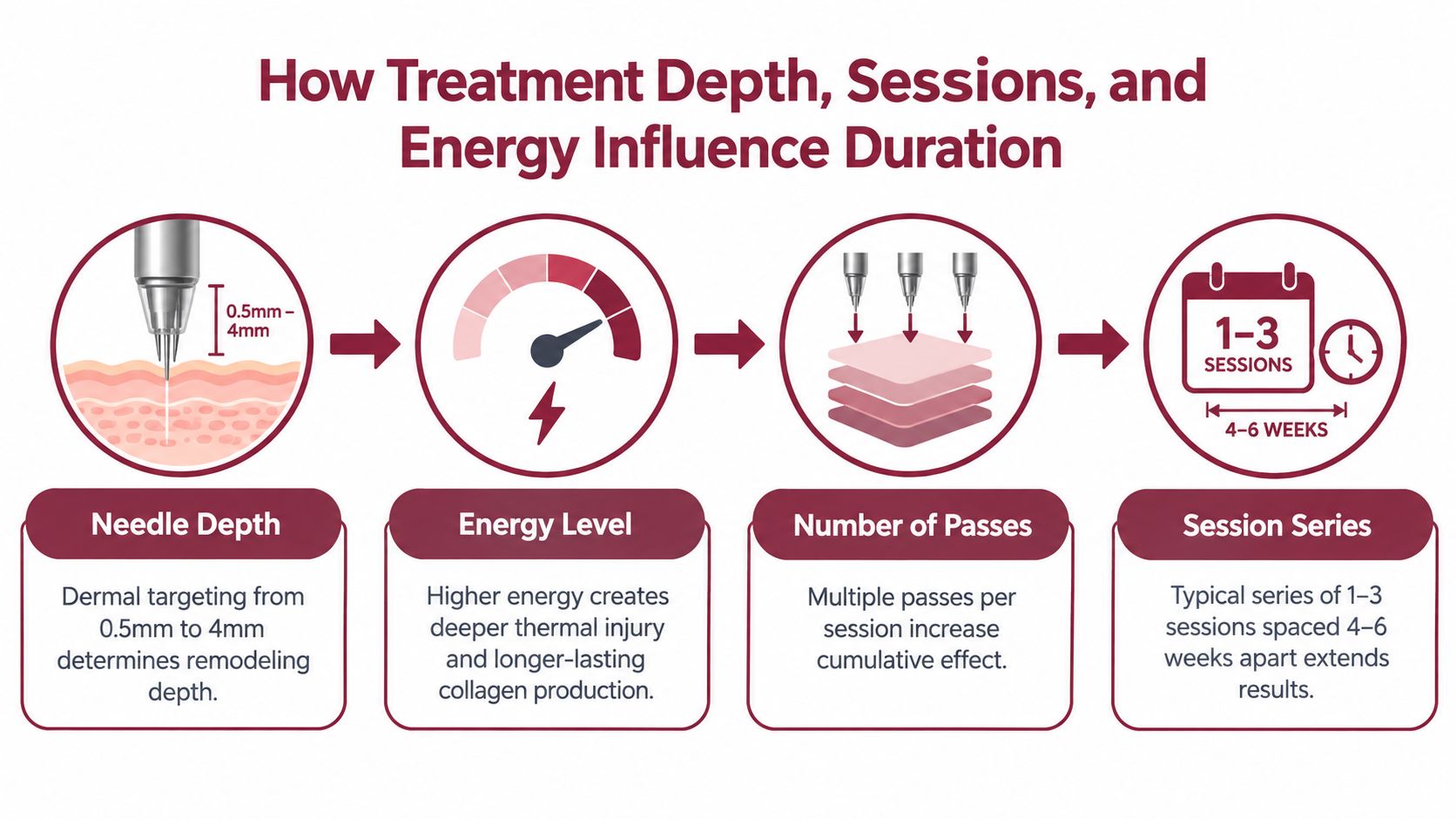
Morpheus8 settings determine where and how strongly the device delivers radiofrequency energy. A provider may adjust needle depth, energy level, number of passes, and session spacing according to the area and concern. These choices aren't interchangeable. A plan for surface texture may differ from one intended to address deeper laxity.
Treatment depth determines the tissue level being targeted. Energy affects the degree of thermal stimulation, while the number of passes influences the cumulative treatment effect. A provider also considers how the skin responds during the session, rather than applying one identical protocol to every person.
Published protocols aren't universal
A prospective controlled study of the lower face, jawline, and neck used one to three sessions spaced 4 to 12 weeks apart, with evaluations at 90 and 180 days. The study shows that published protocols vary rather than following one universal calendar. The study on lower-face, jawline, and neck treatment is a useful reminder that session planning must match the concern and treatment area.
More sessions also do not automatically mean a longer-lasting result. The goal is an appropriate cumulative plan, not the highest possible intensity or the greatest number of appointments. A provider may space sessions to allow the skin to recover and to evaluate how it responds before making further adjustments.
Ask how the planned depth, energy, and session spacing relate to your specific concern. That conversation is more informative than asking for a standard number of months that supposedly applies to everyone.
What to Expect Across Face, Neck, Body, and Acne Scars
The evidence doesn't treat every body area as one category. Face, neck, body, and acne-scar studies use different protocols, follow-up periods, and outcome measures. The table below places those findings side by side without turning them into promises.
| Treatment Area | Typical Follow-Up | What the Evidence Shows |
|---|---|---|
| Face | Often 3 to 6 months, with effects assessed within a broader 6 to 12 month window | Facial radiofrequency microneedling results commonly mature over several months, while evidence beyond one year remains limited. |
| Neck and jawline | Evaluations at 90 and 180 days in one prospective study | Results may become more apparent over time, and protocols can range from one to three sessions with different spacing. |
| Body | Measured through 6 months in a body study | In a study of 31 women and 62 treated body areas, investigator-rated improvement reached 95% at three months, while 68% of treated areas still showed at least 25% improvement at six months. Upper-arm and bra-line areas maintained reported improvement in 100% of subjects at the one-, three-, and six-month assessments. The body-area study |
| Acne scars | Extended follow-up to 3 years in one retrospective study | Relapse occurred in 7 of 29 patients treated with fractional RF microneedling, approximately 24%. This condition-specific result shouldn't be generalized to facial tightening. Research on RF microneedling for acne scars |
Why the area changes the conversation
Body findings can look encouraging, but they shouldn't be transferred directly to the face or neck. The body study included specific areas and measured improvement in a particular way. It shows that anatomy matters, not that every treated body location will behave identically.
Acne-scar evidence also deserves careful interpretation. The three-year follow-up is longer than most radiofrequency microneedling studies, but it was retrospective and focused on scarring. Someone exploring RF microneedling for acne scars should ask how scar type, depth, and treatment goals affect the plan.
For facial rejuvenation, the most defensible expectation remains gradual change evaluated over months, with a commonly discussed evidence window of 6 to 12 months rather than a guaranteed multi-year outcome.
Building a Maintenance Rhythm That Fits Your Skin
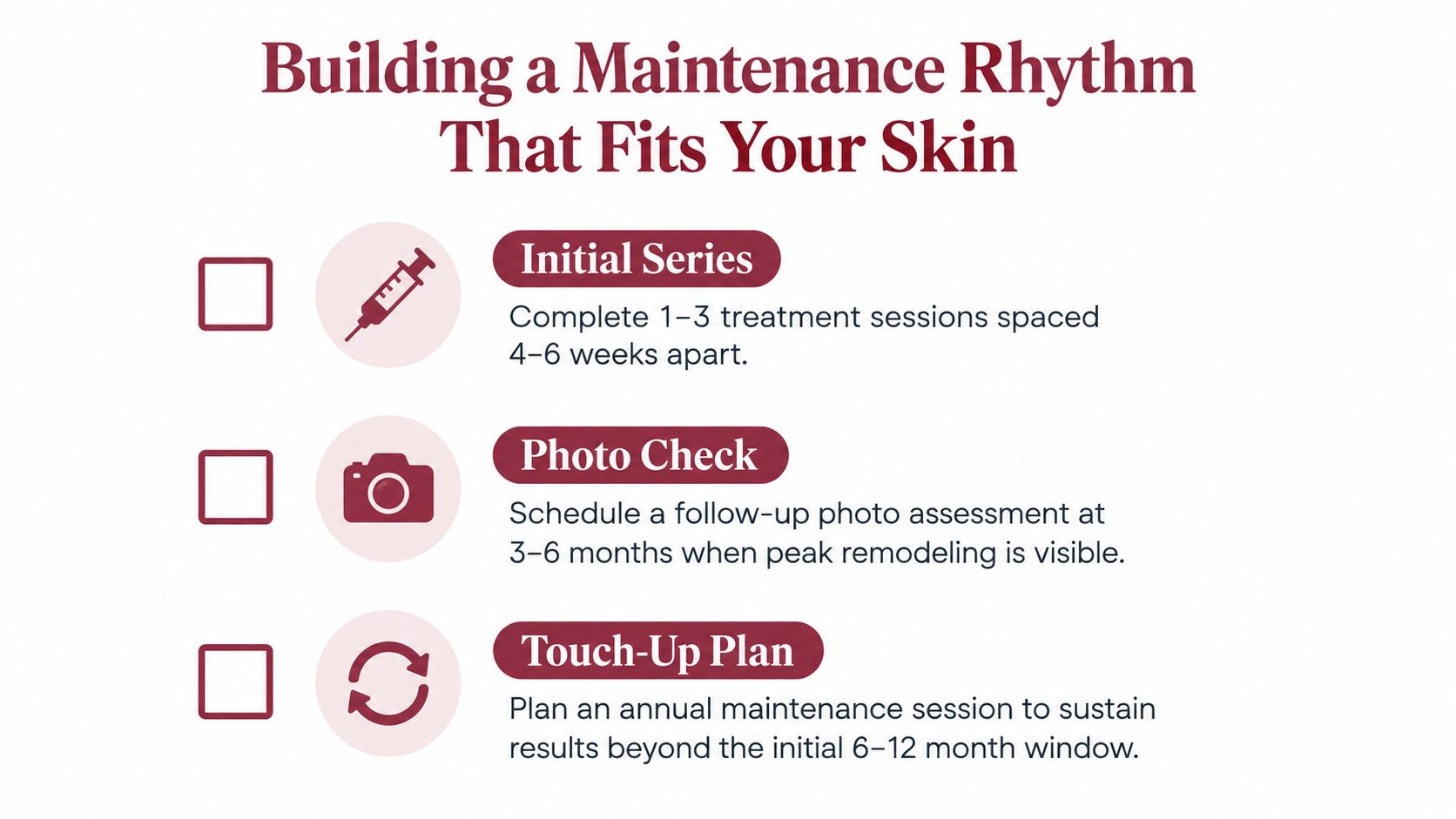
How can you plan Morpheus8 maintenance when results develop gradually and individual skin changes over time? Use three time horizons: the first 1 to 3 months for remodeling, the 6- to 12-month window for reviewing durability, and the longer period shaped by aging, skin condition, and personal goals.
A practical rhythm
Complete the initial plan. Your provider may recommend more than one session based on the treatment area and concern. These sessions establish the treatment foundation before you judge the final pattern of change.
Review photographs after remodeling develops. Compare images around 3 to 6 months, when early swelling and gradual collagen changes are easier to distinguish from the longer-term result. Use similar lighting, angles, and facial expression. A consistent photo record works like a calendar for the skin, making subtle changes easier to assess.
Reassess as aging continues. A review around the 6- to 12-month window can help you and your provider decide whether further treatment fits your goals. Longer-term evidence remains limited, so this appointment is a planning point rather than a promise of a fixed duration. The broader evidence review
Support the result between appointments
Daily broad-spectrum sunscreen helps reduce ongoing ultraviolet exposure. If your provider recommends a retinoid, peptide-focused product, or another skincare approach, follow that individualized guidance. Stable weight and smoking cessation may also support the skin's longer-term condition.
These habits support the conditions in which your skin maintains its appearance, while aging and other biological factors continue to influence the timeline. Maintenance is ongoing collagen support and a way to respond to changing goals.
Maintenance is a planning decision, not a verdict on whether the original treatment worked.
Common Misconceptions About Morpheus8 Longevity
One session is always enough. A single treatment can create visible change, but published protocols range from one to three sessions. The appropriate course depends on the concern, treatment area, skin response, and provider's assessment. A series may be needed before judging the result.
The results are permanent. Morpheus8 stimulates collagen remodeling; it does not pause aging or prevent effects from ultraviolet exposure, weight change, and other influences on skin quality. The practical question is how to remain near the upper end of the 6- to 12-month evidence window: complete the recommended series, protect your skin from the sun, and maintain a stable weight when possible. Longer-term research remains limited, so these steps may support durability without guaranteeing it.
Morpheus8 replaces a facelift. Morpheus8 may improve tightening and texture, but it is not a surgical lift or an equivalent substitute. The suitable option depends on laxity, goals, treatment area, and the change a patient expects.
It is painless and guarantees tightening. Sensation and recovery vary with treatment depth, energy, and location. A qualified provider should explain comfort measures, possible reactions, candidacy, and realistic outcomes. No treatment should be presented as painless for everyone or guaranteed to tighten skin.
As the acne-scar data above showed, even the longest follow-up found relapse in about a quarter of patients. That supports careful, concern-specific counseling, not a universal claim about longevity. Patients comparing Morpheus8 with fractional CO2 laser skin resurfacing should judge options by the problem being treated and the evidence available for that goal.
Planning Your Own Morpheus8 Timeline at Spa Black
A useful personal framework has three parts: expect remodeling during the first 1 to 3 months, evaluate the evidence-aligned outcome across roughly 6 to 12 months, and plan for an ongoing aging-and-maintenance window afterward. Your face, neck, body area, or acne scars may need a different protocol and follow-up schedule.
A consultation at Spa Black in San Antonio can connect those time horizons to your skin condition, goals, and treatment area. The Morpheus8 treatment service can be discussed as part of an individualized plan, while your provider determines candidacy, settings, session timing, and realistic durability after assessing you in person.
Spa Black offers Morpheus8 in San Antonio for patients seeking non-surgical support for skin tightening, texture improvement, and collagen remodeling. Visit Spa Black to arrange a consultation and discuss a timeline that fits your skin, your goals, and the evidence.