


You may be noticing rougher texture, acne-scar indentations, or early loosening around the jaw and wondering whether Morpheus8 is a sensible next step. The name turns up in conversations and online, but it can be hard to tell what the device does from what a treatment is sometimes said to do.
The straightforward answer to “What is Morpheus8 treatment?” is that it's a form of radiofrequency microneedling. It uses needles and radiofrequency energy to create controlled effects beneath the skin, with settings adjusted for the person and the area being treated. It's not a surgical facelift, and it can't promise the same result for every concern or patient.
To make a thoughtful decision, it helps to separate the device from the procedure and the evidence behind particular uses. That means understanding how treatment works, which skin concerns have stronger support, what an appointment may involve, and why a careful safety conversation matters.
Table of Contents
- Why Patients Ask What Morpheus8 Treatment Actually Is
- How Morpheus8 Combines Microneedling With Radiofrequency
- What Skin Concerns Morpheus8 Is Best Supported For
- What Happens During a Morpheus8 Treatment Session
- How Many Sessions You May Need and What Downtime Looks Like
- Safety Considerations and Risk Profiles Worth Understanding
- Setting Realistic Expectations and Comparing It to Other Options
- Questions to Ask Before You Book a Morpheus8 Consultation
Why Patients Ask What Morpheus8 Treatment Actually Is
A common starting point is a mirror or a photograph. Someone notices acne-scar irregularity, fine lines, or mild looseness and begins weighing options: leave it alone, try a non-surgical skin treatment, or ask about a more invasive procedure. They may hear “skin tightening” and “collagen remodeling” without learning what those phrases mean in practice.
Morpheus8 is a particular device used for fractional radiofrequency microneedling, not a synonym for every microneedling or skin-tightening treatment. Fine needles enter the skin to a chosen depth and deliver radiofrequency energy. The combined mechanical and heat-based effects are intended to prompt dermal remodeling over time. Settings matter, so the device name alone doesn't tell you exactly how a session will be performed or what results to expect.
Regulatory language also needs a careful reading. The FDA says legally marketed microneedling devices are authorized to improve the appearance of facial acne scars, facial wrinkles, and abdominal scars in patients aged 22 years or older (FDA information on microneedling devices). The FDA classifies RF-microneedling devices as Class II medical devices cleared through the 510(k) pathway. That pathway relies on substantial equivalence to an existing legally marketed device, which is different from the premarket approval standard for high-risk devices.
A useful distinction: Regulatory clearance describes specific uses and a route to market. It doesn't mean every promotional claim about tightening, pigment, fat, or lifting has the same level of support.
Morpheus8 is best understood as a physician-supervised, minimally invasive skin-remodeling procedure, not an operation or a guaranteed answer to every concern. Treatment planning should consider the diagnosis, skin type, body area, needle depth, energy, and the patient's risk profile. Those are the questions that turn curiosity into an informed consultation.
How Morpheus8 Combines Microneedling With Radiofrequency
The treatment works on two levels at once: needles create controlled micro-injuries, while localized heat adds a second stimulus deeper in the skin. Together, these effects are intended to prompt the body's healing response and encourage gradual tissue remodeling. The process affects more than the skin's surface.
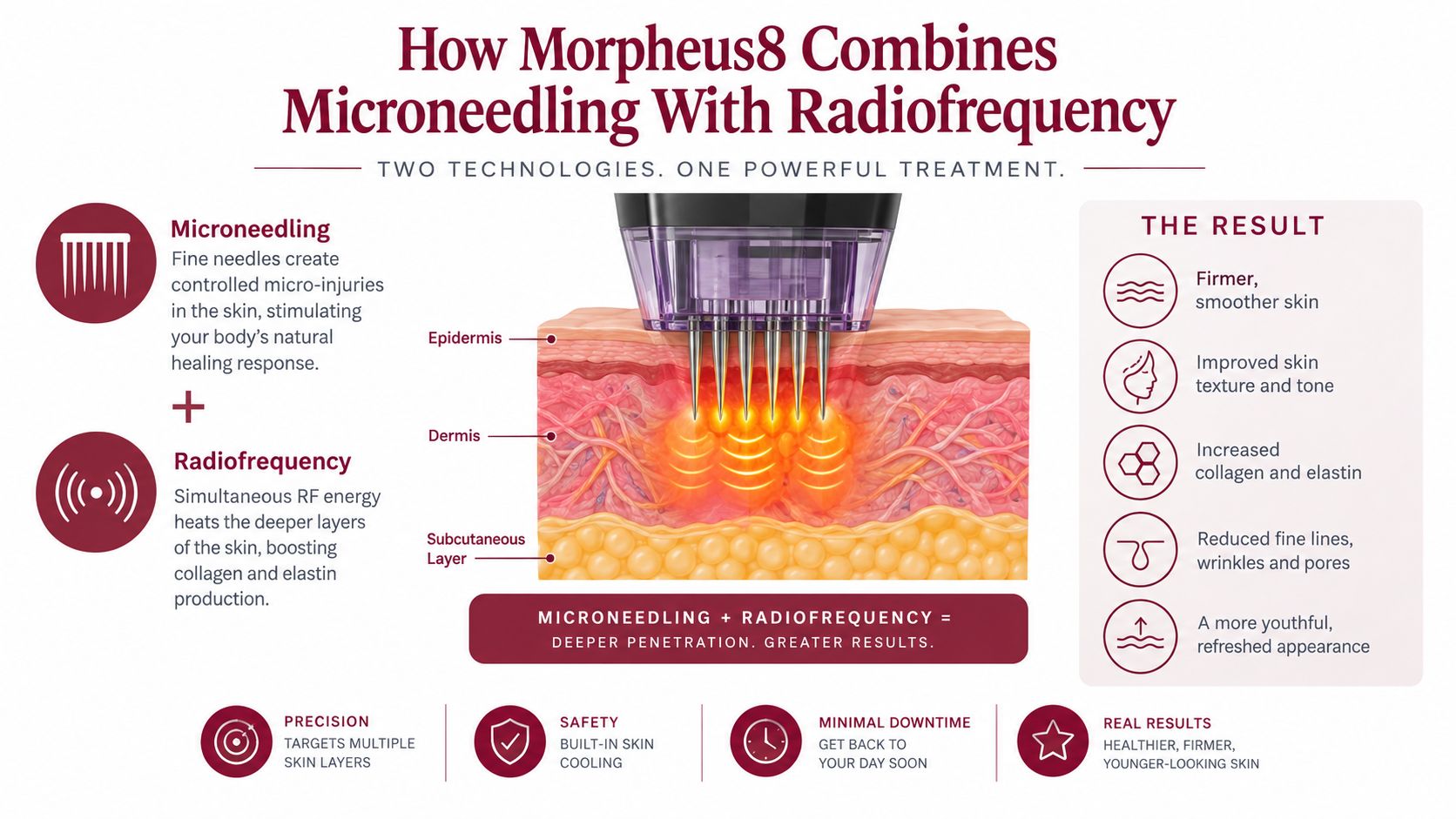
The procedure is commonly called fractional bipolar radiofrequency microneedling. “Fractional” means it creates targeted treatment zones rather than affecting every point of skin equally. “Bipolar” describes how the handpiece delivers radiofrequency energy between its electrodes. In Morpheus8, coated needles enter the skin to a set depth and release energy through their tips, concentrating heat near the treatment zones.
Depth and energy are adjustable. A registered clinical protocol describes handpieces with 12 or 24 needles and adjustable penetration from 1 to 4 mm on the lower face. It specifies two passes at each depth, with energy chosen according to skin thickness and texture. The protocol schedules four treatments, spaced 4 to 6 weeks apart, and assesses results at 3 and 6 months. This is a study schedule, not a guarantee that every patient needs the same course or will see the same result (registered Morpheus8 clinical protocol).
Anatomy helps explain why settings vary. Thin skin around the eyes generally calls for more conservative depth and energy than thicker tissue. The provider also considers the treatment goal and the patient's skin characteristics. For background on ingredients discussed alongside microneedling, see this guide to best peptides to pair with microneedling. It does not replace individualized clinical aftercare advice.
What Skin Concerns Morpheus8 Is Best Supported For
A person seeking help for indented acne scars is asking a different question from someone concerned about brown spots or deep wrinkles. Evidence for one concern does not establish that Morpheus8 works equally well for another.
A 2025 systematic review found fractional radiofrequency microneedling likely effective as a stand-alone treatment for atrophic acne scars, which are depressions or irregularities in the skin's surface (systematic review of fractional radiofrequency microneedling for acne scars). This is a better-supported use than treating the device as a universal solution. Spa Black also explains RF microneedling for acne scars.
A synthesis of 20 studies involving 558 participants reported improvements in aesthetic outcomes, including skin texture and tightening (clinical synthesis of RF microneedling studies). Some analyses reported positive results in more than 90% of patients, but that figure is not a guaranteed Morpheus8 success rate. The studies used different devices and settings, selected different patients, and varied in treatment intervals, follow-up, and outcome measures.
| Concern | How to interpret the evidence |
|---|---|
| Atrophic acne scars | A specifically supported use, although results vary by patient. |
| Uneven texture and fine lines | Possible areas of improvement, influenced by treatment settings and individual factors. |
| Mild laxity | Some patients may improve, but the procedure should not be presented as a surgical lift. |
| Deep wrinkles, pigmentation, or fat reduction | Evidence for scars or texture does not establish results for these concerns. |
For example, someone mainly concerned about sun-related discoloration should first clarify what type of pigment change is present. General sun-damaged skin care, including the GLAZE House of Wellness sun repair tips, may offer broader skin-health context, but neither establishes that Morpheus8 treats every pigment concern. A clinician should identify the concern and explain whether the evidence supports the proposed treatment.
What Happens During a Morpheus8 Treatment Session
The appointment begins with a conversation, not the handpiece. The clinician reviews the concern you want to address, your skin history, relevant medications, prior procedures, and any active irritation or infection. Photography and consent may be part of the process so you understand the plan and can compare changes later.
Before treatment, the provider cleans the area and applies topical numbing medication. They may mark the skin and choose the needle tip and treatment pattern. The plan should reflect anatomy and skin thickness, rather than applying the same settings across every part of the face or body.
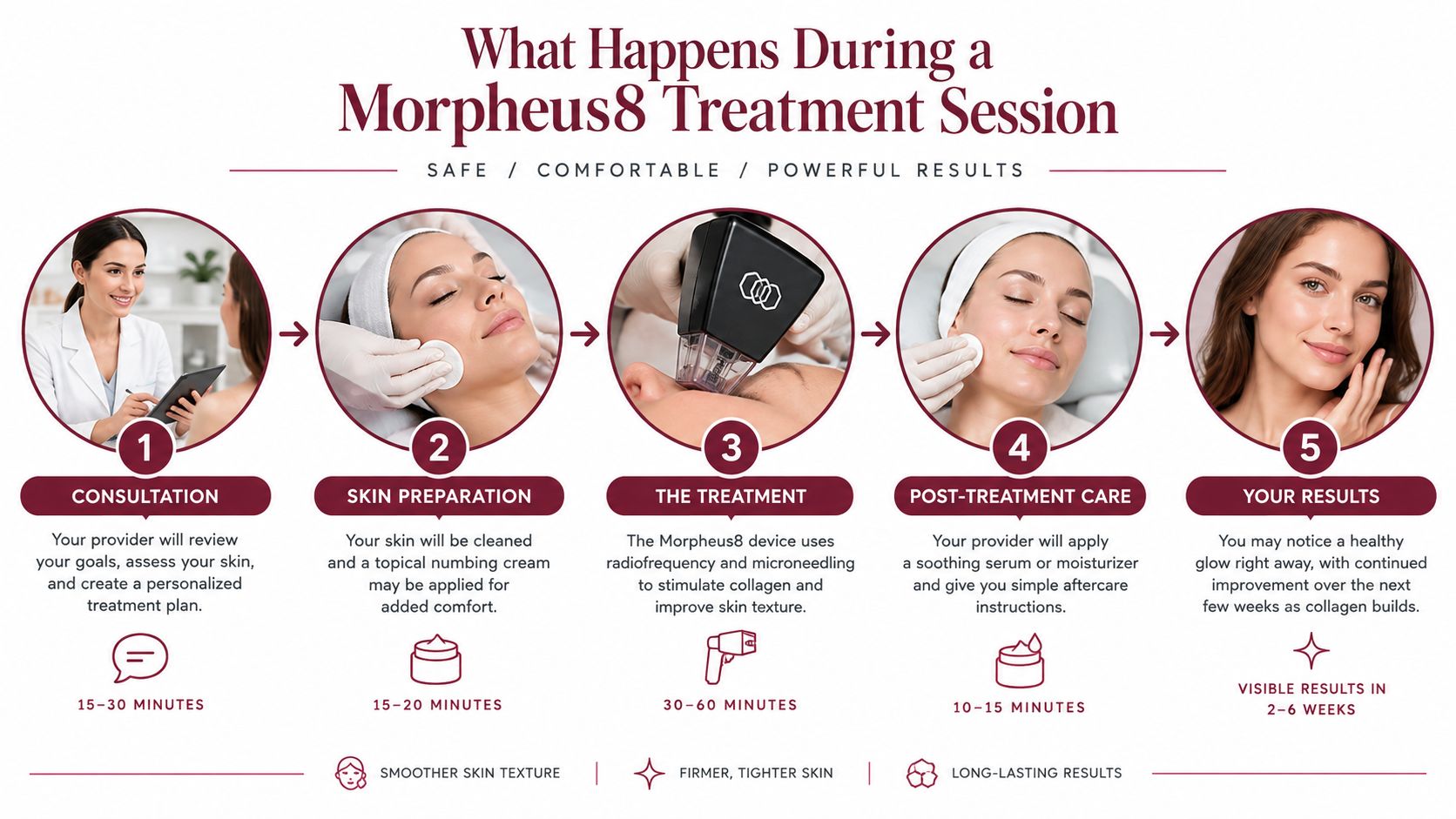
During treatment, the device is placed against the skin in a series of passes. A clinical protocol describes two passes per depth, while the provider selects depth and energy for the treatment area. Sensations vary; numbing can help, but the procedure shouldn't be described as painless. Tell the clinician if the sensation feels unexpectedly intense.
Afterward, the skin may look red or swollen, with small grid-like marks from the treatment. The provider gives aftercare guidance based on the treated area and your skin response. Share recent sun exposure, medication changes, and active skincare use before the visit, and follow the clinic's instructions afterward rather than adding products or procedures on your own.
Before treatment: Ask what areas will be treated, what settings are planned, what response is expected, and whom to contact if healing doesn't follow the expected course.
How Many Sessions You May Need and What Downtime Looks Like
Your calendar can help set expectations, but it cannot predict your exact recovery. The clinical review describes treatment intervals of 3–6 weeks and downtime of roughly 2–5 days in the cited protocol (clinical review of RF microneedling parameters and safety). These are reported ranges, not a guarantee. Redness, swelling, and temporary grid marks may be visible, and the response can differ by treatment area and individual.
| Area | Typical depth | Energy range | Expected downtime |
|---|---|---|---|
| Face | Approximately 1–2 mm | Individualized to anatomy and skin | Roughly 2–5 days in the cited protocol |
| Selected body areas | Approximately 3–4 mm | Individualized to tissue and treatment goal | Roughly 2–5 days in the cited protocol |
| Bony or periorbital regions | About 2 mm in the review | Conservative, clinician-selected settings | Roughly 2–5 days in the cited protocol |
The review's ranges are descriptions of clinical practice, not settings to choose for yourself or a fixed Spa Black treatment plan. Depth and energy depend on tissue thickness and skin type. More aggressive settings may raise the risk of pain, prolonged redness or swelling, grid marks, burns, or pigment changes, so the clinician should tailor the approach to the area being treated.
Recovery and results follow different clocks. The visible irritation may settle within days, while collagen remodeling develops gradually. A quick return to usual activities does not mean the final change is already apparent. Ask your clinician when progress should be assessed and whether another session fits your treatment goal and response.
Safety Considerations and Risk Profiles Worth Understanding
“Minimal downtime” doesn't mean risk-free. RF microneedling is a heat-based medical procedure, and its risks can include burns, prolonged redness, swelling, grid marks, and post-inflammatory pigment alteration. More serious complications can occur with certain uses, so the treatment area, device technique, depth, energy, sterile practice, and operator training all matter.
The FDA's safety communication in October 2025 warned that certain uses of RF microneedling had been associated with burns, scarring, fat loss, disfigurement, nerve damage, and cases requiring medical or surgical intervention (FDA safety communication on RF microneedling). The warning doesn't mean every Morpheus8 treatment is unsafe. It does make a specific safety discussion essential, especially for facial areas where unintended volume loss or nerve injury could have serious effects.
Some patients may need a more cautious plan. The clinical review recommends conservative escalation for darker Fitzpatrick skin types because heat and inflammation can contribute to pigment changes. Before treatment, discuss active dermatitis or infection, a history of abnormal scarring or pigment changes, recent isotretinoin or procedures, and herpes reactivation risk. A provider should also document the intended depth and energy for each treatment area.
Seek prompt clinical review for blistering, severe pain, worsening discoloration, numbness, or symptoms that get worse rather than improve.
The consultation should cover how the clinician screens for these factors, maintains sterile technique, and responds if a complication occurs. If you're weighing different skin treatments, Spa Black's information about a chemical peel in San Antonio can help you formulate questions about treatment choice, but candidacy still needs individual assessment.
Setting Realistic Expectations and Comparing It to Other Options
A before-and-after photograph shows one person's outcome under particular conditions. It offers a possibility, not a forecast. Lighting, treatment area, and the protocol behind the image matter when judging whether that result relates to your goal.
The broader review of microneedling facial-rejuvenation research included 21 studies and 723 patients; 90% of studies used multiple sessions, and pooled satisfaction was 83%, with a 95% confidence interval of 76% to 88%. These figures describe varied microneedling research, rather than a Morpheus8-specific success rate. Satisfaction also differs from a measured change in wrinkles.
The prospective study discussed earlier reported temporary redness and swelling, with wrinkle improvement varying by facial region. Its findings apply to the patients, areas, and protocol studied. A small study without severe adverse events cannot establish that every treatment is risk-free.
Morpheus8 is the device; RF microneedling is the procedure. Device clearance and evidence for a particular cosmetic result are separate questions, so marketing claims need support from relevant studies.
Comparing treatments works like matching a tool to a repair: start with the problem. Conventional microneedling, RF microneedling, and laser resurfacing affect tissue differently. Spa Black offers Morpheus8 for patients exploring RF microneedling, while fractional CO2 laser treatment offers a different resurfacing approach.

Morpheus8 is a remodeling procedure, not a surgical facelift. Expectations should reflect the published protocol and the concern being treated. Deep wrinkles, substantial laxity, pigment, and fat concerns should not be grouped into a single promise of rejuvenation. A useful outcome is a defined, assessable improvement, with limits explained before treatment.
Questions to Ask Before You Book a Morpheus8 Consultation
A useful consultation should leave you with a clear diagnosis, a treatment rationale, and a safety plan. Bring your medical and skin history, including prior procedures, active or recent irritation, medication changes, scarring or pigment responses, and any history of cold sores. Be ready to discuss recent sun exposure and the products you use on your skin.
Use these questions to guide the conversation:
- What concern are we treating? Ask the clinician to identify the skin change and explain why RF microneedling fits that goal.
- What settings do you plan to use for my skin and this area? Ask how skin type, tissue thickness, and anatomy affect needle depth and energy.
- How many sessions and what spacing do you recommend for me? Ask what might lead the plan to change as your skin responds.
- What should I expect during recovery? Discuss visible redness or swelling, aftercare, and how to plan around work or social commitments.
- Who performs the treatment, and how are complications handled? Ask about training, medical oversight, sterile technique, and whom to contact if healing concerns arise.
How soon do results appear? Some changes may be gradual as remodeling takes place; don't judge the outcome immediately after a session. Your provider should explain when they'll assess progress.
Does it hurt? Sensation varies. Topical numbing may be used, but the procedure isn't guaranteed to be painless.
Can darker skin tones be treated? Treatment may be considered, but settings and risk require individualized assessment, including discussion of pigment-change risk.
Can it replace a facelift? No. Morpheus8 is a minimally invasive skin-remodeling procedure, not surgery, and shouldn't be represented as an equivalent lift.

At Spa Black in San Antonio, a consultation can help you discuss whether Morpheus8 fits your skin concern, medical history, and expectations. Visit Spa Black to learn about the treatment and arrange a consultation.
Before booking, write down the concern you want assessed and bring a list of relevant medications, procedures, and skin reactions. A clear plan should explain the diagnosis, settings, expected recovery, and how your progress will be reviewed.