



You catch your side profile in a photo someone else took, and that's when you see it. The skin under your chin hangs softer than you remember, your jawline looks blurred, and a turtleneck suddenly feels like strategy, not style. You're not looking for a miracle cream. You want a straight answer about treatment for loose skin on neck concerns, what can tighten it, and when non-surgical care stops being money well spent. That's the conversation we have every day, and it starts by identifying your real problem before anyone sells you a device.
Table of Contents
- Why Neck Skin Loses Its Tightness in the First Place
- How to Read Your Own Neck Before Choosing a Treatment
- Non-Surgical Tightening Options Worth Knowing
- What the Evidence Actually Shows for RF and Ultrasound
- Addressing Fat, Bands, and Lines Alongside Laxity
- When Surgery Becomes the Honest Recommendation
- How Spa Black in San Antonio Approaches Neck Rejuvenation
- Bringing It All Together Before Your Consultation
Why Neck Skin Loses Its Tightness in the First Place
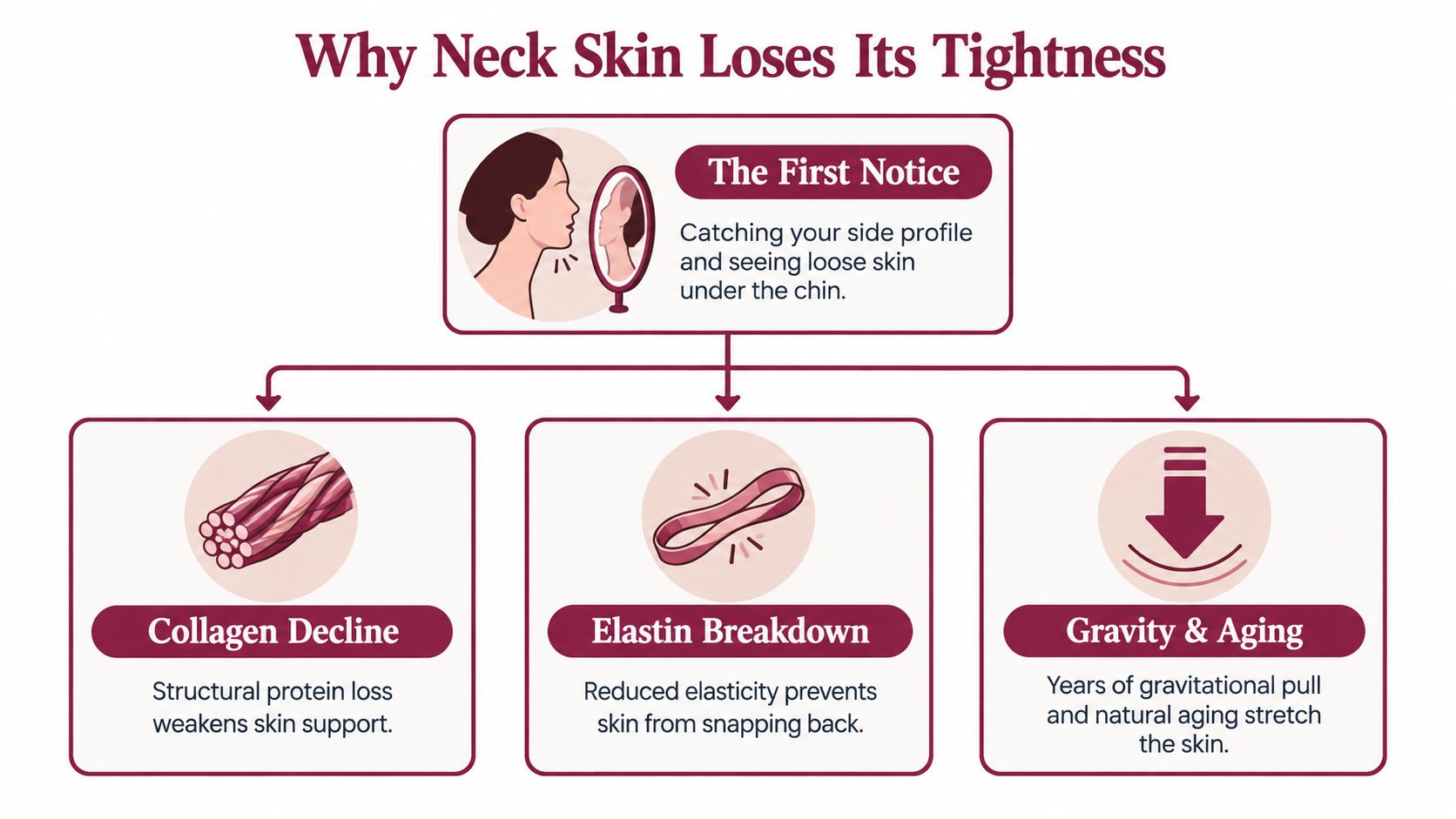
Headlines rarely catch neck aging head-on. Instead, the change appears when turning to back out of a parking space, glancing down at a phone camera, or catching a candid profile where the angle under the chin has softened. By the time the skin can be pinched and held, several layers have already changed underneath.
The Support System Under Your Skin
Young neck skin snaps back because collagen gives it structure and elastin gives it recoil. As both decline with age, the skin gets thinner, drier, and less able to recover from folding. Neck skin also has fewer oil glands than facial skin, so it shows dryness and crepiness earlier, and it's exposed to sun almost as often as your face while getting a fraction of the sunscreen.
Below the surface, two other layers matter. A pad of submental fat under the chin can grow heavier or become more visible as skin loosens around it. Deeper still, the thin, sheet-like platysma muscle can separate and form vertical cords that pull the jawline down when you talk or clench.
Skin, fat, and muscle age on different schedules. Treating one layer while ignoring the others is why so many people feel underwhelmed after a single session.
Why One Product Rarely Fixes Everything
Repeated motion folds the same horizontal lines deeper each year. Weight loss can leave skin that once stretched over more volume now hanging with nowhere to go. Gravity doesn't create laxity alone, but it reveals every bit of lost support, day after day.
That's why a cream that hydrates surface texture won't lift hanging skin, and why a tightening device won't erase a muscle band. The honest first question isn't which machine is newest. It's which layer is driving what you see in that photo, because each layer responds to a different kind of treatment for loose skin on neck aging.
How to Read Your Own Neck Before Choosing a Treatment
Stand in good light with a hand mirror angled so you can see your profile. Don't stretch your chin up or tuck it down. Just look at rest first, because that's how everyone else sees you, and it's the baseline any provider should assess before recommending anything.
Four Checks That Separate the Problems
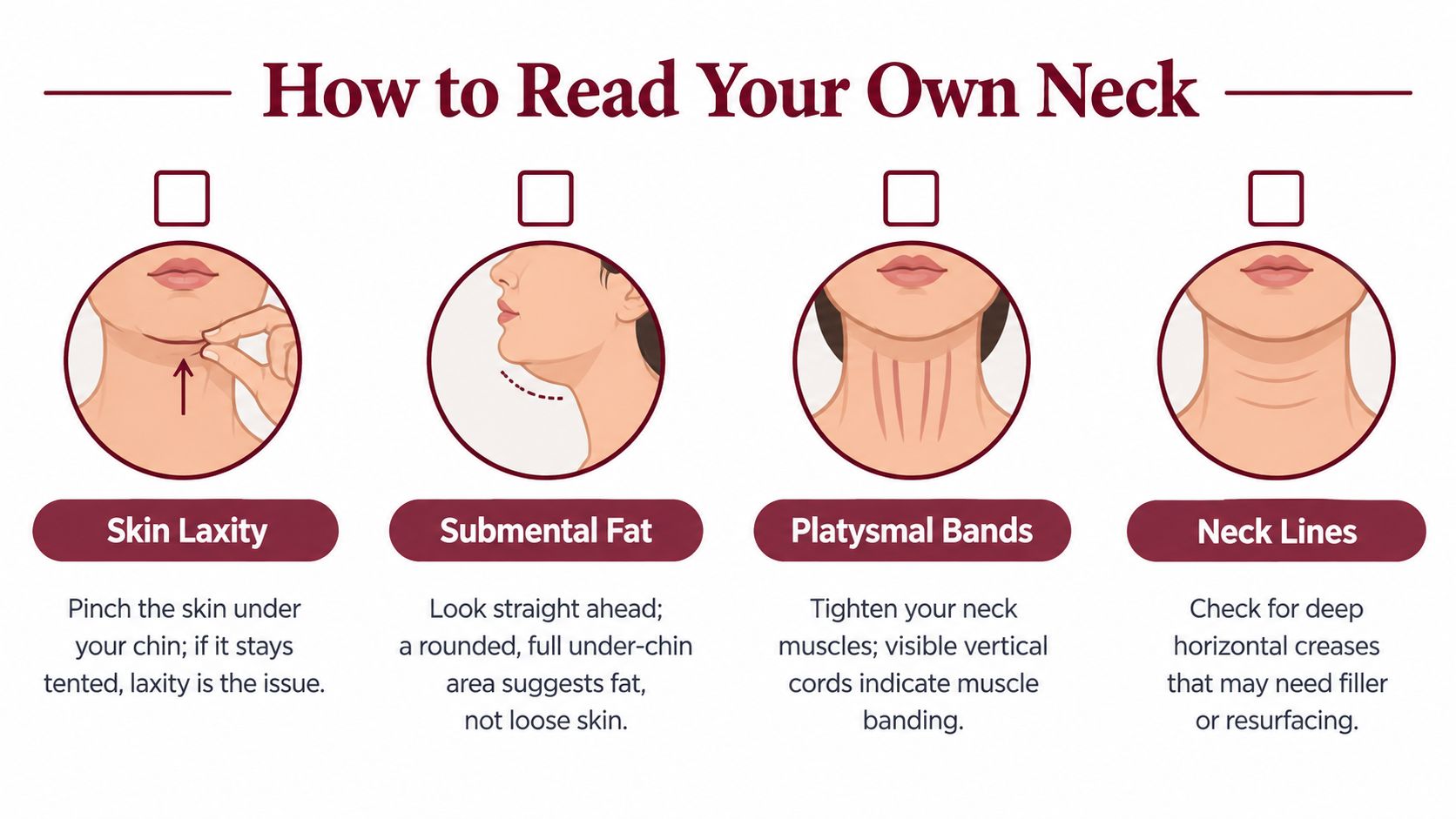
- The Pinch Test for Laxity: Gently pinch the skin under your chin and let go. If it stays tented or settles slowly, you've got true skin laxity, meaning there's more skin than the structure beneath it can support.
- The Straight-Ahead Check for Fat: Look forward with your chin level. A rounded, full pocket under the chin that feels soft and thick points to submental fat, not loose skin, even though the two often travel together.
- The Grimace Test for Bands: Tighten your neck like you're saying a hard "eee" or clench your jaw. Vertical cords that pop out are platysmal bands, a muscle issue that skin tightening alone won't correct.
- The Chin-Down Check for Lines: Tilt your chin toward your chest. Deep horizontal creases that stay etched when you look back up are surface lines, and they need resurfacing or injectable strategies rather than lifting.
Severity Changes the Entire Conversation
Mild laxity feels like slight softness with good snap-back. Moderate laxity shows visible looseness at rest but the skin still has some quality. Severe laxity means skin hangs, folds, or drapes, and that's a different category entirely.
Skin quality matters just as much. Thin, sun-damaged, crepey skin responds differently than thicker skin with better elasticity, and your skin type affects risk, including pigment changes after energy treatments. A sound assessment examines the neck during movement and weighs all of this, consistent with clinical guidance on evaluating neck laxity and anatomy.
Write down which of the four checks bothers you most. That single answer will steer your consultation better than any device name you bring in from social media.
Non-Surgical Tightening Options Worth Knowing
Non-surgical tightening works on a simple principle. Controlled heat or injury in the deeper skin layers triggers your body to rebuild collagen, and that remodeling firms the skin gradually over weeks to months. No energy device removes skin, and anyone who implies otherwise is overselling.
The Main Technologies, Side by Side
Morpheus8 combines microneedling with radiofrequency energy delivered below the surface, supporting skin tightening, texture improvement, and collagen remodeling. It's not painless, and it doesn't replace a facelift, but for mild to moderate laxity with texture concerns, it's often our workhorse. Fractional and surface radiofrequency platforms heat the dermis without needles, suiting patients who want gentler sessions with little downtime. Microfocused ultrasound places focused heat points at deeper tissue planes without breaking the surface, appealing if you can't take visible recovery time.
Surface quality needs different tools. CO2 laser therapy resurfaces damaged outer skin and stimulates collagen, which helps crepiness and etched lines more than deep laxity. IPL photofacial treatment targets pigment and redness, improving tone rather than tightness, and it isn't right for every skin type. For small, targeted areas, patients sometimes research plasma-based skin tightening options alongside these platforms, which is worth discussing during assessment rather than booking blind.
| Technology | What It Targets | Typical Downtime | Best Candidate |
|---|---|---|---|
| Morpheus8 RF Microneedling | Laxity plus texture | Several days of redness | Mild to moderate laxity |
| Surface Radiofrequency | Mild laxity, firmness | Minimal | Early softness, maintenance |
| Microfocused Ultrasound | Deeper support layers | Minimal | Mild to moderate laxity, no downtime available |
| CO2 Laser Resurfacing | Crepiness, lines, sun damage | About a week of healing | Surface quality concerns |
| IPL Photofacial | Pigment and redness | Minimal | Uneven tone alongside laxity |
Results from all of these build slowly. You'll judge collagen remodeling at months, not days, and a typical patient needs a series rather than one session. The right choice depends on whether your dominant issue is depth, surface, or both, and a plan that pairs technologies usually outperforms loyalty to a single machine.
What the Evidence Actually Shows for RF and Ultrasound
Marketing makes every device sound predictable. The published data is more honest, and more useful, so let's calibrate your expectations before you spend anything.
Radiofrequency Delivers Real but Partial Correction
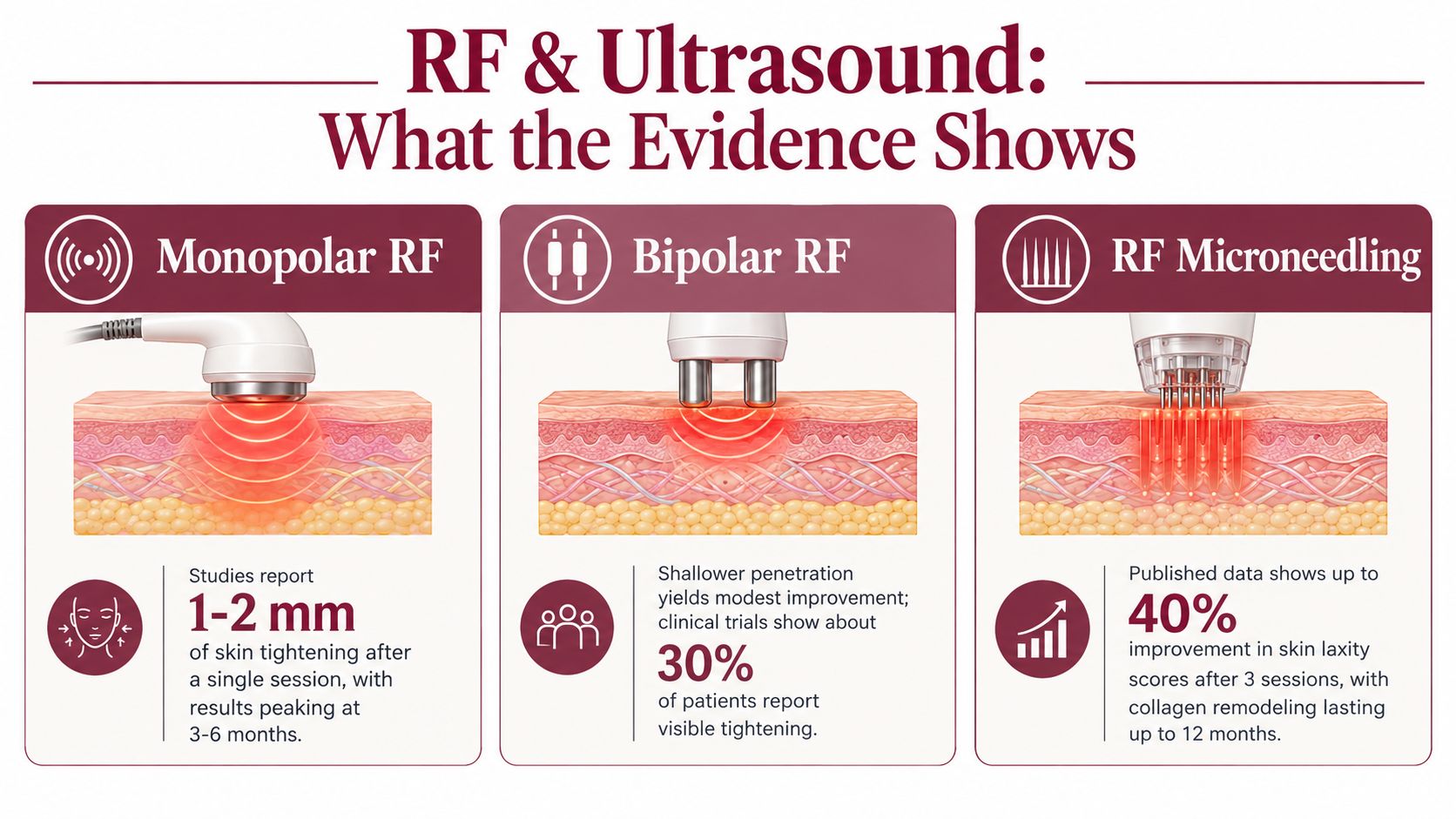
In a prospective study, patients treated with a minimally invasive radiofrequency combination for neck laxity gained a 1.4-point objective improvement on the Baker Face-Neck Classification, and 93% said they were pleased and would repeat treatment, as reported in the prospective radiofrequency neck laxity study. That's meaningful satisfaction. But comparative data in that same body of work found roughly 49% laxity improvement after surgical facelift versus 16% after fractional RF, which tells you the ceiling clearly.
Side effects were mostly temporary. Prolonged swelling beyond six weeks occurred in 4.8%, hardened areas beyond twelve weeks in 3.2%, and transient nerve weakness in 1.2%, all resolving without further intervention. Reviews also note major complications are reported more often with monopolar systems than bipolar, so device type and conservative neck settings matter.
Microneedling RF and Ultrasound on the Timeline
Radiofrequency microneedling improves gradually. A systematic review found approximately 50% of participants achieved at least 50% improvement in neck-aging scores, with average improvement of 37.0% at three months and 41.6% at six months, per the systematic review of radiofrequency microneedling for neck aging. Improvement at six months beating three months confirms you shouldn't judge early.
For ultrasound, masked reviewers judged lower-face and neck laxity improved in 58.1% of evaluable patients at 90 days, while 24.7% were rated worse, according to a clinical evaluation and meta-analysis of microfocused ultrasound. Head-to-head, a meta-analysis found no statistically significant difference between HIFU and radiofrequency for neck outcomes at any follow-up point, a nuance well covered in this skin tightening treatment guide comparing the two technologies.
Practical rule: FDA-cleared means a device met safety and intended-use standards. It doesn't mean it works equally well for every neck.
Addressing Fat, Bands, and Lines Alongside Laxity
Here's where many plans go wrong. A patient books tightening, but her real issue is fullness under the chin, or muscle cords, and the tightening session was never designed to fix either. Combined problems need combined, targeted plans.

When Fullness Is Faking Laxity
Submental fat makes skin look looser than it is by weighing the under-chin area down and softening the jaw angle. Radiofrequency-based platforms such as Vanquish Radio Frequency belong to the body-contouring family used to address stubborn fat areas, and they're support tools, not substitutes for surgery. If fat is dominant, some patients eventually explore procedural routes like chin liposuction for submental fullness, because removing volume alone can leave existing laxity looking more obvious, not less. Sequence matters, and your provider should explain the order before starting.
Bands Are Muscle, Lines Are Surface
Vertical platysmal bands come from muscle activity, so they respond to neuromodulators. The FDA prescribing information identifies platysma-band treatment as a BOTOX Cosmetic indication, with a safety profile consistent with its other uses, as stated in the FDA BOTOX Cosmetic prescribing information. That treatment softens banding. It doesn't remove skin or lift anything structurally.
For skin quality itself, collagen-stimulating injectables have emerging support. A study of hyperdiluted calcium hydroxylapatite for neck rejuvenation reported 65% of patients very satisfied and 30% satisfied, with significant improvement in dermal thickness at P < 0.001 and only minor, self-limiting redness, swelling, and bruising, per the peer-reviewed study of hyperdiluted calcium hydroxylapatite. Horizontal lines and crepey texture often pair better with resurfacing lasers or microneedling than with lifting devices.
Each tool addresses one layer. Stacking them with intention beats repeating one treatment and hoping it covers everything.
When Surgery Becomes the Honest Recommendation
We make our living on non-surgical care, and we'll still tell you this plainly. If you have substantial hanging skin, no device in a med spa will remove it. Energy remodels collagen within the skin you have. It cannot delete redundant skin, and repeated sessions past that point just cost you money and time.
What a Neck Lift Actually Does Differently
A neck lift removes or repositions excess skin and addresses underlying tissues, including fat and the platysma, in one structural correction. The scale of this procedure is not niche. The International Society of Aesthetic Plastic Surgery reported 477,624 neck-lift procedures worldwide in its 2024 survey, roughly twice an earlier reported level of 251,308, according to the ISAPS Global Survey 2024. Treatment selection in the clinical literature follows severity, with moderate to severe laxity needing substantial skin removal often requiring a periauricular approach, sometimes combined with a face lift.
Recovery is real but defined. Bruising commonly resolves within about two weeks, residual tightness may persist for several months, incisions sit behind the ears and along the hairline, and drains or dressings may be used, as described in surgical society guidance on neck lift recovery.
The Threshold We Use With Patients
- Stay non-surgical if your laxity is mild to moderate, your skin quality is decent, and gradual improvement fits your goals.
- Get a surgical opinion if skin hangs at rest, bands are severe, or you've already done reasonable non-surgical treatment without change.
- Stop adding sessions if each round delivers less than the last. That's your tissue telling you the limit.
Reading up on finding the right plastic surgeon in San Antonio before you need one makes that referral conversation calmer and smarter. Early surgical consultation isn't failure. Sometimes it's the most cost-effective advice we can give.
How Spa Black in San Antonio Approaches Neck Rejuvenation
At Spa Black in San Antonio, we don't start with a device menu. We start with the same four-part assessment you practiced at your mirror, skin quality, submental fat, platysma condition, and severity of laxity, examined at rest and in movement. Only after we've named your dominant problem do we talk about technology.
Matching Approved Services to Each Layer
For collagen remodeling and combined laxity with texture concerns, Morpheus8 and microneedling anchor most plans. Radiofrequency microneedling results build over months, and supporting data from radiofrequency-assisted treatment show investigator-rated marked improvement rising from 33% at three months to 55% at six months, per a study of radiofrequency-assisted lipolysis for neck laxity, though that study followed post-facialplasty patients, so we don't generalize it carelessly.
For tone and surface texture, our laser family includes Fotona SP Dynamis, CO2 laser therapy, IPL, and TightLase, selected by skin type and pigment risk. For contour support, Vanquish and related body-contouring platforms address fat concerns as part of a broader plan. For platysmal bands, neuromodulators including Botox, Xeomin, Jeuveau, and Letybo target the muscle component directly.
What to Expect From the Visit
You'll get physician oversight, a candid severity grade, and a written sequence if staging treatments makes sense. With two San Antonio locations, online booking, and memberships that help plan a series sensibly, scheduling the follow-through is straightforward.
Ask us three questions. What is my dominant problem? What improvement is realistic, in plain language? At what point would you send me to a surgeon instead? If the assessment points beyond non-surgical care, we'll say so and help with referral. That honesty is part of the service.
Bringing It All Together Before Your Consultation
You don't need to arrive with a device picked out. You need to arrive with clear observations, and five minutes of preparation will make your consultation far more productive.
Your Short Pre-Visit Checklist
- Name your main concern: Skin, fat, bands, or lines, in that order of how much each bothers you.
- Note your timeline: When you first noticed it, and whether weight change played a role.
- List what you've tried: Creams, devices, injectables, and how each performed.
- Set your downtime: Days you can realistically take, not days you wish you could.
The evidence base itself urges this kind of honesty. A 2025 systematic review of noninvasive radiofrequency studies reported generally favorable outcomes with mostly mild, temporary adverse events, while warning that settings, outcome measures, and study quality varied substantially, as summarized in a systematic review of noninvasive radiofrequency tightening. Variable evidence means your individual assessment carries extra weight.
A good plan might combine non-surgical services, might escalate to surgical referral, or might reasonably be to wait. All three are valid when they follow an honest assessment. What separates a satisfying outcome from a frustrating series of sessions is matching the treatment for loose skin on neck concerns to the layer actually causing them.
If you're ready to find out which layer is driving your neck concerns, Spa Black Med Spa offers physician-overseen consultations that map Morpheus8, laser, contouring, and neuromodulator options to your specific anatomy, with a straight answer if surgery serves you better. Book your assessment at Spa Black and bring your checklist with you.