



Some patients notice change around 3 weeks after CoolSculpting, more pronounced change often appears by about 2 months, and improvement can continue toward 4 to 6 months because treated fat cells clear through the body's natural processes rather than being removed during the session. If you've just left an appointment and checked the mirror in the car, that gap between treatment day and visible change is the part that confuses people most.
You're not waiting for a product to start working. You're waiting for your body to finish a cleanup job that the cooling only started, and that job happens in layers.
Table of Contents
- Why CoolSculpting Results Take Time
- The Biology Behind the Timeline
- A Week-by-Week Timeline of What to Expect
- Factors That Change How Soon and How Much
- Single Sessions, Multiple Cycles, and Final Assessment
- Common Misconceptions About CoolSculpting Timing
- Follow-Up, Red Flags, and Setting Real Expectations
Why CoolSculpting Results Take Time
You walk out, get home, lift your shirt or turn sideways in good light, and the treated area looks exactly like it did that morning. That moment creates the central misunderstanding about how long does CoolSculpting take to work. Nothing was physically taken out during your visit, so there's nothing new to see yet.
Think of the appointment as the starting signal, not the finish. Controlled cooling targets fat cells under the skin during the session, but the contour change depends on what your tissues do afterward. That's why judging the result that evening, or even that week, tells you almost nothing useful.
The Staged Answer Most People Need
Cleveland Clinic's guidance on fat freezing and cryolipolysis reports that some patients notice changes as early as 3 weeks, with more dramatic improvement generally appearing at about 2 months, and optimal results taking 3 to 6 months. Those aren't three competing answers. They're three different points on the same curve.
- Around 3 weeks: The earliest visible softening of the treated contour may appear for some people.
- Around 2 months: Change usually becomes easier to recognize in photos or in how clothing sits.
- Around 3 to 6 months: The result is more fully developed, which is why this window matters for final judgment.
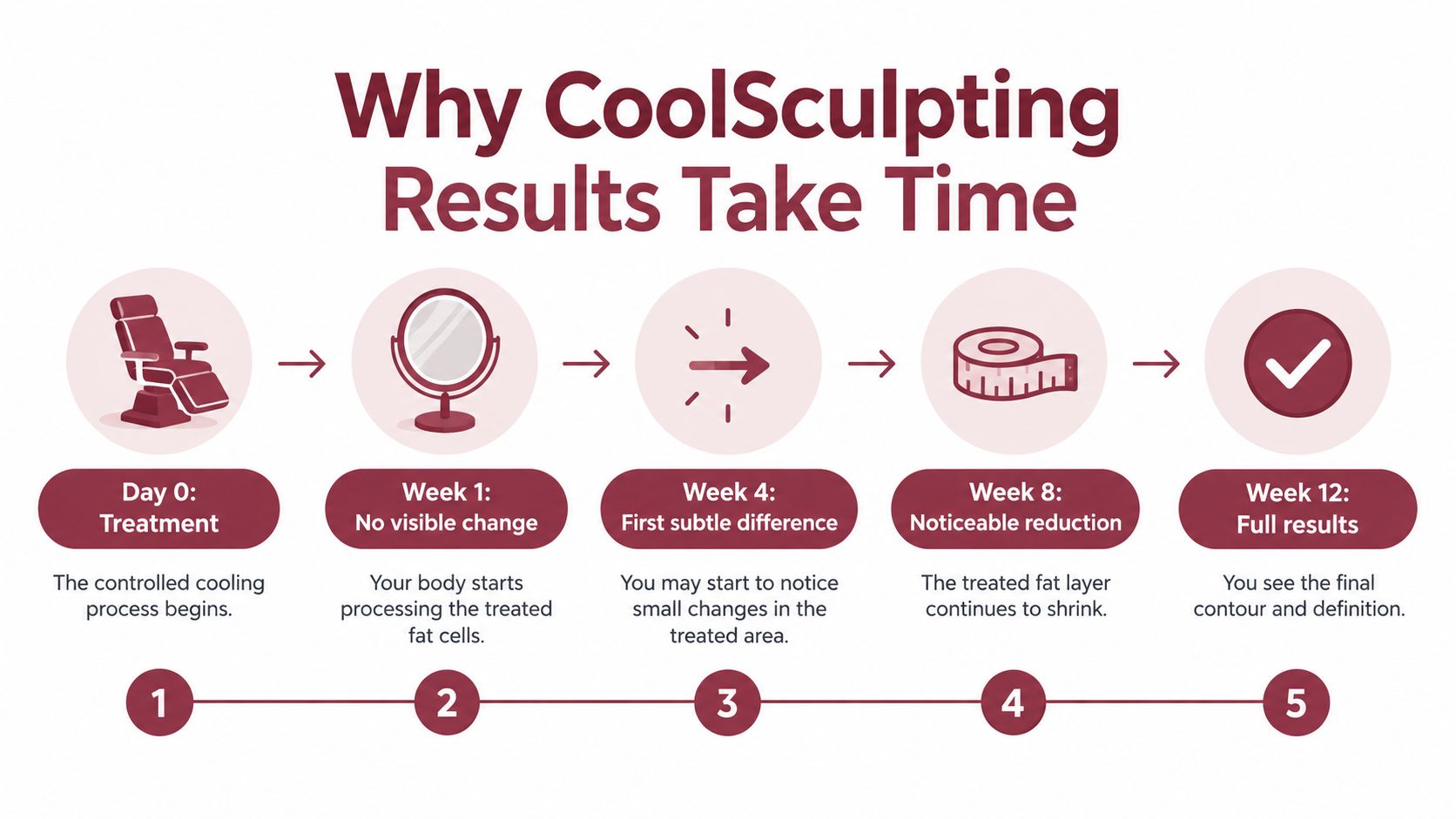
That staging also explains why day-to-day mirror checks are misleading. A change that's spread across weeks is hard to catch in real time because you adapt to your own reflection. Standardized photographs taken in the same light, posture, and clothing show gradual change far more reliably than memory does.
Practical rule: Treat the first visible change as progress, not as the endpoint. Early improvement doesn't mean the process has finished.
Patience here isn't a sales line. It's built into the mechanism itself. The fat cells affected by cooling still occupy space until your body processes them, and the surrounding tissue needs time to settle as that volume reduces. Once you understand that the calendar follows biology, the waiting period becomes easier to interpret and much less likely to feel like nothing is happening.
The Biology Behind the Timeline
Your body doesn't remove a treated fat cell the way you'd empty a drawer. It breaks the cell down gradually and carries the material away through normal clearance pathways. That slower, orderly process is the whole reason contour change unfolds over months instead of days.
Step One and Two, Cooling and Cell Injury
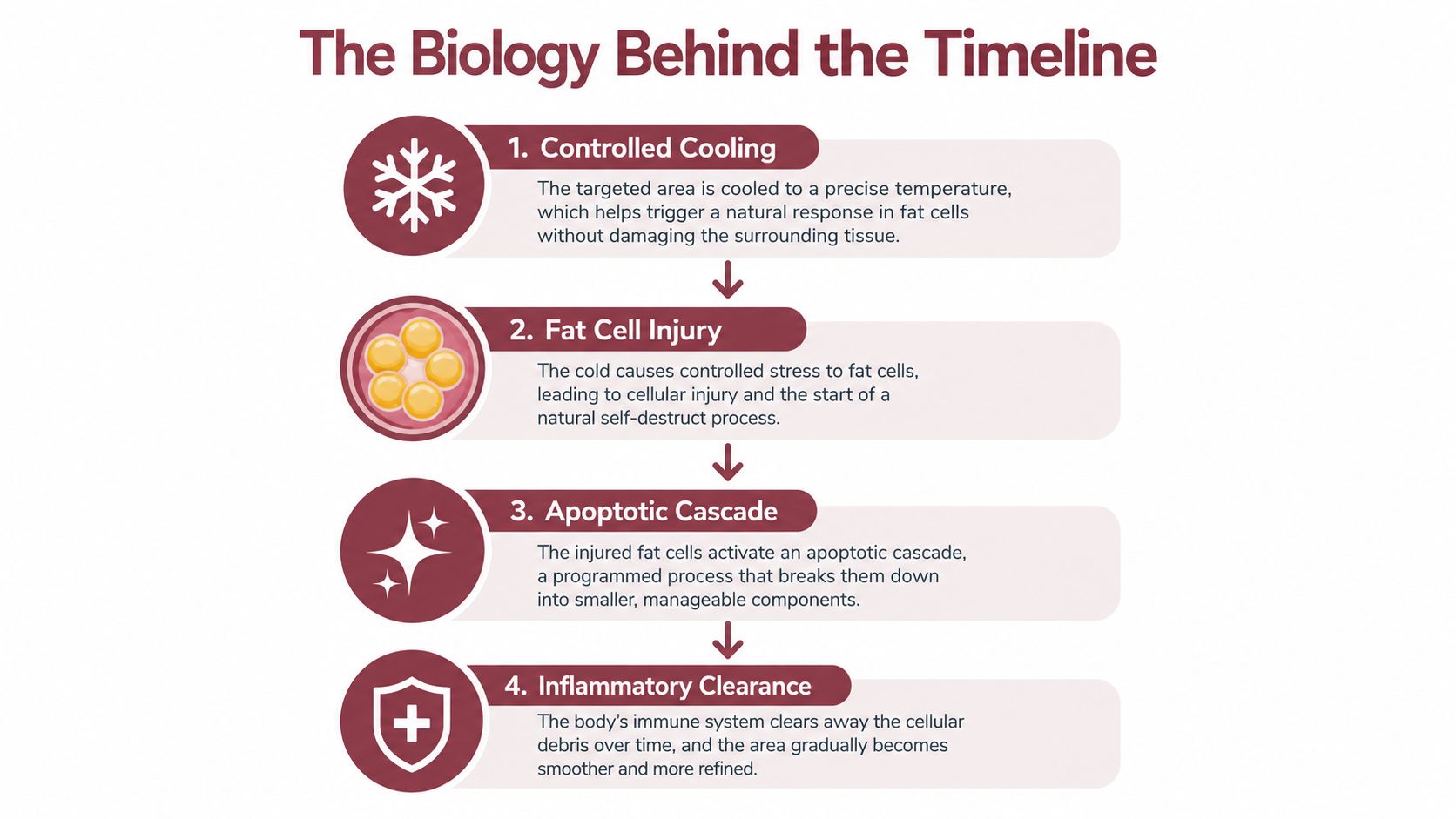
During treatment, an applicator delivers controlled cooling to a defined pocket of subcutaneous fat. Fat cells are susceptible to that cold exposure, so the cooling injures them while the treatment is designed to target that tissue layer. The skin surface may feel numb afterward, but the important event is happening below it.
Once injured, those fat cells begin apoptosis, a regulated form of cell death. The cell doesn't vanish at that point. It loses its ability to function normally and becomes material your body needs to clear, which is why the treated area doesn't instantly shrink when the applicator comes off.
Step Three and Four, Inflammation and Clearance
Your immune system responds to the injured cells with a localized inflammatory response. Immune cells called macrophages move in, engulf damaged cell material, and progressively clear it. You may experience that phase as swelling, tenderness, firmness, or numbness, all of which can temporarily hide any slimming underneath.
A clinical review of cryolipolysis histology and fat cell clearance indicates that clearance of damaged adipocytes develops over several weeks and is largely established by approximately 3 months after cryolipolysis. That single fact makes the calendar intuitive. If clearance itself takes weeks to become established, visible contour change can't be immediate.
- Cooling: Fat cells in the treatment area are exposed to controlled cold.
- Injury: Susceptible cells are damaged and begin breaking down.
- Clearance: Macrophages progressively remove the damaged material.
- Remodeling: The tissue settles as volume reduces and inflammation resolves.
It's also why the area can feel odd before it looks different. Numbness or tenderness reflects tissue response, not fat reduction you can measure. Some people feel discouraged because sensation changes arrive quickly while shape changes lag behind. Those two timelines run on different tracks.
Sensation is not a progress meter. Feeling numb, firm, or tender tells you tissue reacted, but it doesn't tell you how much contour change you'll ultimately see.
As inflammation settles and cleared volume no longer takes up space, the treated area can look flatter or less prominent. That transition is gradual because each step depends on the one before it. Cooling starts the sequence, your biology finishes it, and the mirror only catches up near the end of that chain.
A Week-by-Week Timeline of What to Expect
Calendars help because vague advice to wait several months leaves you guessing in between. The windows below aren't guarantees, and your experience may sit earlier or later within them. They give you a sensible way to place what you're seeing and feeling right now.
The First Days Through Week Four
In the first few days, expect the treated area to look unchanged or slightly fuller. Swelling, tenderness, and altered sensation are common parts of the early tissue response, so a waistband feeling snug at this stage doesn't mean treatment failed. Photos taken now are useful mainly as a record, not as evidence of outcome.
During weeks two to four, swelling generally begins to settle and the earliest contour softening may become apparent. This is often when people start comparing sides or pinching the area repeatedly. Resist drawing conclusions from touch alone, since firmness and numbness can linger while clearance is still underway.
- Days 1 to 7: Prioritize comfort and note any symptoms rather than measuring for change.
- Weeks 2 to 4: Watch for swelling to ease, and compare photos only under consistent conditions.
- By about 3 weeks: Some patients begin noticing the first visible difference, as covered earlier.
- At 4 weeks: A lack of obvious change is still compatible with a developing result.
Weeks Six Through Month Six
The six to eight week window is when measurement often becomes more informative than casual observation. Clothing may sit differently, and a tape measure placed at the same landmark can register change before your eye trusts it. Consistency matters more than frequency, so measure at the same time of day and in the same position.
Clinical measurement data on fat volume change after cryolipolysis show mean fat volume reductions of 149.1 mL at 8 weeks and 264.8 mL at 12 weeks after the final treatment. Those are study averages with substantial individual variation, not amounts you should expect to reproduce. Their value is showing that measurable change can grow between those two checkpoints.
A useful checkpoint habit: Photograph and measure at baseline, again around 8 to 12 weeks, and again near 6 months instead of checking daily.
Around three months, many practices schedule a formal review because the response is developed enough to assess and discuss whether another session makes sense. From four to six months, refinement may continue as remaining clearance and tissue settling complete. If your three month result looks good but not finished, that doesn't automatically mean you need more treatment. It may mean your final assessment date hasn't arrived yet.
Factors That Change How Soon and How Much
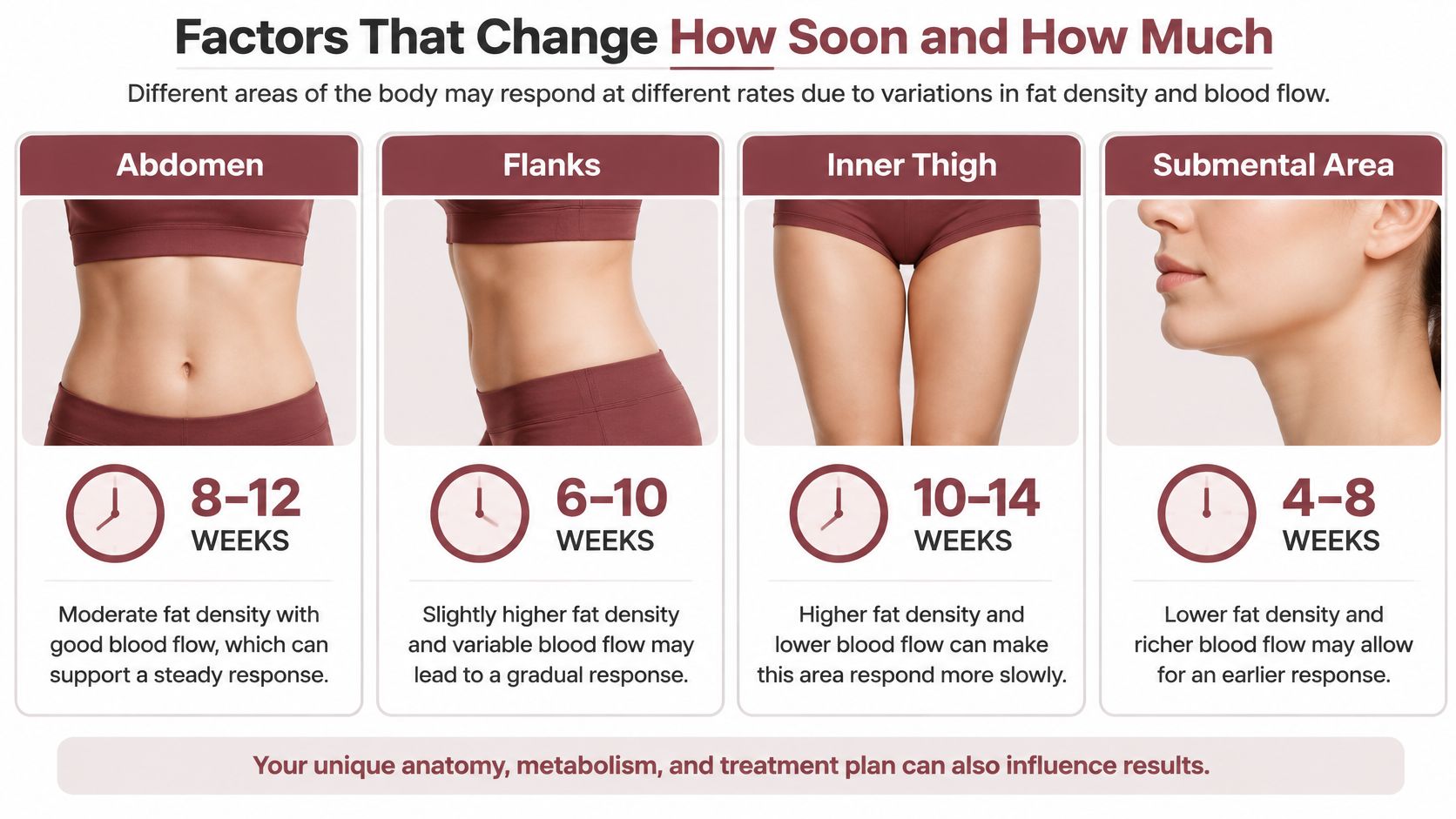
Two people can be treated on the same day and compare notes at week eight with very different stories. That doesn't necessarily mean one treatment worked and the other didn't. Anatomy, treatment planning, and the specific area involved all shift both the pace and the degree of change.
Body Region and Baseline Fat
A 2025 systematic review and meta-analysis of cryolipolysis outcomes across body regions covering 30 studies and 3,158 participants found measurable reductions in several adiposity outcomes at approximately 3 months, but evidence was heterogeneous and benefits varied by body region. That variability is a core finding, not a footnote.
A thicker, well-defined fat pocket gives the applicator more tissue to draw in and treat, while a thinner or more diffuse layer may produce subtler change. Areas also differ in shape, tissue firmness, and how easily a contour difference shows in clothing. If you're weighing which areas fit this treatment, reviewing the range of CoolSculpting treatment areas helps you see why one-size timelines don't apply across the body.
Applicator Fit, Placement, and Your Habits
Applicator fit matters because cooling has to reach the intended tissue evenly. A pocket that matches the applicator shape well may respond differently from one that sits at an awkward angle or extends beyond the treatment zone. Placement decisions made during planning therefore influence the result months later, even though you can't feel that effect directly.
- Baseline fat thickness: More treatable volume can make change easier to see, though it may also mean a plan needs more than one session.
- Number of cycles: Coverage across a larger area affects how uniform the contour change appears.
- Weight stability: Gaining weight during the waiting period can enlarge remaining fat cells and mask localized reduction.
- Comparison habits: Different lighting, posture, or bloating can make identical contours look like different results.
Age and general metabolic differences can also influence how tissue responds and settles, but they don't give you a formula for predicting your exact week of visible change. Be cautious with anyone who promises a precise date. Honest planning uses ranges and checkpoints.
Social media comparisons distort this further. A stranger's reveal photo rarely shows their starting fat thickness, number of cycles, weight changes, or how many months passed between images. Use your own baseline photos as the reference point. They're the only comparison that holds the important variables reasonably constant.
Single Sessions, Multiple Cycles, and Final Assessment
A single session and a multi-session plan run on different clocks, and mixing them up causes a lot of unnecessary disappointment. Your assessment milestones should be counted from your final treatment in a series, not automatically from your first appointment. That distinction can shift your expected timeline by weeks.
Why Sessions Are Spaced Apart
Earlier clinical research on fat layer reduction and session spacing reported approximately 20.4% reduction in the treated fat layer at 2 months and 25.5% at 6 months after one treatment, with sessions commonly separated by several weeks. Spacing isn't idle waiting. It lets inflammation settle so your provider can judge the actual response before deciding whether more treatment is warranted.
Stacking another session too early creates a measurement problem. If the first response hasn't declared itself, neither you nor your provider can tell how much additional reduction is still coming. Waiting protects you from treating an area that's already on track and from misreading temporary fullness as untreated fat.
| Milestone | Typical Change Reported | Individual Variability |
|---|---|---|
| 2 months after one treatment | Approximately 20.4% reduction in the treated fat layer in earlier clinical research | Response varies by area, baseline fat, and applicator placement |
| 6 months after one treatment | Approximately 25.5% reduction in that same research | Some patients plateau earlier, others refine longer |
| After a final session in a series | Assessment windows restart from that last treatment date | Total change depends on cycles completed and tissue response |
How Plans Differ in Practice
A smaller, well-defined pocket may be addressed in one session, with your review a few months later confirming whether you're satisfied. A larger area or a more substantial reduction goal may call for additional cycles, each followed by its own clearance period. If you're deciding between those paths, guidance on how many CoolSculpting treatments you may need can help you frame questions for a consultation.
Count your milestones from the last session in your plan. Counting from the first appointment almost guarantees you'll judge the result too early.
Final assessment is a judgment about contour, not just a date. At that visit, standardized photos, measurements, and your own sense of how the area looks in clothing all count. A good outcome on paper that still bothers you in a fitted dress or shirt deserves discussion. Equally, a modest measurement change that visibly smooths a bulge may fully meet your goal.
Common Misconceptions About CoolSculpting Timing
Most disappointment with timing comes from expectations that were wrong at the start, not from treatments that did nothing. Clearing up four persistent misconceptions will do more for your satisfaction than any amount of mirror checking. Each one distorts how you interpret the weeks after treatment.
It Should Be Visible Right Away, and Bigger Means Worse
Because many aesthetic treatments show something immediately, people assume CoolSculpting will too. It can't, for the biological reasons already described. The treated cells remain in place until clearance progresses, so an unchanged mirror image in week one carries no information about your final result.
Cleveland Clinic's explanation of CoolSculpting side effects and early inflammation notes that temporary inflammation can make the treated area appear fuller immediately after treatment, which may obscure early slimming and lead patients to misjudge early progress. Looking slightly larger early on is therefore compatible with a normal response. It feels backwards, but it isn't evidence that fat increased.
The Scale Will Prove It Worked
CoolSculpting is localized contouring, not weight loss. It reduces fat in a treated pocket, which may change how a waistband fits without moving your total body weight in any noticeable way. Judging it by the scale sets a test the treatment was never designed to pass.
That distinction between measurement and weight confuses people in fitness contexts too, and this muscle vs fat progress guide explains why inches and scale readings can move independently. For CoolSculpting, circumference and photos of the treated area are the meaningful measures. Your bathroom scale can't isolate one flank or one section of abdomen.
- Symmetry is guaranteed: It isn't. Most bodies start slightly asymmetric, and each side can respond on its own schedule.
- One session always finishes the job: Some areas and goals need additional cycles, decided after the first response is assessed.
- No change at 12 weeks means failure: Response varies by region and plan, so a later review may be appropriate before concluding anything.
- Longer waiting means fat keeps disappearing indefinitely: Continued refinement has limits, and waiting longer shouldn't be presented as proof of ongoing fat loss.
Curated before and after images feed all four misconceptions at once. They compress months into a swipe and rarely disclose session counts or starting anatomy. Keep your own dated photos, use the checkpoint schedule, and let your six month comparison carry more weight than anyone else's highlight reel.
Follow-Up, Red Flags, and Setting Real Expectations
A structured follow-up plan turns months of waiting into a series of small, answerable questions. You don't need to monitor constantly. You need consistent records at the right intervals and a clear sense of which changes deserve a phone call.
A Simple Self-Monitoring Routine
Take baseline photos before treatment from the front, side, and back where relevant, in the same light and underwear or fitted clothing each time. Add a circumference measurement at a fixed landmark, such as the navel line for abdominal treatment. Repeat both around 8 to 12 weeks and again near 6 months.
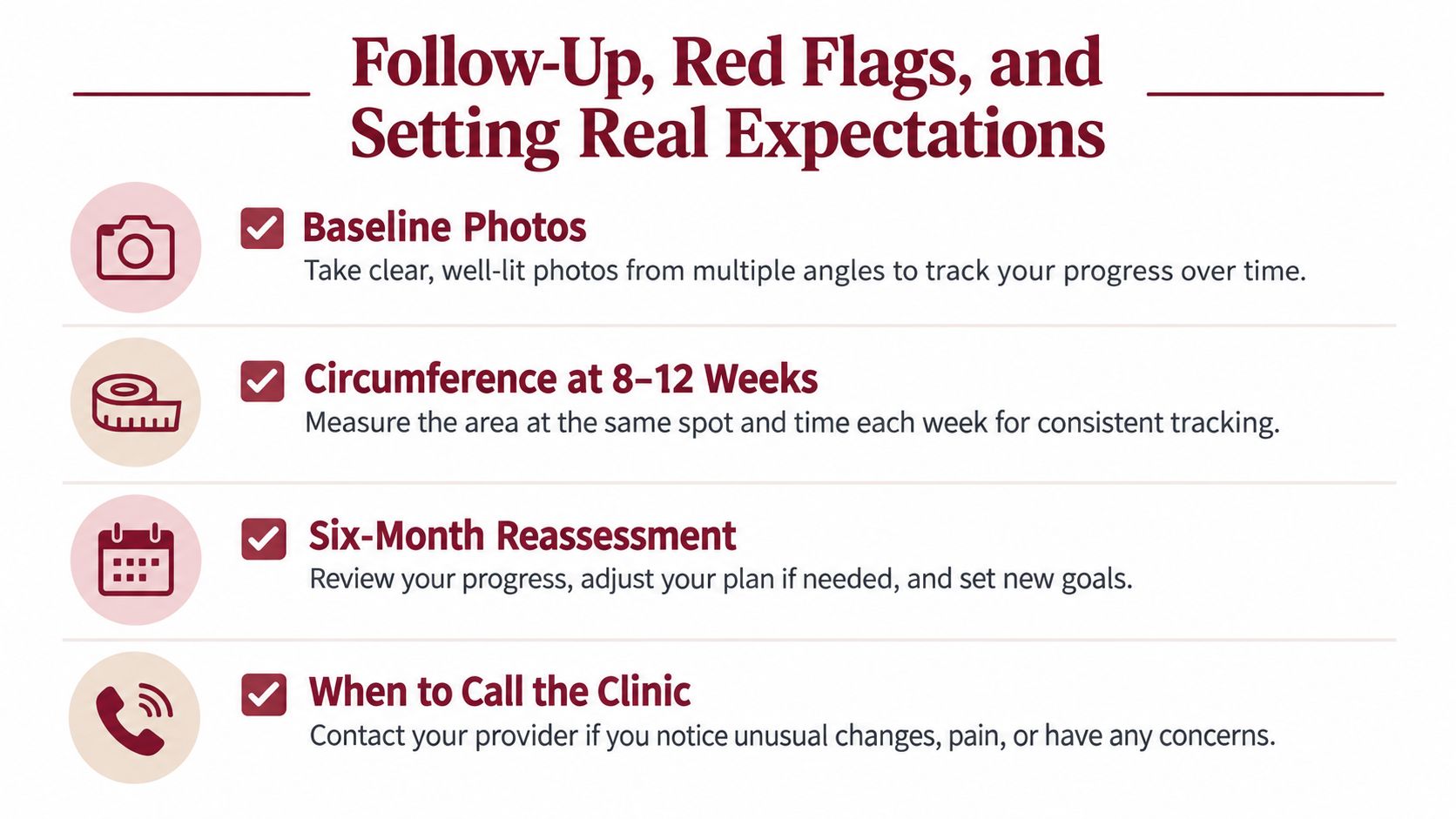
Write down anything unusual with dates rather than relying on memory. Note when numbness fades, when tenderness resolves, and whether the area feels softer or firmer over time. That record makes any follow-up conversation far more productive.
When Enlargement Needs Medical Assessment
One rare outcome deserves specific awareness. Paradoxical adipose hyperplasia, or PAH, is a delayed enlargement of the treated area rather than ordinary early swelling. A literature review of PAH incidence and management timing citing a multicenter study of 2,114 patients and 8,658 treatment cycles reported PAH rates of 0.05% to 0.39%, with management generally delayed until the affected area softens, typically within 6 to 8 months.
Timing is the key distinction. Normal swelling appears early and recedes, while concerning enlargement persists or develops after routine recovery should have finished. If a treated area becomes progressively larger and firm months later, document it with standardized photos and contact your treating practice for evaluation. You can also read more detail on PAH after CoolSculpting to understand how it differs from expected inflammation.
At Spa Black in San Antonio, as at any responsible practice, that kind of delayed change warrants in-person assessment rather than another treatment session booked on assumption. PAH is uncommon, and knowing about it isn't a reason for alarm. It's a reason to keep dated records and to treat persistent, progressive enlargement as a medical question instead of something to wait out.
Real expectations hold all of this together. Expect gradual, localized contour change measured in months, judged by photos and circumference rather than weight, with individual variation by area and treatment plan. That framing won't make results arrive faster, but it will let you recognize them accurately when they do.
If you're mapping out how long does CoolSculpting take to work for a specific area you're considering, a consultation at Spa Black Med Spa can translate these general milestones into a timeline based on your anatomy, treatment area, and whether a single session or a series fits your goals. You'll leave with clear photo and follow-up checkpoints and honest guidance on what change is realistic for you. Visit Spa Black to book your consultation and start with a plan built around your own timeline.