


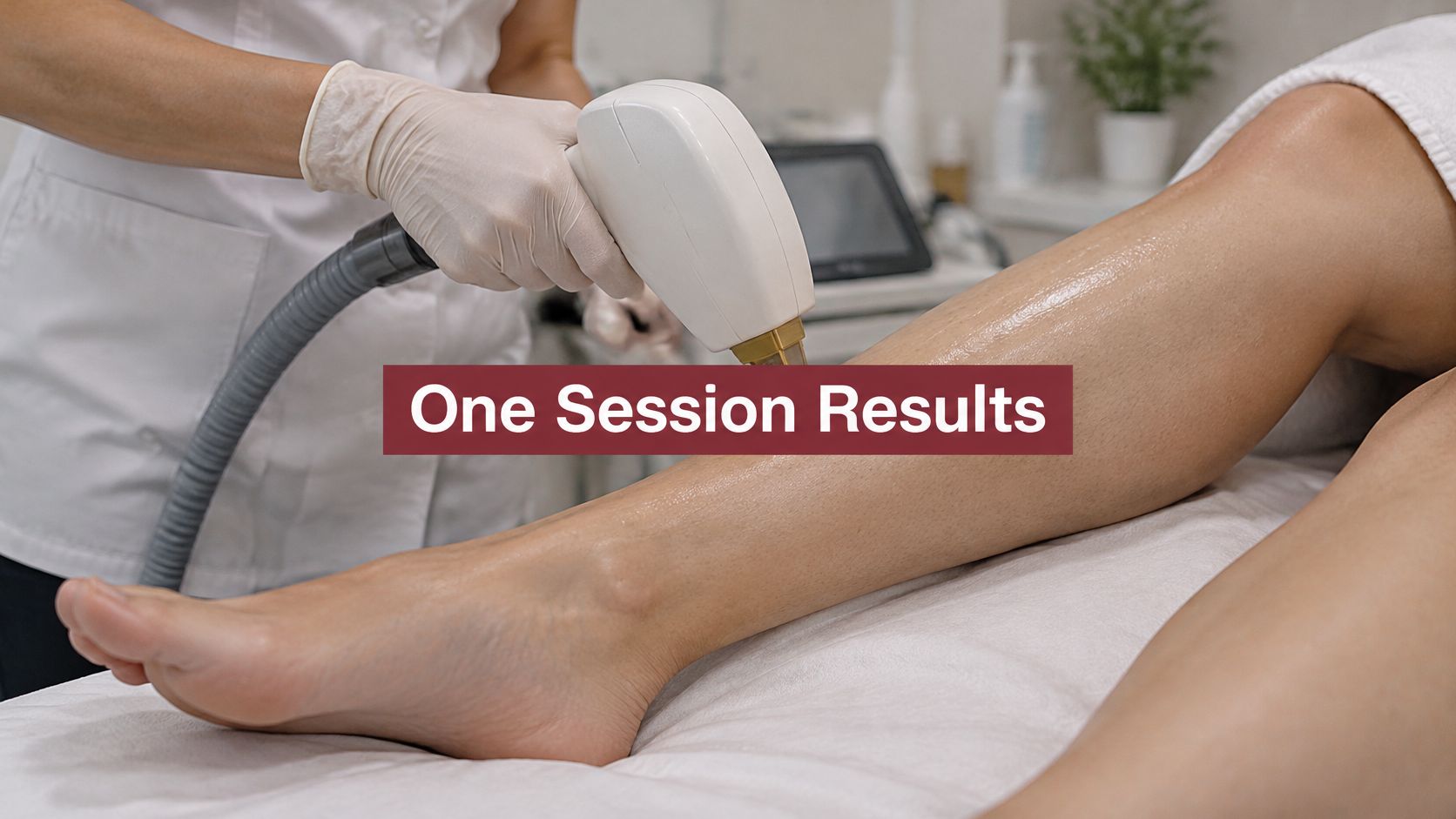
If hair is still visible the morning after treatment, does that mean the laser didn't work? That question exposes the gap in how laser hair removal results after one session are usually judged. What you see immediately, what sheds later, and what regrows over time are three different things, and only the last two tell you whether that first visit did anything useful.
Table of Contents
- What One Laser Session Can Realistically Show
- How Laser Hair Removal Targets Active Follicles
- Expected Hair Reduction After One Treatment
- Track Your Results Through the Shedding Timeline
- Factors That Change Your One-Session Outcome
- Normal Reactions and Warning Signs to Watch For
- Plan the Next Step for Better Long-Term Reduction
What One Laser Session Can Realistically Show
You're home from your appointment, you run a hand over the treated area, and there's stubble. It feels almost unchanged. Maybe one patch looks a little clearer while another looks exactly as it did that morning. It's easy to decide, in that moment, that nothing happened.
That conclusion is premature. A first session can affect the follicles that were responsive on that day, but it can't reach every follicle in the area at once. The hairs you can still see may not have shed yet, or they may belong to follicles that weren't in a responsive phase when the laser fired. Neither possibility automatically means failure.
Think of session one as an early checkpoint, not a finished result. For many people at Spa Black in San Antonio, the most accurate expectation after that first visit is slower growth, patchiness, or reduced density in responsive areas, rather than complete smoothness.
What Counts as a Real Change
You're looking for changes in regrowth, not an instantly bare surface. Useful early signs include the following patterns.
- Slower return: Hair takes longer to become noticeable than it did before treatment.
- Uneven density: Some patches look thinner while others look unchanged, which fits how follicles cycle independently.
- Finer texture: Regrowth in responsive spots may feel softer or look less coarse than your baseline.
If the area isn't completely smooth after one visit, that alone doesn't tell you the session failed. It tells you the process isn't finished.
Two people can have the same treatment on the same day and notice different things. One sees obvious thinning in a few weeks. The other sees little change at first and only notices slower regrowth later. Hair thickness, pigmentation, body location, treatment settings, and timing within the growth cycle all shape what's visible and when.
That's why judging laser hair removal results after one session by the mirror on day one misleads you. The fair test is whether density and regrowth behavior change over the following weeks compared with where you started. Everything that follows in this guide builds on that one distinction, starting with the biology that makes a partial, patchy first result the normal outcome rather than a disappointing exception.
How Laser Hair Removal Targets Active Follicles
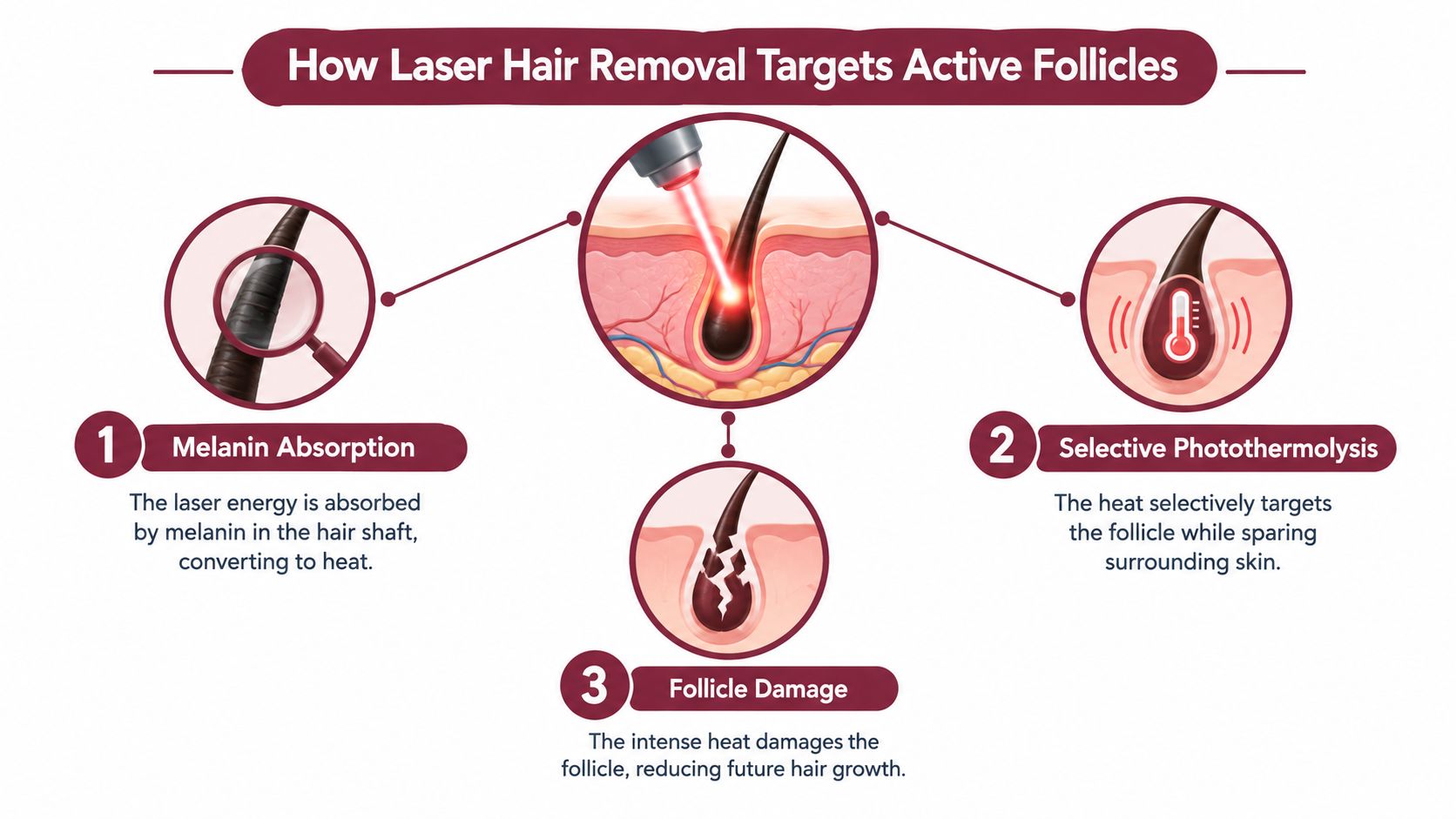
Start with what the laser does. The mechanism is called selective photothermolysis. Laser energy is absorbed primarily by melanin, the pigment in the hair shaft and follicular structures, and that absorbed energy heats the follicle as an NIH reviewed clinical summary of the mechanism explains. The goal is to damage the follicle's ability to produce hair while limiting injury to surrounding skin.
Pigment is the target, so pigment is also the limitation. A follicle with a dark, actively growing hair gives the laser a strong signal to lock onto. A follicle with little pigment activity gives it far less to work with.
The Three Growth Phases
Every follicle cycles through the same three stages, but not on the same schedule as its neighbors.
- Anagen: The active growth phase. The hair is connected to the follicle and contains more active pigment, so it's the most responsive to treatment.
- Catagen: A transitional phase when growth winds down and pigment activity drops.
- Telogen: A resting phase. The old hair may shed, and the follicle waits before starting a new cycle.
Laser energy is most effective when follicles are in anagen, and because follicles cycle through anagen, catagen, and telogen independently, a single treatment cannot target every follicle at the same time as clinical guidance on the hair growth cycle describes.
A Partial Coverage Analogy
Imagine a field of small lights, where only some are switched on at any moment. The laser responds to the lights that are on. The ones that are dim or off that day aren't broken or immune. They're not sending a strong enough signal yet, and some of them will switch on later.
That analogy explains three things you'll see after one visit. Treated anagen hairs may shed over the following days or weeks. Quiet follicles may stay quiet for a while and then produce hair that looks like new growth. Follicles in between may respond weakly and regrow more slowly or more finely than before.
Practical rule: Regrowth after one session often comes from follicles that weren't treatable that day, not from follicles the laser treated and missed.
This is also why dark, coarse terminal hairs generally respond more readily than fine or lightly pigmented hairs. More pigment means a stronger target. It doesn't mean fine hair never responds. It means the signal is weaker, so early change can be subtler and easier to overlook.
Once you understand partial coverage, the percentages in the next section make sense. A single session was never positioned to clear an area. It was positioned to affect one cohort of follicles, the ones in active growth, while the rest wait for a later visit.
Expected Hair Reduction After One Treatment
How much hair will one laser session reduce? Published estimates range from modest to substantial, because the result depends on how and when hair is counted, as well as the treatment settings and body area.
An NIH-reviewed clinical summary reports approximately 10% to 40% reduction after one treatment. It also describes higher outcomes after repeated treatments, in its review of single-session and repeated-treatment results. Cleveland Clinic's patient guidance gives a narrower estimate of approximately 10% to 25% less hair growth after the first treatment.
A dermatology reference estimates approximately 20% reduction per appropriately performed treatment, when the targeted hairs are in the active growth phase and treatment settings are suitable, as described in its clinical overview. Use that as a broad reference point, not as a promise that one-fifth of visible hair will disappear permanently after one visit.
Published One-Session Benchmarks
| Evidence Source | Reported One-Session Result | Important Context |
|---|---|---|
| NIH-reviewed clinical summary | Approximately 10% to 40% reduction after one treatment | A broad range across patients and settings; higher outcomes are reported after repeated treatments |
| Cleveland Clinic patient guidance | Approximately 10% to 25% less growth after the first treatment | Describes the range reported in the source, not a guaranteed individual result |
| Ruby laser clinical evidence review | Mean reduction of about 20% at three months, 35% at six months, 42% at nine months, and 41% at twelve months after one treatment, as summarized in an evidence-based review of ruby laser outcomes | Device-specific data from an older ruby laser; results may not transfer to other systems |
The ruby laser results show why timing matters: a reduction measured months later can appear greater than an early measurement. Shedding and delayed regrowth change what is visible, while follicles that were outside the active growth phase can produce hair later. The same review reports a separate study in which every participant had less than 25% reduction after one treatment, illustrating how individual outcomes can differ from a group average.
Use these figures as reference points, not as a personal forecast. The device, treatment area, growth cycle, and measurement date all shape the result. For broader patient education before a consultation, browse Longevity Medical Institute's skin hair aesthetic guide collection.
A useful first-session comparison is the treated area's hair density and texture at the same location and a consistent interval after treatment. A percentage without that context can be misleading. Cleveland Clinic's patient guidance, cited above, also helps set expectations for how results develop.
Track Your Results Through the Shedding Timeline
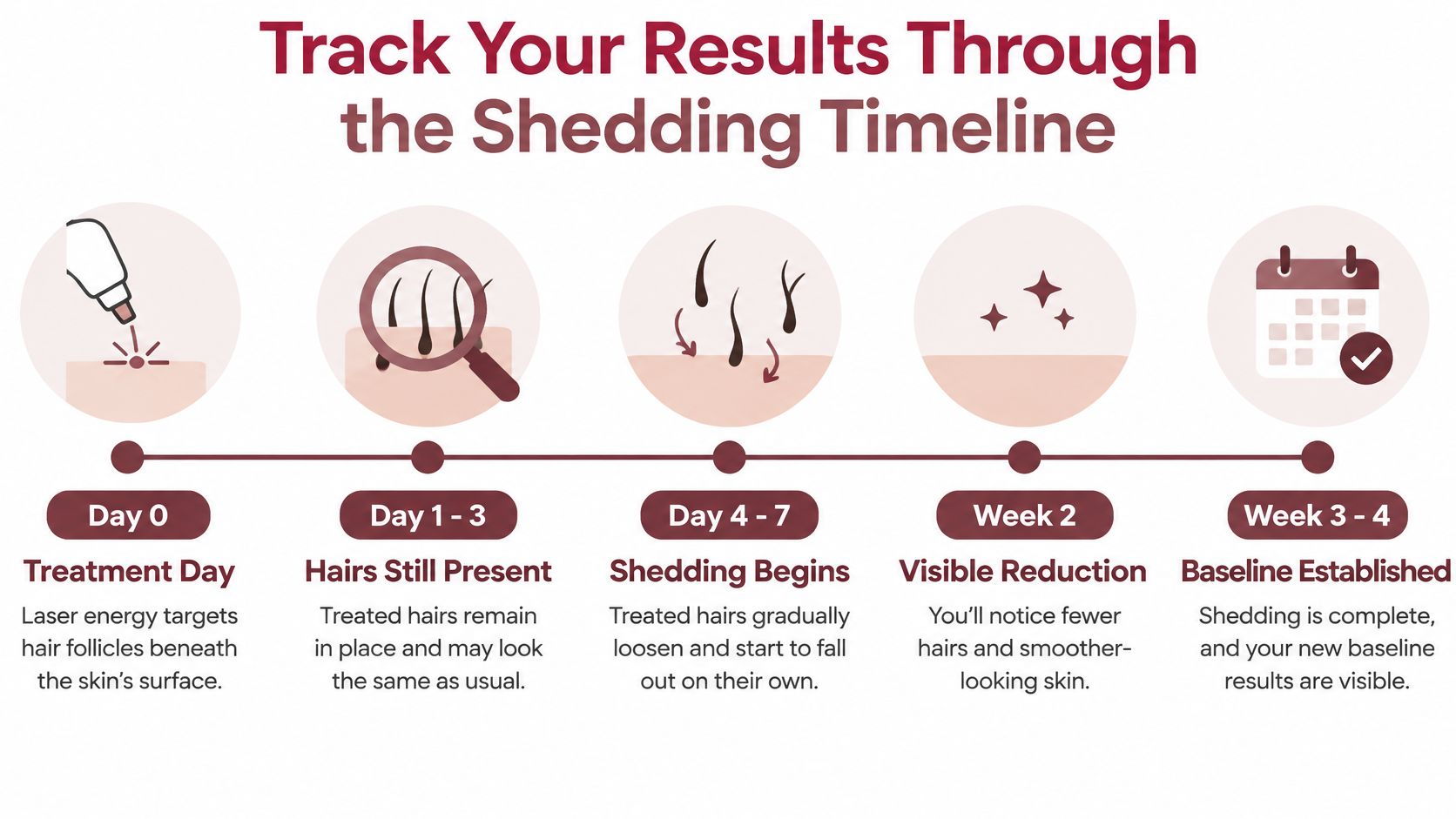
Treated hairs don't vanish during the appointment. Many remain in the follicle for a while and then work their way out. If you check daily, you'll mostly watch that slow exit and mistake it for regrowth. A simple checkpoint routine gives you cleaner information.
The First Days After Treatment
Expect the area to look largely unchanged at first. Hairs that absorbed energy are still physically present, so density can look identical to your pre treatment baseline. Some hairs may even look more noticeable against temporarily reddened skin. None of that measures your result yet.
Resist pulling at hairs to test whether they're loose. You'll learn nothing reliable, and you'll irritate skin that's already been heated. Shaving between sessions is a separate question to confirm with your provider, but tugging and picking help no one.
Shedding Over the Following Weeks
Over the following days or weeks, treated hairs commonly shed, and density in responsive patches starts to look lower. At the same time, follicles that weren't in anagen during your session keep doing their job. So you can see shedding and fresh growth in the same week, side by side. That's not the treatment working and failing simultaneously. It's two different follicle groups on two different schedules.
Timing also depends on where you were treated. Facial hair has an approximately 6 month growth cycle, axillary hair about 7 months, and leg hair about 1 year, according to clinical guidance on site specific growth cycles. A leg and an upper lip won't reveal change on the same timetable, which is one reason follow up timing matters.
A Simple Tracking Routine
- Photograph the same spot: Use the same lighting, distance, and angle each time so comparisons are fair.
- Pick set checkpoints: Compare at planned intervals instead of inspecting the area every morning.
- Note texture and speed: Record whether regrowth feels finer or returns more slowly, not just whether it exists.
- Assess at a defined follow up: A structured review around 3 to 6 months can be more informative than judging results immediately, using standardized photographs or hair counts as a clinical evidence review of single session follow up suggests.
That window isn't a universal clinical rule, and your provider may schedule reviews differently. The point is consistency. When you compare like with like, laser hair removal results after one session stop being a guessing game and become something you can document and discuss.
Factors That Change Your One-Session Outcome
A first session treats only the follicles that are in a responsive growth phase at that time. The visible result also depends on the hair, treatment area, skin tone, device settings, and individual biology. These factors help explain why early change can be clear in one area and subtle in another.
| Factor | May support a clearer early response | May make early change subtler |
|---|---|---|
| Hair color and thickness | Darker, coarser hair offers more pigment for the laser to target | Fine or lightly pigmented hair provides a weaker target |
| Body site and growth timing | More follicles may be active during the treatment window | Different areas cycle on different schedules |
| Skin tone | Settings can be tailored to the person's skin and hair | Settings may need adjustment to manage heat reaching surrounding skin |
| Laser parameters | Wavelength, energy, pulse duration, spot size, and cooling suit the treatment area and patient | Mismatched or overly conservative settings may reduce the follicle's exposure to heat |
| Hormonal influences | A stable hormonal environment may support steadier patterns | Hormonal changes can stimulate new hair growth |
| Treatment timing | Follow-up sessions can target follicles as new groups enter an active phase | Irregular timing may miss those changing growth phases |
Dark, coarse hair generally gives the laser more pigment to target than fine or lightly colored hair. Skin tone also affects how a provider chooses settings, since the aim is to heat the follicle while limiting the effect on surrounding skin, as the NIH clinical summary of treatment variables cited earlier explains. For guidance on questions to ask about device choice and settings, see this overview of safe laser hair removal for Black skin.
Why Body Site Changes the Story
The same session can produce different-looking results on different body areas because follicles do not all follow the same schedule. Consistent with the growth cycle differences described earlier in this guide, long-term evidence across treatment courses has found that reduction can vary by site. A subtle early response on the face does not predict the result on the legs, or vice versa.
Device settings shape the treatment too. Wavelength, energy, pulse duration, spot size, and cooling affect how heat reaches the follicle. Results from one device or set of settings cannot automatically predict how another treatment will work for your hair and skin.
Bring your questions about hair thickness, treatment area, skin tone, and hormonal history to the consultation. They help your provider explain what may affect your first-session response and how follow-up timing can account for your growth cycle.
Normal Reactions and Warning Signs to Watch For
Some temporary change after treatment is expected. The skill is telling ordinary post treatment effects apart from changes your provider should hear about. When in doubt, reporting early beats waiting and worrying.
Changes That Are Usually Part of the Process
Mild redness, sensitivity, swelling, or a feeling of warmth in the treated area can follow a session, since the follicle and surrounding tissue have absorbed heat. Visible stubble during the shedding phase also belongs in this category. Hair that's still present, or regrowth that looks patchy, isn't necessarily abnormal in the first weeks.
Keep your response simple during this period.
- Leave the area alone: Avoid picking at shedding hairs or scrubbing irritated skin.
- Watch the trend: Temporary effects should ease rather than steadily intensify.
- Follow your aftercare instructions: Use the specific guidance your treating provider gave you, not generic advice from social media.
Signs That Deserve a Call
Contact your treating provider if discomfort escalates instead of settling, or if you notice blistering or anything that looks like a burn. Those changes sit outside the expected pattern and warrant direct review. For a fuller discussion of delayed and less common effects, this guide to laser hair removal long term side effects is worth reading before your next session.
One uncommon reaction deserves specific mention. Paradoxical hypertrichosis is unexpected increased or denser hair growth after laser or intense pulsed light treatment. A systematic review and meta analysis covering 9,733 patients estimated pooled prevalence at 3%, concentrated on the face and neck, with only 0.08% of non facial and neck cases affected according to that systematic review and meta analysis.
A separate 2024 study of 7,381 patients recorded the phenomenon in 25 patients, or 0.34%, and found no significant association with Fitzpatrick skin type, hormonal imbalance, or hormonal medication, while daily sun protection was associated with lower incidence. The evidence isn't definitive, which is exactly why progressive thickening, especially around the jawline, cheeks, and neck, should be reported and evaluated rather than panicked over or self treated.
Don't try to diagnose an unusual reaction yourself. Describe what changed, when it changed, and let the treating provider connect the dots.
Normal shedding looks like gradual thinning with some unevenness. A warning sign looks like escalation, injury, or growth that's clearly denser than your baseline. That distinction protects you from both false alarms and missed problems.
Plan the Next Step for Better Long-Term Reduction
The next appointment is timed around hair growth, not a calendar rule that applies to everyone. Laser energy affects follicles most effectively while they are in an active growth phase. Because hairs in one treatment area cycle at different times, follow-up sessions give newly active follicles another opportunity to respond.
Treatment-course guidance cited earlier describes multiple sessions, with spacing adjusted to the area and the person's response. Cleveland Clinic's patient guidance, cited in the reduction section above, describes most patients as needing about six to eight treatments. These figures are planning ranges, not a promise of a specific result or schedule. Your provider can help set timing based on the area treated and how your hair is changing. For more on how long to wait between laser hair removal sessions, see our guide.

Long-term reduction is assessed after a treatment course, not by judging the skin right after one visit. The FDA defines permanent hair reduction as a long-term, stable decrease in the number of hairs regrowing, measured six, nine, and twelve months after a treatment regimen is complete in its device submission. The term describes reduced regrowth, not a guarantee that every hair is gone forever. Some finer hairs may return, and maintenance treatments may be appropriate.
Your Next-Step Checklist
- Record your baseline: Photograph the area before the next session, using the same lighting and distance.
- Compare at planned checkpoints: Look for changes over time rather than checking day by day.
- Share changes with your provider: Report unexpected changes in hair growth or your skin's response.
- Review the schedule together: Discuss treatment settings, timing, and likely maintenance based on your progress.
One session is an early data point. A series allows the treatment to address follicles as they enter active growth at different times.
If you're weighing a first session or wondering whether your early result looks on track, Spa Black Med Spa offers laser hair removal consultations where your hair type, skin tone, treatment area, and session timing are reviewed before a plan is set. Bring your baseline photos and your questions about realistic reduction, and visit Spa Black to book a consultation in San Antonio and map out your next step.