


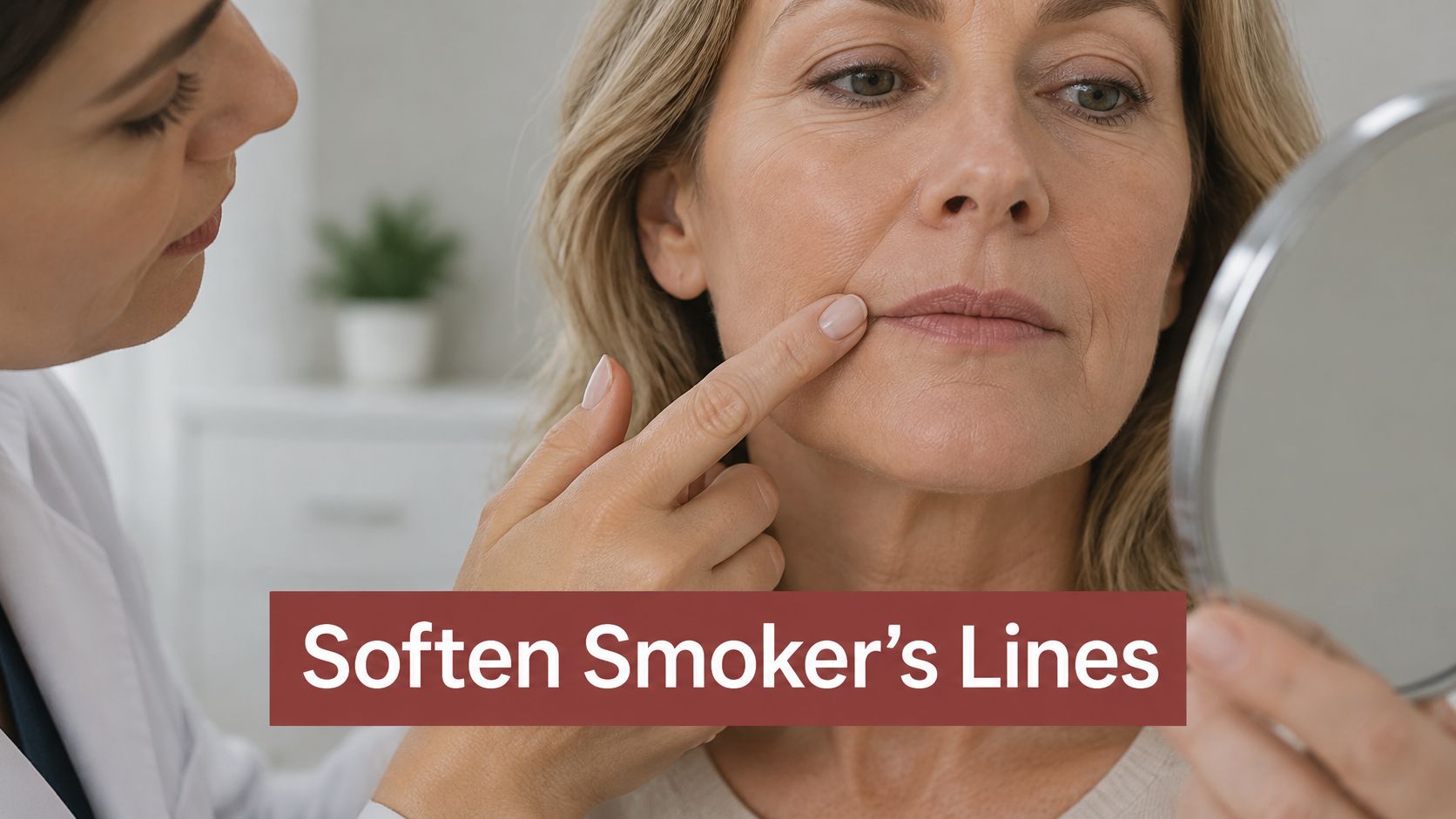
A study of 224 women aged 35 to 84 found visible signs of cigarette-related skin in 66 of 84 smokers and 27 of 140 nonsmokers. That is 78.6% of smokers compared with 19.3% of nonsmokers, a relative risk of 4.1, according to the summary of that observational work. The difference remained after researchers accounted for age and sun exposure. In the study, smokers aged 40 to 49 could have wrinkling similar to nonsmokers aged 60 to 69.
Smoke-related lines are a skin and tissue problem, and the plan starts with your smoking history. Lip fillers for smokers lines may be part of that plan, but active smoking also affects safety, consent, healing, and aftercare. Tell your clinician whether you smoke, vape, or use nicotine in another form. That disclosure helps them decide whether to proceed, adjust timing, or stage treatment. Filler can address some visible lines, but it cannot undo all smoke-related skin changes.
Table of Contents
- Which Smoker's Lines Lip Filler Can Soften
- Filler and Alternative Options Compared
- How Lip Filler Treatment Works Step by Step
- Smoking Risks and Warning Signs That Change the Plan
- Aftercare Timeline and Smoking Cessation Window
- Deciding Whether to Book Your Smoker-Line Treatment
Which Smoker's Lines Lip Filler Can Soften
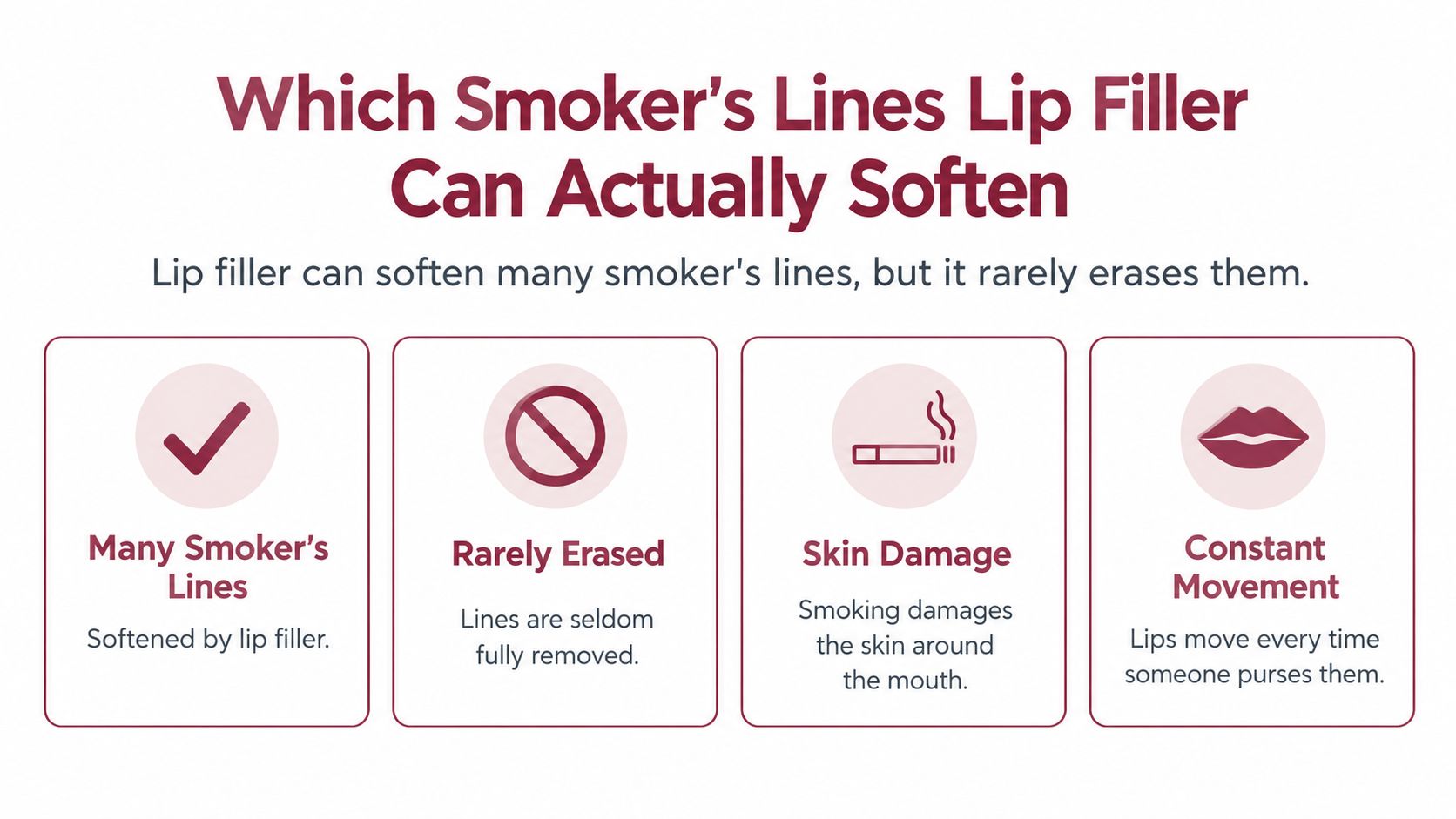
Lip filler can soften many smoker's lines, but it rarely erases them. The result depends on what is making each line visible: movement, changes in skin texture, or lost lip volume. A crease that looks mild in a still photo may reappear when you speak, sip, or smile.
Repeated pursing folds the skin along the same paths as the orbicularis oris muscle moves. Over time, collagen loss and smoke-related thinning can make those folds visible even when your mouth is at rest. Filler adds support beneath a crease, like padding beneath folded fabric. It can soften the line's appearance, though it cannot restore lost collagen or prevent the muscle from moving.
Match the pattern before you pick a product
| Line pattern | What drives it | Treatment role | Realistic expectation |
|---|---|---|---|
| Fine lines that show only when puckering | Repeated orbicularis oris movement | Softer hyaluronic acid can soften the crease | Softer at rest; movement lines may return |
| Etched vertical lines visible at rest | Skin thinning, collagen loss, and smoke-related damage | Filler softens but rarely erases; texture treatment may be added | Partial improvement; texture may need a separate plan |
| Lip flattening with lines | Volume loss in the lip body and border | Volume filler restores the lip border and supports the area | Fuller lip; lines look less pronounced |
| Deep lines with laxity or pigment change | Tissue quality plus sun and smoke damage | Filler-first is usually not the answer | Resurfacing or laser may suit better; satisfaction may be lower in smokers |
A clinical study of fractional Er:YAG laser treatment for wrinkles around the mouth and eyes found that treatment success decreased with smoking and increasing age. The same study linked smoking with patient satisfaction for periorbital wrinkles at P = .014. Both findings were reported in the Journal of Cosmetic Dermatology. The authors concluded that the 2940-nanometer fractional Er:YAG laser treated perioral and periorbital wrinkles with equal overall success. Smokers may still respond, while being less satisfied than nonsmokers. Set expectations around softening, not complete removal.
For etched texture, fractional CO2 laser skin resurfacing may be a more suitable partner than adding more filler. Your smoking history also affects the discussion: disclose whether you smoke, vape, or use nicotine so the clinician can assess the plan, risks, and consent with you.
Practical rule: Sort your lines into one row before you book, and bring photos of them at rest and while puckering.
Filler and Alternative Options Compared
The FDA lists absorbable dermal fillers for adults over 21 for moderate-to-severe facial wrinkles and folds, including perioral lines, the small wrinkles around the mouth and lips. This identifies a treatment category, not a personal recommendation. A clinician still needs to assess the lines, lip border, health history, and smoking habits before discussing an option. Active smoking belongs in that conversation because it can affect treatment risk, healing, and aftercare.
Hyaluronic acid is commonly used for lip and perioral treatment because it adds temporary volume and can soften lines. If a result is too full or develops a nodule, an appropriately trained clinician may use hyaluronidase to break down the filler. That gives this category a practical advantage when a treatment needs adjustment, though it does not remove the need to discuss risks before consent.
Six routes, not one syringe
| Option | Best suited for | Main trade-off | Reversibility |
|---|---|---|---|
| Softer hyaluronic acid fillers | Superficial vertical lines and fine softening | Limited volume; often needs repeat sessions | Dissolvable with hyaluronidase |
| Lip-focused hyaluronic acid | Lip border and body with perioral softening | Can feel firm if overfilled | Dissolvable with hyaluronidase |
| Lip enhancement treatment | Candidates seeking lip enhancement after assessment | Product fit must be confirmed at consultation | Not a substitute for line-filling HA; results vary and aren't permanent |
| Neuromodulator | Lines driven by repetitive pursing | No added volume; effect wears off over months | Temporary; not dissolvable |
| Microneedling | Texture and fine skin quality | Several sessions; discomfort expected | Gradual collagen remodeling, not instantly reversible |
| Fractional CO2 laser | Etched-in lines with texture change | Downtime; smokers may see lower satisfaction | Not reversible |
Each option addresses a different part of the problem. Softer gels are placed to soften the crease itself, while lip-focused gels support the border and body. Too much filler can make the upper lip feel stiff. A lip enhancement treatment may be discussed for lip tissue after an assessment, but it does not replace line-filling filler or surgery.
A neuromodulator can reduce repeated pursing, which may contribute to lines; a lip flip is another approach a clinician may discuss alongside filler. Microneedling works on skin texture through gradual collagen remodeling, so it generally involves more than one visit. Fractional CO2 laser treatment targets etched lines and texture, with downtime to consider.
These approaches may be combined when volume, movement, and surface texture all contribute to the concern. The comparison table cannot determine the right dose or treatment timing. For someone who smokes, disclose that exposure before choosing a procedure, so the clinician can weigh safety, healing, and whether to proceed now.
How Lip Filler Treatment Works Step by Step
The sequence below is the logic a careful visit follows. Your provider sets the exact product, numbing, and aliquot size. Small early asymmetries are common and should be judged at review, not on the treatment table.
Before the needle
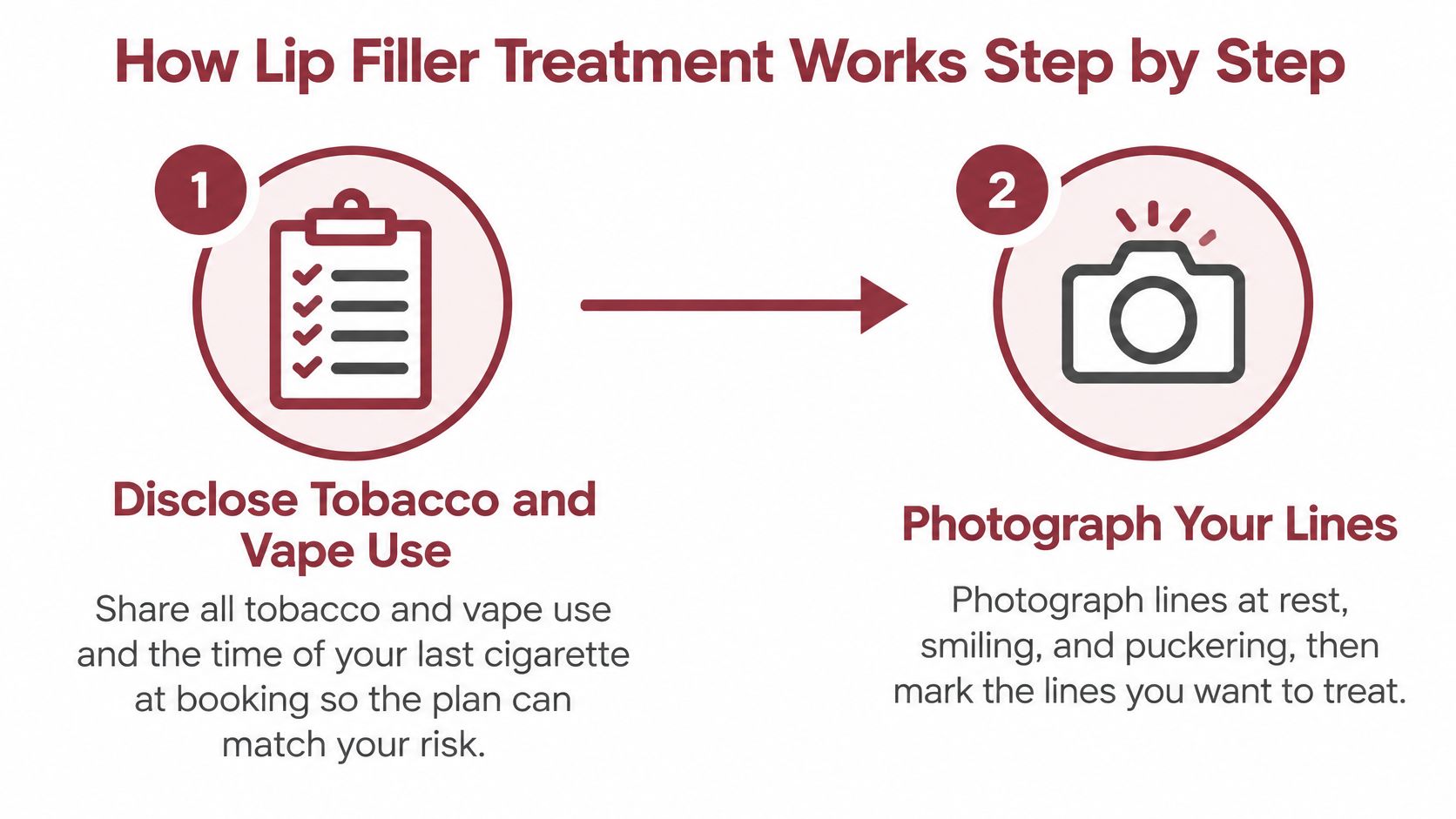
- Disclose every tobacco and vape exposure at booking, including the time of your last cigarette, nicotine replacement, and cannabis smoke. The plan has to match blood-flow and healing risk, and a hidden pack makes consent incomplete.
- Photograph the lines at rest, smiling, and puckering, then mark the ones you want treated. Memory is a poor map once swelling starts, and the three views stop you from chasing every crease.
- Choose product and plane together. Superficial vertical lines usually get a softer filler in the dermis or just beneath it, in small amounts, with a look after each pass instead of one large bolus.
- Cleanse the skin and numb as the provider prefers. Clean skin lowers infection risk, and numbing lets you stay still so placement stays precise.
During and right after injection
- Inject one line at a time and reassess. A single high-volume deposit is how an upper lip turns heavy. The goal is a softer crease, not a filled trench.
- Protect the white roll. Stacking product along the upper lip border creates a stiff, unnatural edge that makeup and speech both show.
- Check skin color after each pass. Blanching or a dusky tone means stop and escalate immediately. Color change is a circulation signal, not a bruise to watch at home.
- Massage only if the provider asks, then re-photograph under the same light. Unplanned rubbing can shift product you just placed with care.
- Book the review for after swelling settles, usually weeks rather than days. That visit is where you decide on a touch-up, not the evening of treatment.
Active inflammation, infection, or skin that isn't healing well should pause the plan. Herpes history, dental support, prior filler, and medicines that increase bruising belong in the same pre-treatment conversation as the cigarette history.
Smoking Risks and Warning Signs That Change the Plan
Separate ordinary aftermath from emergencies before you blame the habit or the product.
Swelling and bruising are common after lip filler and generally show up soon after injection, then settle within days to weeks. Track them day by day. Report anything that worsens instead of fading.
Unusual or escalating pain, vision changes, or white, gray, or blue skin near the injection site are emergencies. Seek immediate medical attention and say you received filler. That same FDA guidance calls accidental injection into a blood vessel the most concerning filler risk. The likelihood is low, but blockage can reduce blood supply and cause tissue necrosis, vision abnormalities including blindness, or stroke. The lip and perioral region is highly vascular, which is why this warning sits next to smoker's-line treatment.
Why the habit changes the odds
Nicotine and tobacco compounds can reduce tissue oxygenation, impair fibroblast activity and collagen remodeling, increase platelet adhesiveness, and weaken immune response. Those mechanisms can make healing and infection control harder. A clinical review reported dermal-filler complications in smokers at more than twice the rate of nonsmokers, though the methods don't map cleanly onto lip injections alone, so read it as a warning rather than a personal percentage (clinical review).
| Sign | What it may mean | What to do |
|---|---|---|
| Swelling and bruising in the first days | Expected inflammation | Follow aftercare and track it day by day |
| Unusual or escalating pain | Possible vascular compromise | Seek immediate medical attention |
| Blanching, or white, gray, or blue skin | Reduced blood supply near the site | Immediate medical attention; say you received filler |
| Changes in vision | Serious vascular event | Emergency care immediately |
| Dusky or cool skin | Impaired circulation | Urgent evaluation the same day |
| Firm nodule or lump after weeks | Inflammation or excess product | Provider review; hyaluronic acid may be dissolved |
Active smoking changes the consent conversation, the aftercare plan, and the timing of treatment. It isn't an automatic no.
Aftercare Timeline and Smoking Cessation Window
The first day after lip filler calls for a clear pause: avoid smoking or vaping for at least 24 hours, and do not drink through a straw. Standard post-filler guidance groups these activities because both can involve repeated lip pursing and pressure on the treated area. Follow your injector's instructions if they recommend a longer break.
One smoke-free day does not reverse years of smoke-related skin change. It does give the treated area time without repeated movement and pressure. Smoking history also matters when setting expectations, particularly when lip wrinkles are more pronounced.
What each window is for
| Window | What to do | Why it matters |
|---|---|---|
| First 24 hours | No smoking or vaping; no drinking through a straw; avoid pressure on the lips | Repeated pursing and pressure stress the treated area |
| Days 2 to 7 | Track swelling and bruising; keep the area clean; do not massage unless advised | Swelling and bruising may take days to weeks to resolve |
| Weeks 2 to 4 | Review the result once swelling settles; note any asymmetry | Early results can differ from the settled result |
| Months 1 to 6 | Discuss a touch-up if needed; continue quitting or reducing smoking | Ongoing smoking may affect how lines progress |
Give swelling time to settle before judging asymmetry. A day-two reflection can show temporary swelling, not the final result. See the guide to how long lip fillers take to settle for more on when to assess the change.
A 2024 peer-reviewed study of 155 patients undergoing rhytidectomy, including 66 with a smoking history (7 current and 59 former), found significantly worse lip-wrinkle scores at baseline and three months (P < .01). The authors concluded that facial wrinkling is more severe in smokers, particularly around the lips. This study examined patients having surgery, so it cannot predict one person's filler result. Still, smoking may make wrinkle treatment less satisfying, and filler cannot erase every etched line. Before treatment, tell your clinician whether you smoke, how often, and when you last smoked. That information helps them discuss timing and aftercare with you.
Deciding Whether to Book Your Smoker-Line Treatment
A small case series followed 13 adult women who received hyaluronic acid filler in the lips and surrounding area. Each received about 1.2 ± 0.4 mL, and more than 92% reported significant improvement in appearance (2024 case series). The results describe reported improvement in a small group. They cannot predict how much your lines will soften or how long the result will last.

Book now or wait
Book a consultation if your lines are mostly movement-driven or moderate, you can follow the 24-hour no-smoking and no-straw instructions, and you are ready to describe your tobacco use openly. Smoking is part of the safety discussion, not just a cause of wrinkles. Disclose how much and how often you smoke so the clinician can discuss risks, aftercare, and timing before recommending filler.
Wait if you have a cold sore, infection, inflamed skin, recent dental work, or have not checked your medication list with the clinician. Irritated tissue can add avoidable risk.
Ask about a combined plan if your lines are sharply etched or the skin texture is poor. Filler adds volume, but it may not address every feature of the lines; ask which treatment fits your concerns.
For a consultation at Spa Black in San Antonio, bring your smoking history, medication list, and photos of your lines at rest and while puckering. Ask how your smoking affects the treatment plan and what filler can realistically change. You can book the visit online.
Spa Black offers hyaluronic acid lip fillers, neuromodulators, and skin-resurfacing options for adults considering ways to soften smoker's lines. A consultation gives you a chance to discuss your smoking history, line pattern, and product options before treatment. Visit Spa Black to book and bring your photos.