


What if the amount your friend loved is the wrong amount for your lips, even if you want a similar result? That's the problem with shopping for lip filler by syringe count. You're not buying a size, you're asking an injector to change shape, proportion and projection in tissue that has very little spare room. So when you ask how much lip filler do I need, the honest answer starts with a different question. What exactly are we trying to fix or enhance?
Table of Contents
- Rethinking the Question Before You Book
- What an Injector Looks At Before Suggesting a Volume
- Typical Volumes by Aesthetic Goal
- Your Lip Filler Consultation Checklist
- Why Staging Treatment Often Beats One Large Visit
- Safety Considerations That Go Beyond Syringe Count
- Planning Your Visit at Spa Black in San Antonio
Rethinking the Question Before You Book
Most first-timers walk in expecting a clean verdict, half a syringe or a full one. I don't give that verdict from a photo or a price list, and you shouldn't trust anyone who does. Volume is a consultation outcome, not a menu item. Two people can both want natural lips and need different amounts because one wants crisper borders and the other wants more visible fullness.
Start by naming the job in plain language. Do you want border definition, more projection when you turn to the side, better balance between upper and lower lip, correction of a lopsided corner, or softer lines around the mouth? Each job uses product differently. Tiny, controlled deposits can refine shape and encourage eversion without adding bulk, as described in a clinical report using about 0.05 cc per injection deposit.
Why Syringe Count Misleads You
A syringe tells you how much product exists, not where it'll go or how your tissue will hold it. 1 cc is approximately equal to 1 mL and commonly corresponds to one prefilled syringe, but that unit says nothing about your starting size. On small lips, a full syringe can look obvious. On fuller lips or lips with age-related thinning, the same amount can look modest once swelling settles.
Your history changes the math too. Prior filler that hasn't fully gone, scar tissue, naturally tight tissue, or a lip that curls inward will all affect placement. Age matters for the same reason, not because older patients automatically need more, but because restoring lost structure is a different task from enhancing lips that are already full.
My rule for first-timers is simple. Choose the injector and the plan first, then let the volume follow from your goal and anatomy.
Bring reference photos if they're useful, but bring them as direction, not as a promise. I want to hear words like subtle, balanced or noticeable in your own terms. Then we can translate that language into a starting volume, with room to refine later if you want more.
What an Injector Looks At Before Suggesting a Volume
Before I talk numbers, I'm looking at your lips at rest, when you speak and when you smile. A lip that looks balanced in a still photo can pull unevenly in conversation. That movement matters because filler placed for a selfie can look wrong in real life.
Here's the checklist that drives the dose.
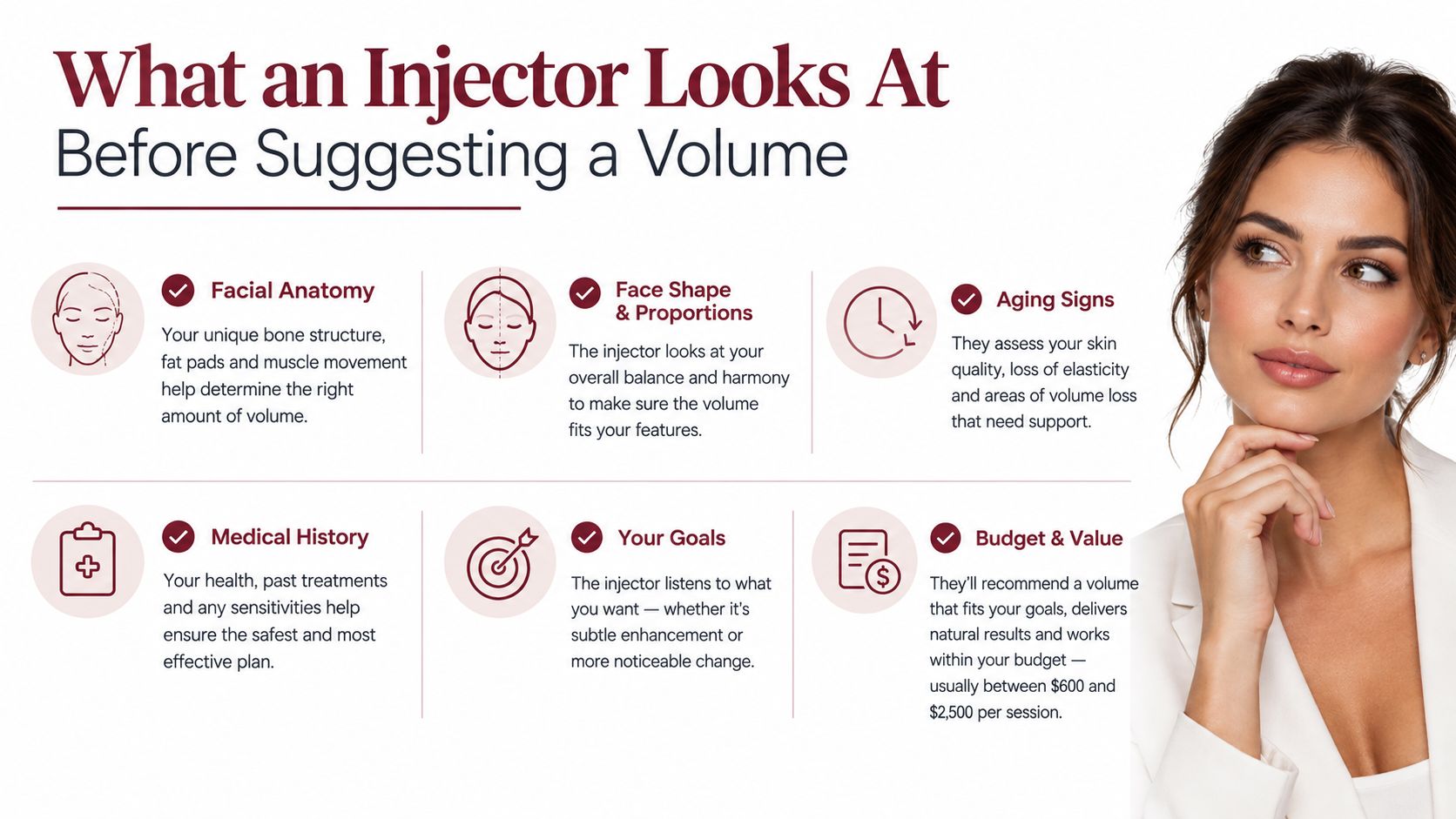
The Anatomy Checklist in the Chair
- Upper-to-lower-lip proportion: If your upper lip is much thinner than your lower, I may favor the upper lip, but I won't chase a ratio that fights your face.
- Vermilion show: This is how much pink lip shows. Low show often calls for eversion and shape work, not just bulk.
- Cupid's bow and border: A flat or blurred bow can improve with precise border work using less product than a full volume build.
- Symmetry: One side may need a small correction while the other needs almost nothing, which is why even splits aren't a universal prescription.
- Tissue quality: Thin, soft tissue stretches differently from firmer tissue. Tight lips usually need a more conservative start.
- Prior filler: Old product, migration or lumps change where new product can safely and attractively go.
That last point is where people get surprised. If you've had filler before, I'm not starting from zero, even if you think it's gone. If you're comparing products like Volbella, Juvederm Ultra XC, Belotero Balance or Versa, the product choice also follows the job, softer definition versus more lift. There's useful background in this guide to finding the right lip filler to enhance your lips, but the final pick should happen after an in-person look.
Take two patients treated the same morning. One wants lipstick to stop bleeding into fine border lines. The other wants visibly fuller lips after years of thinning. The first may need careful border refinement with a modest amount. The second may need a staged rebuild. Different plans aren't guesswork, they're the point of personalized care.
Typical Volumes by Aesthetic Goal
You still deserve ballpark ranges, so here's how I'd frame them in a consultation. Treat these as starting conversations, not prescriptions. A conservative published range is approximately 0.4 to 1.0 mL per session, with one clinical series using 0.4 to 1.0 cc in all patients, according to published clinical data on conservative hyaluronic-acid dosing. Within that, about 0.4 to 0.6 cc often suits subtle definition or a first treatment, while around 0.7 to 1.0 cc can give a more noticeable change, depending on anatomy and the injector's plan.
| Goal | Typical Starting Volume | What to Expect Once Settled |
|---|---|---|
| Subtle definition and hydration | About 0.4 to 0.6 mL | Clearer border, slight fullness, friends may not pinpoint why |
| Balanced fullness for a first treatment | About 0.5 to 1.0 mL | Noticeable but proportionate volume if tissue allows |
| More noticeable enhancement | Around 0.7 to 1.0 mL to start, then reassess | Fuller shape and projection, usually best built in stages |
| Lips plus perioral lines or mouth corners | Individualized, often more total product across areas | Lips plus nearby support, not just bigger lips |
Why Some Studies Report Much Higher Averages
If you search online, you'll find larger numbers and wonder if a single syringe is undertreatment. It isn't necessarily. In a large trial, mean lip volume was 1.82 mL in one group and 2.24 mL in the control group, and total volume across lips and perioral areas reached 2.65 mL and 3.33 mL, as reported alongside larger multicenter lip augmentation trial volumes. Those protocols treated broader areas and different objectives, so don't import their averages into your first appointment.
Real-world data is just as variable. One study found initial volumes from 0.8 to 3.0 mL with a mean of 1.6 mL, while touch-ups averaged 1.0 mL, a spread detailed in real-world lip filler volume research by age and treatment stage. That range proves my point. The right question isn't which average wins, it's which end of the range fits your goal, tissue and tolerance for change.
One more distinction helps. Filler adds volume and shape, neuromodulators relax muscle. If you're unsure whether your concern is volume or movement around the mouth, this explainer on Botox vs Juvederm is a helpful primer before you ask for either by name.
Your Lip Filler Consultation Checklist
A good consultation should feel like an exam and a conversation, not a sales pitch for a second syringe. If nobody asks about your history, takes baseline photos or explains what happens after swelling, that's a red flag. You should leave knowing the product, the planned amount per lip and when you'll be reassessed.
Bring this list with you and expect direct answers.
What Your Injector Should Ask You
- Medical history and allergies: Including prior reactions, cold sore history and any active infection near the mouth.
- Prior filler: What was placed, when, where and whether you've ever had it dissolved or had lumps.
- Medications and supplements: Anything relevant to bruising risk should be reviewed before treatment day.
- Your goal in your own words: Subtle definition, symmetry, projection or restoration after thinning, stated clearly.
- Baseline photographs: Front and side views so later changes aren't judged from memory or bathroom lighting.
What You Should Ask Back
Ask which hyaluronic-acid filler is planned and why it fits your goal. Ask how much is planned for the upper lip versus the lower, and whether a needle or cannula will be used. Technique varies even at similar volumes, and different tools suit different placement tasks, so you deserve the reasoning, not just the tool name.
Also ask what conservative means in your case. If the plan is to start smaller, when will you return, and what would justify adding more? If the plan is closer to a full syringe, what anatomical feature supports that choice?
If an injector can't explain the dose by pointing to your proportions, your tissue and your stated goal, don't let the appointment drift into treatment that day.
Finish with aftercare and warning signs, in writing if possible. You should know whom to contact after hours and which symptoms shouldn't wait until morning. That answer tells you a lot about the practice.
Why Staging Treatment Often Beats One Large Visit
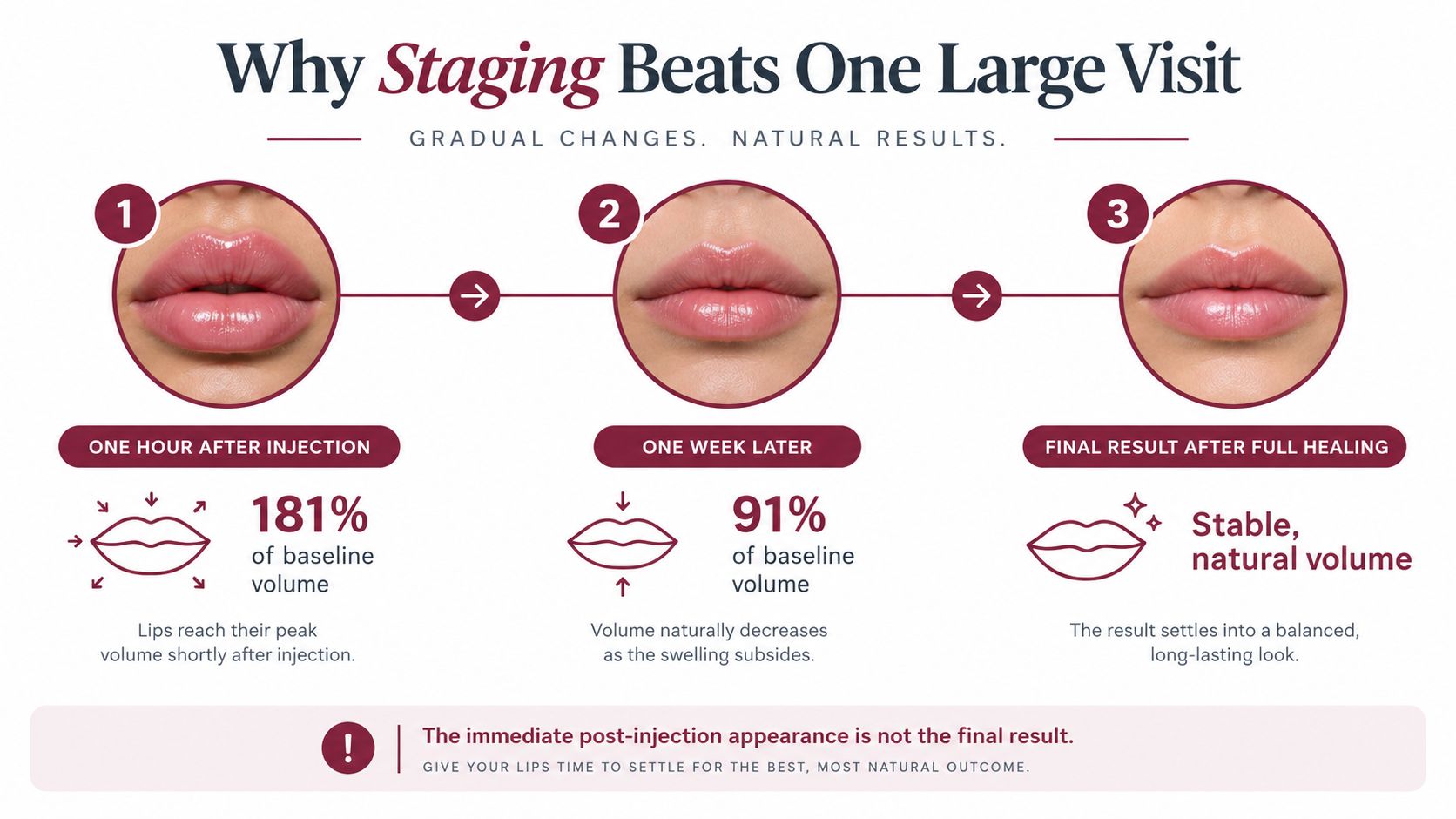
I'll be blunt. Most overfilled lips I see weren't caused by one reckless decision. They were caused by judging swollen lips too early and adding more before the first treatment had settled. Staging beats one large visit for most first-timers because you can always add a little, but correcting too much is a bigger project.
The swelling data explains why patience isn't just a preference. Three-dimensional research found lip volume reached about 181% of baseline one hour after injection, fell to about 91% at one week, and continued to roughly 55% at six months and 39% at nine months after a specific technique, according to three-dimensional research tracking lip volume after injection. That's not a universal timeline for every product, but it demolishes the idea that day-one size is your result.
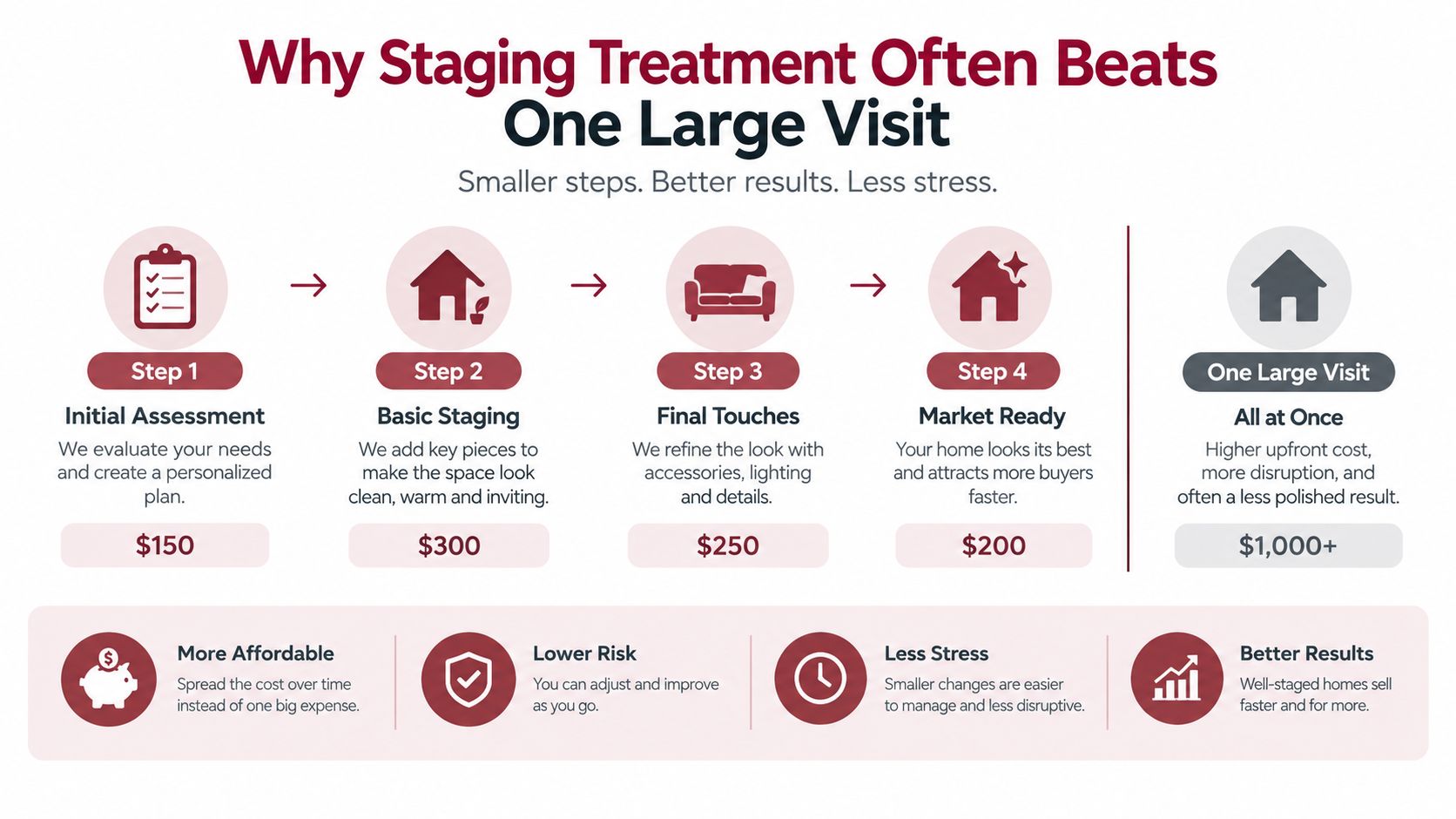
How a Staged Plan Usually Works
- Start conservative: Place enough to achieve the agreed shape change without stretching tissue aggressively.
- Wait for swelling to resolve: Judge symmetry and fullness only after the acute phase passes, using baseline photos for comparison.
- Refine if needed: Add a small amount for a specific reason, such as one side settling flatter or a border needing support.
This matters across ages too. Mean total volumes including touch-ups rose from about 1.1 mL in patients aged 20 to 34 to 1.6 mL in patients aged 46 and older in one dataset already noted earlier in the research. I read that as different tissue and different goals, not an instruction that older lips should automatically get more in visit one.
If you're anxious during the puffy phase, read about how long it takes for lip fillers to settle before you message anyone asking for a top-up. Then look again with fresh eyes. Lips that seemed uneven on day two often look balanced once one-sided swelling and bruising calm down.
Safety Considerations That Go Beyond Syringe Count
More filler is not a stronger version of the same result. Lips have limited soft-tissue space, rich blood supply and important anatomy packed into a small area. That is why who injects you and how matter at least as much as how much is in the syringe.
Set your expectations with the full picture. A meta-analysis reported lip fullness improvement in 60% of participants, aesthetic improvement in 82% and satisfaction in 68%, while serious events beyond 30 days occurred in roughly 1.1% of cases, findings summarized in a recent meta-analysis of lip filler outcomes and adverse events. Common short-term reactions in that body of data included swelling, firmness, bruising and tenderness, so plan your calendar accordingly and don't book right before major photos.
Method and Product Limits Matter
The FDA states fillers should be given by a licensed health care professional using a syringe with a needle or cannula, and needle-free devices aren't FDA-approved for filler delivery because safety and effectiveness are unknown, per FDA guidance on dermal filler administration and vascular risk. Avoid high-pressure pens entirely. Precise placement isn't optional in lips.
Product labeling also sets ceilings, not targets. For one FDA-cleared lip filler, labeling says not to exceed 1.5 mL for the upper lip and 1.5 mL for the lower lip per treatment including touch-up, for a 3 mL lip total, with a 6 mL maximum for lips and perioral area combined, as stated in FDA-cleared labeling for submucosal lip filler dosing limits. Most aesthetic plans should sit well below a maximum. A ceiling is a safety boundary, not a goal.
Know the urgent signs before you leave. Sudden severe pain, unusual blanching or discoloration, cool skin, or rapidly worsening asymmetry warrants immediate contact with your injector because vascular occlusion needs prompt assessment. Accidental injection into a vessel is uncommon but can cause tissue necrosis, vision problems including blindness, or stroke, which is why anatomical expertise matters.
For the routine side of recovery, an injectable filler aftercare guide can reinforce the basics your injector gives you, but it never replaces direct instructions for your case. Follow your injector's plan first, especially if anything feels unusual.
Planning Your Visit at Spa Black in San Antonio
So, how much lip filler do you need? You need the amount that fits your goal, your proportions and your tissue, placed conservatively enough that you can judge the settled result before deciding on more. For many first-timers, that conversation lands in the subunit to one-syringe starting range, but the number only means something after an in-person assessment.
At Spa Black in San Antonio, start with a consultation for lip fillers, review your medical history and prior treatments, and agree on a staged plan before any product is opened. You can review the service details for lip fillers and injectable lip enhancement and bring your checklist, your questions and your own definition of natural. Don't borrow a friend's dose. Borrow a better process.

Book a lip filler consultation at Spa Black in San Antonio to have your proportions, tissue quality and prior filler assessed in person before any volume is chosen. You'll leave with a conservative starting plan, a clear reassessment timeline and specific aftercare instructions, so your result is built on your anatomy rather than a syringe count copied from someone else.