



You're standing in front of the mirror, turning your face slightly from side to side. You want a softer cupid's bow, a little more definition, or subtle fullness, but the needle makes you pause. Searching for lip filler risks can make that decision harder because mild bruising and rare emergencies often appear together in the same list.
A more useful approach is to treat risk as a spectrum. Some effects are expected parts of healing. Others need a provider's review, and a small group requires immediate medical action. Understanding where each possibility fits helps you make a calmer decision and recognize when a symptom is routine, concerning, or urgent.
Table of Contents
- A Spectrum of Lip Filler Risks
- What the Numbers Say About Complication Rates
- Common Short-Term Risks Most Patients Will Notice
- Vascular Occlusion and the Most Serious Acute Risk
- Delayed and Less Obvious Lip Filler Risks
- How Provider, Product, and Technique Lower Risk
- Warning Signs and Emergency Steps to Remember
- Putting It All Together Before Your Appointment
A Spectrum of Lip Filler Risks
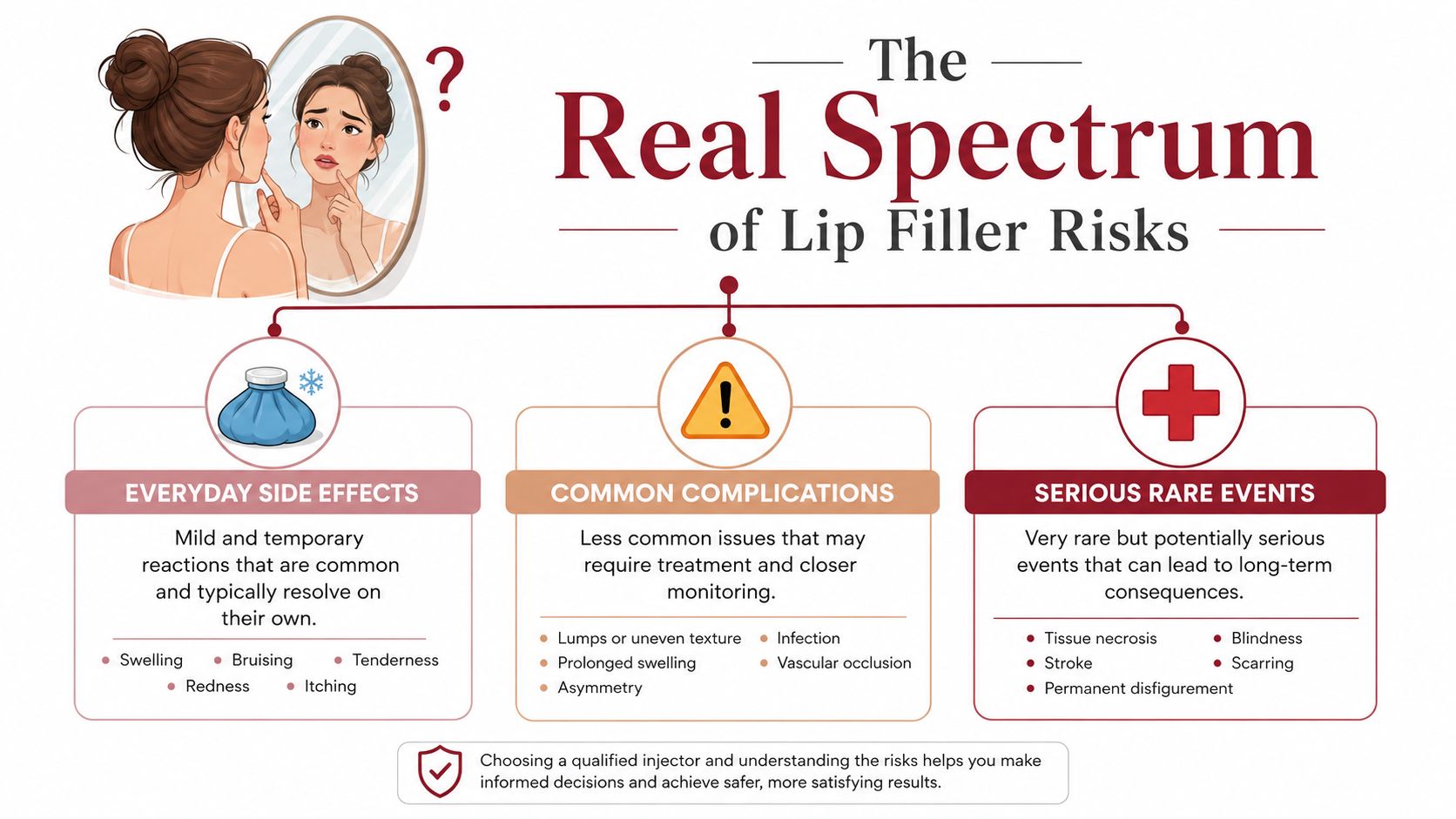
You approve a small change, then notice your lips look fuller, uneven, or more bruised than expected in the mirror. That moment can make every possible complication feel equally threatening. Risk is easier to understand as a spectrum, from normal healing effects to uncommon problems that require rapid assessment.
The first layers are usually part of healing
The most familiar layer includes swelling, redness, tenderness, and bruising around injection points. Lips can feel puffy and sensitive, almost like a sunburned pillow, during early recovery. Because the area is highly visible, the appearance may seem dramatic without indicating serious harm. Follow the provider's aftercare instructions and monitor whether symptoms begin settling.
The next layer includes temporary lumpiness, firmness, or mild asymmetry. Uneven swelling can make one side look fuller before the filler and inflammation settle. Improvement is reassuring. Persistent, worsening, or increasingly painful changes should prompt a provider review rather than repeated pressing or self-treatment.
Later layers call for quicker judgment
A more serious layer includes infection and vascular occlusion. Increasing warmth, redness, pain, drainage, or fever can suggest infection and warrants prompt contact with the injector. Vascular occlusion happens when filler enters or compresses a blood vessel, reducing oxygen delivery to tissue. It can injure tissue and, in facial injections, affect vision, so sudden severe pain, unusual color change, or vision symptoms need urgent medical attention.
Another layer includes delayed inflammatory reactions, nodules, granulomas, migration, and hypersensitivity-type responses. These may develop after an initially uneventful appointment, sometimes after illness or dental work. Report new persistent lumps or unexplained swelling instead of waiting indefinitely.
Practical rule: Match your action to both likelihood and consequence. Monitor common mild effects, contact the provider about persistent changes, and seek immediate help for rare symptoms that could cause lasting harm. Before treatment, verify the injector's medical credentials and ask how urgent complications are handled.
A complete guide to lip fillers can clarify the procedure, while recognizing these layers helps you respond appropriately to what you observe.
What the Numbers Say About Complication Rates
Large datasets help put fear into proportion, but the numbers need careful reading. A 2025 retrospective study followed 209,083 patients across 290,307 injection sites from October 2020 through April 2024. It found 12 serious complications, including 2 infections and 10 vascular obstructions, for a severe complication incidence of 0.0041% (2025 hyaluronic acid filler study).
A separate multicenter study published in 2023 reviewed 41,775 cases across 58,533 injection sites. It identified 29 early complications within 14 days, producing an overall early complication rate of 0.07%. Vascular compromise accounted for 18 of those 29 cases, and the highest site-specific early rate occurred in the upper eyelids at 0.41%, based on 1 of 241 sites (2023 multicenter complication study).
| Complication Type | Study A Rate, Overall | Study B Rate, Overall | Lip-Specific Rate | Frequency Tier |
|---|---|---|---|---|
| Serious complications | 0.0041% | Not reported in the same format | Not isolated in the study summary | Rare, clinically important |
| Early complications | Not reported in the same format | 0.07% | Not isolated in the study summary | Uncommon |
| Vascular compromise or obstruction | Included in 12 serious events | 18 of 29 early events | Lips are recognized as a common occlusion site | Rare, urgent |
| Highest reported site-specific rate | Not isolated in the study summary | 0.41% upper eyelid rate | Lip-specific rate not provided | Anatomically variable |
These studies don't provide a single definitive lip-specific percentage. They also use different denominators and study designs, so you shouldn't treat the rates as interchangeable. One may count injection sites, while another emphasizes patient cases or early events.
A separate FDA safety presentation cites a literature estimate of about 1 in 6,000 syringes, while an NIH-indexed retrospective study calculated vascular adverse events at 1 in 6,558 injections, or 0.015% (FDA safety presentation). The variation reflects reporting methods and definitions, not proof that one number applies to every injector or every lip treatment.
Common Short-Term Risks Most Patients Will Notice
The effects most patients notice are usually much less dramatic than the risks that dominate online searches. Swelling often appears soon after injections and can make the lips look larger or less even than intended. Comparing your lips from hour to hour can create unnecessary anxiety because inflammation changes throughout the day.
Bruising may look like faint purple dots, a small plum-colored patch, or the mark left by an awkward sip of red wine. Small needle punctures can disturb tiny vessels beneath the skin. The color may change as it fades, so a bruise that shifts from purple toward yellow isn't automatically worsening.
What healing can feel like
Tenderness and mild firmness can make smiling, drinking, or pressing the lips together feel unfamiliar. Temporary lumpiness may reflect swelling or product distribution before the tissue settles. Don't massage a firm area unless your injector specifically recommends it, because the correct response depends on whether the issue is routine swelling, misplaced product, inflammation, or something more serious.
Mild asymmetry is also common during the settling period. Humans rarely have perfectly symmetrical lips to begin with, and swelling can exaggerate natural differences. Track changes with consistent photos in similar lighting instead of relying on a close-up mirror check.
Monitor: Symptoms that gradually stabilize or improve are generally more reassuring than symptoms that intensify, spread, or change color.
The first days after lip filler and bruise recovery can vary by person, product, injection pattern, and individual healing response. Contact your provider if pain becomes severe, swelling keeps increasing, the skin develops unusual discoloration, or you develop fever, drainage, or other signs of infection.
Vascular Occlusion and the Most Serious Acute Risk
Think of a small facial artery as a garden hose. If filler enters the vessel or presses against it, blood flow can become obstructed, much like water stops moving when a hose kinks. The tissue beyond that blockage may not receive enough oxygen.
Published estimates vary because studies measure events differently. Reviews describe vascular occlusion incidence from about 0.001% to 0.1%, with one review citing 1 in 5,000 injections and another report calculating 1 in 6,558 injections, or 0.015% (review of dermal filler vascular occlusion). These figures describe a rare event, but rarity doesn't make the consequences unimportant.
Why the lips require anatomical skill
The lips contain interconnected blood vessels, and filler can obstruct or compress arterial branches. If blood flow is compromised, the result may include ischemia, skin necrosis, scarring, visual loss, blindness, or stroke. Reviews of filler-related blindness describe retrograde arterial embolism as the usual pathway when product reaches arterial connections associated with the eye (review of filler-related blindness).
Symptoms can begin quickly, sometimes within minutes or hours. Escalating pain, persistent blanching, cool skin, dusky mottling, or a spreading color change should never be managed by waiting overnight.
For hyaluronic acid filler, hyaluronidase is the specific reversal agent and should be used immediately when vascular compromise is suspected. Expert guidance emphasizes that irreversible injury can develop rapidly once perfusion is lost, which is why a qualified injector should have an emergency response plan and reversal medication available (clinical guidance on hyaluronidase and vascular compromise).
Delayed and Less Obvious Lip Filler Risks
Some lip filler problems don't announce themselves during the appointment. A delayed nodule or granuloma may appear weeks or months after the lips seemed fully settled. A lump can result from product placement, inflammation, infection, or a foreign-body response, and those causes require different management.
A 2024 review found granulomatous foreign-body reactions accounted for 76.6% of reported filler lip reactions in that review, while angioedema was described as an early reaction (2024 review of lip adverse reactions). Another review reported delayed-onset nodules in 0.1% to 1.0% of cases and described granulomas as a rare side effect at about 0.01% (review of lip filler complications).
| Complication | Typical Onset | Common Trigger | Hyaluronidase Effective? |
|---|---|---|---|
| Temporary lumpiness | Early healing period | Swelling or uneven settling | Sometimes, only if product-related |
| Delayed nodule | Weeks to months | Inflammation, infection, or product reaction | May help when hyaluronic acid is involved |
| Foreign-body granuloma | Delayed | Immune response to filler material | May be insufficient alone |
| Angioedema-type swelling | Early or delayed | Hypersensitivity response | Requires clinical evaluation |
| Migration | Gradual | Product movement or placement factors | Often considered when the filler is hyaluronic acid |
Inflammation can flare after a viral or bacterial illness, vaccination, or dental procedure, according to FDA safety information. The FDA also warns that nodules or granulomas may require injections, oral antibiotics, or surgical removal. A previously quiet area can therefore become noticeable after an event that seems unrelated to cosmetic treatment.
Hyaluronic acid's reversibility is a meaningful safety advantage, but dissolving isn't a universal answer. A provider needs to determine whether the problem is simple product irregularity, infection, inflammation, or another process before choosing treatment. Report persistent firmness, new lumps, worsening swelling, numbness, or changes in speech or eating rather than trying to correct the area yourself.
How Provider, Product, and Technique Lower Risk
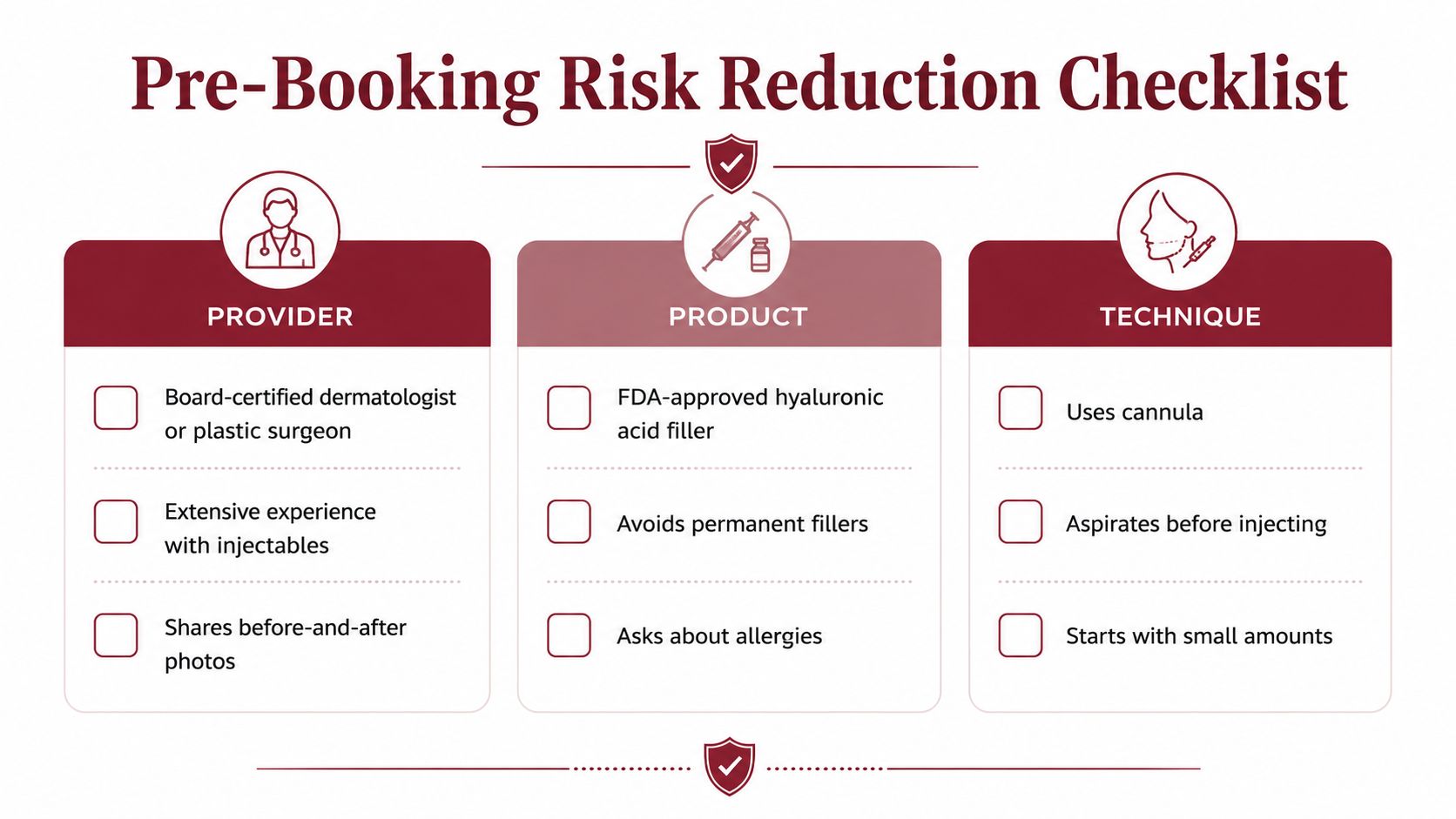
Risk reduction starts before the syringe is opened. Evaluate three areas: who injects, what they inject, and how they plan to inject it.
Verify the provider
Choose a licensed medical professional working within the applicable supervision requirements, such as a physician, nurse practitioner, physician assistant, or registered nurse under physician supervision. Ask about specific filler training, facial anatomy education, experience with lip injections, and management of vascular complications.
A provider should be willing to show relevant lip before-and-after examples and explain what would happen if you developed an urgent complication. Confirm that hyaluronidase is available on site, not merely obtainable later from another location.
Ask product questions without hesitation
For lip enhancement, ask whether the product is an FDA-approved hyaluronic acid filler with an established safety profile. Ask to see the product name, lot number, and expiration date. Avoid assuming that a familiar-looking package or vague label confirms authenticity.
Hyaluronic acid products can often be reduced with hyaluronidase. That doesn't mean every complication disappears instantly or that reversal is risk-free, but it gives the clinician a specific management option that permanent materials don't provide.
Understand the planned technique
Needle and cannula approaches each have a role, and the choice should reflect the anatomy and treatment goal. Slow injection, small aliquots, careful placement, and a strong understanding of vascular anatomy all matter more than a marketing label.
Ask how the injector assesses blood flow risk, whether aspiration is appropriate for the planned technique, and how they'll respond to unexpected pain or skin color changes. You can also ask about numbing options and the role of lidocaine for lip injections, while remembering that comfort measures don't replace anatomical skill.
A careful consultation should cover cold-sore history, allergies, autoimmune conditions, medications, previous filler, recent illness, and recent dental work. If the provider rushes through those questions or dismisses your concerns, treat that interaction as useful safety information.
Warning Signs and Emergency Steps to Remember
After treatment, use a simple timeline rather than judging every change as either harmless or dangerous.
During the first 24 hours, swelling, tenderness, redness at needle sites, and mild bruising may occur. Increasing severe pain, persistent pale or white skin, coolness, or unusual mottling is different. Those signs require immediate contact with the injector.
During days one through three, bruising and swelling may remain visible, but symptoms should generally begin to stabilize rather than accelerate. Fever, spreading warmth, pus-like drainage, or worsening redness calls for same-day medical evaluation.
During days four through seven, unevenness can still reflect healing, especially if one side was injected more extensively. A new color change, blistering, escalating pain, or rapidly expanding swelling isn't a routine settling issue.
Beyond the first week, a persistent lump or firm area deserves a provider review, particularly if it becomes painful, red, or swollen after an illness or dental procedure. Vision changes, severe headache, weakness, difficulty speaking, or other neurological symptoms require emergency care.
Use this action protocol
- Stop manipulating the area. Don't massage, squeeze, apply unapproved products, or wait for the next routine appointment if red flags appear.
- Call the injector immediately. Describe the exact symptom, when it began, whether it's spreading, and whether the skin is pale, dusky, or blistered.
- Ask about hyaluronidase. If hyaluronic acid filler was used and vascular compromise is suspected, the provider should assess you urgently and begin appropriate treatment.
- Go to an emergency department for major symptoms. Vision changes, severe pain with skin discoloration, blistering, or neurological symptoms shouldn't wait for a callback.
Time matters: A concerning vascular symptom needs action measured in hours, not days. Keep your provider's emergency number accessible before leaving the appointment.
While waiting for help, stay with someone if possible, keep your phone available, and document the change with time-stamped photos in consistent lighting. Don't let a reassuring appearance in one part of the lip override a spreading or intensifying symptom elsewhere.
Putting It All Together Before Your Appointment
A safe decision isn't based on finding a treatment with no risk. It's based on matching each layer of risk with a practical safeguard.
For everyday swelling and bruising, plan realistic recovery time and follow the provider's aftercare instructions. For lumpiness or asymmetry, choose an injector who evaluates the settled result rather than automatically adding more product. For infection or delayed inflammation, disclose medical history and report symptoms that worsen instead of improving.
For the rare vascular emergency, verify the essentials before booking:
- Credentials: Confirm that a licensed medical professional performs the injections and has specific experience with facial fillers.
- Product identification: Ask for an FDA-approved hyaluronic acid product, plus its lot number and expiration date.
- Emergency readiness: Ask whether hyaluronidase is stocked on site and how urgent complications are handled.
- Medical history: Mention allergies, medications, previous filler, cold sores, autoimmune conditions, recent illness, and dental procedures.
- Written aftercare: Leave with clear instructions and an emergency contact method.
- Consultation quality: Expect an anatomy-focused discussion of goals, limitations, alternatives, and complications.
A 2026 meta-analysis found adverse events in 50% of hyaluronic acid lip filler patients, while 1.1% experienced serious adverse events requiring treatment, follow-up, or lasting beyond 30 days (2026 meta-analysis of hyaluronic acid lip filler safety). That broader measure includes adverse events beyond the rarest emergencies, so it shouldn't be confused with the severe complication rates from large retrospective datasets. It does reinforce why informed consent needs to cover more than short-term swelling and bruising.
Spa Black in San Antonio can make consultation, informed consent, product transparency, and an emergency plan part of the same conversation. Those steps aren't optional extras. They're how you turn awareness of lip filler risks into a more informed and confident choice.
If you're considering lip enhancement, visit Spa Black to learn about its injectable services and schedule a consultation in San Antonio. Bring your questions about product selection, provider experience, expected healing, and emergency readiness so you can decide whether lip filler fits your goals with clear information.