



You're free Friday afternoon in Alamo Heights, and you want Botox, laser treatment, body contouring, or a serious skin consultation. A nail salon and a boutique fitness studio may sit nearby, but neither follows the same clinical model as a medical spa. The sleek clinic with a medical director listed in small print might, but the sign alone doesn't prove it.
That distinction matters in San Antonio. The city has a crowded, digitally mature market, and Texas rules now make physician oversight, written delegation, and staff visibility especially important. The right choice isn't automatically the largest practice or the cheapest appointment. It's the clinic whose supervision, services, reputation, and follow-up match what you're planning to have done.
Table of Contents
- What Counts as a Medical Spa in San Antonio
- The San Antonio Med Spa Market at a Glance
- Credentials, Oversight, and Safety Signals
- Services, Locations, and Booking Options
- Reviews, Before and After, and Reputation
- Your Consultation and Booking Checklist
- Matching Your Goals to the Right Clinic
What Counts as a Medical Spa in San Antonio
A medical spa combines a spa-style setting with services that Texas treats as medical acts. That can include neuromodulators such as Botox, dermal fillers, laser-assisted skin treatments, body contouring, and other prescription-grade or energy-based procedures. A facial studio may look similar from the waiting room, but appearance doesn't establish medical oversight.
The key question is simple: who is responsible for the clinical work? Texas regulators explain that Botox and filler injections, body cavitation and contouring, laser-assisted skin treatments, and medical-grade facials fall under physician order and delegation. Laser hair removal follows a different regulatory path through cosmetology regulation, which means one location may operate under more than one framework. The distinction is outlined in Texas regulatory information about Botox and medical procedures, though patients should still ask the clinic how each service is supervised.
The filters I use when comparing clinics
I look at six practical factors before I take a clinic seriously:
- Supervising clinician: Is the medical director identified, licensed, and meaningfully involved?
- Service breadth: Can the practice assess injectables, skin, lasers, body contouring, and wellness without forcing every concern into one treatment?
- Access: Do the location and hours work with a real San Antonio commute?
- Booking structure: Can you book online, reach the office by phone, and understand follow-up procedures?
- Reputation: Are reviews specific, current, and relevant to the treatment you want?
- Intake safety: Does the clinic ask about medications, allergies, prior procedures, skin tone, and medical history?
A credible practice should answer those questions directly. Spa Black's overview of medical spa care in San Antonio is a useful example of the information a local patient should be able to find before booking.
The label “med spa” isn't a standalone license. It describes a delivery model. The defining test is whether the practice treats medical services like medical services, with proper delegation, screening, consent, complication planning, and follow-up.
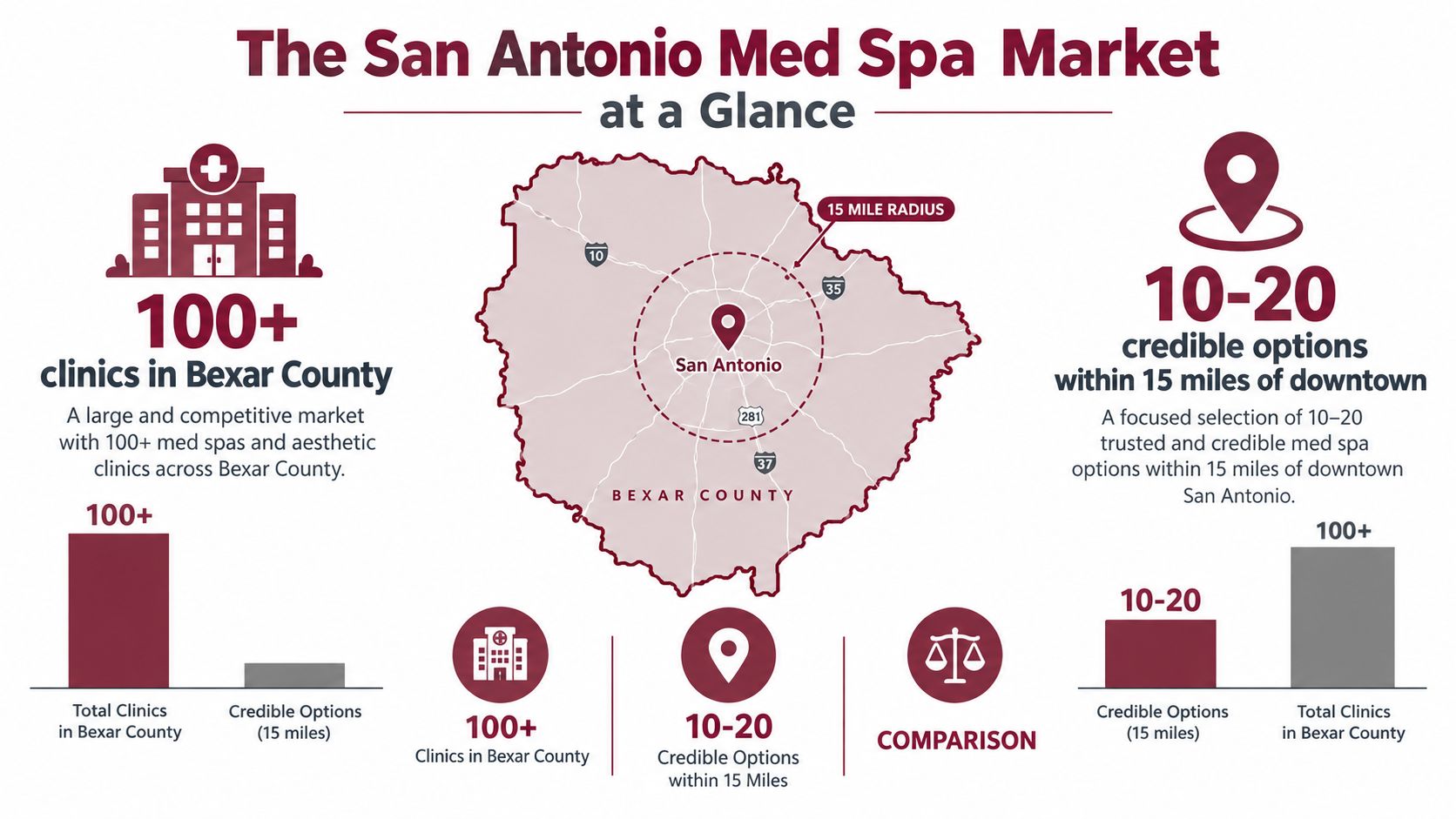
The San Antonio Med Spa Market at a Glance
San Antonio is a strong market for aesthetic and wellness care because it combines a large working-age population with a substantial older cohort. The city has about 1.48 million residents, a median age of 34.9 years, and roughly 63.05% of residents between 18 and 64, while about 190,908 residents are 65 or older, representing 13.09% of the population, according to San Antonio age demographics. That mix supports demand for maintenance treatments, injectables, lasers, body contouring, and restorative aesthetic care.
Texas also represents a major share of the national medical spa market. The American Med Spa Association's 2024 snapshot lists Texas with 7.6% of U.S. medical spa locations, placing the state among the largest markets in the country, as reported in AmSpa's medical spa statistics. For a San Antonio shopper, that means broad awareness and plenty of choices, but also more variation in training, oversight, pricing, and patient experience.
Three clinic archetypes dominate the decision
A physician-led multi-location practice usually offers a wide treatment menu, more than one office, standardized protocols, and memberships. That can make sense if you want injectables now and laser or body services later.
A single-owner boutique often concentrates on injectables and skin. You may get a closer relationship with one injector and quicker scheduling, but the clinic may have fewer devices, narrower clinical coverage, or appointment-only access.
A hybrid wellness clinic layers services such as hormone care, IV therapy, or supervised weight-loss programs onto a lighter aesthetic menu. That structure can suit someone whose goals are broader than facial rejuvenation, but you should verify lab work, provider credentials, and follow-up procedures rather than assuming the wellness branding guarantees medical depth.
A 2026 business census-style dataset lists 572 medical spas in San Antonio, with 508 having websites and 155 listing both phone and email, according to local Texas med-spa market data. The same dataset reports that 53.15% are single-owner operations and that the average business age is 5 years and 2 months. Those figures point to a fragmented market where reputation, clinical differentiation, and convenient digital booking matter more than scale alone.
For treatment-specific research, a focused guide such as San Antonio laser hair removal clinics can help you compare the details that a generic directory usually skips.
Credentials, Oversight, and Safety Signals
The safest San Antonio med spa is the one that can name its clinical chain of responsibility before you pay a deposit. Texas coverage states that TMB Rule 169.28 took effect on January 9, 2025, classifying non-surgical cosmetic procedures as the practice of medicine and requiring written delegation, physician posting, and staff identification. HB 3749, known as Jenifer's Law, took effect September 1, 2025, requiring IV therapy in IV therapy centers to be administered by an RN or higher-level clinician, as summarized in Texas med-spa regulatory guidance.
Ask who actually supervises the treatment
Before booking an injection, get the supervising physician's name and role. “We have a medical director” is not enough. Ask whether that physician is a plastic surgeon, dermatologist, family medicine physician, or another licensed clinician. Then ask how the practice handles chart review, treatment protocols, and complications.
If physician-led care matters to you, look for board-certified plastic surgeon oversight, and confirm what that oversight means at the location you will visit. A multi-location practice may have broader clinical coverage, while a single-owner boutique may offer more direct access to one injector. Neither label proves safety. The operating details do.
For injectables, confirm whether the person treating you is a physician, nurse practitioner, or registered nurse. A license is the starting point. Ask about aesthetic training, experience with the product and treatment area, and the clinic's response plan for vascular or allergic complications.
Practical rule: Staff should explain who delegates the service, who can be reached during treatment, and what happens if a complication occurs. If they avoid those questions, leave.
Inspect the safety process, not just the décor
A legitimate consultation covers medical history, medications, allergies, previous procedures, skin characteristics, and your actual goals. For lasers and energy devices, ask about the specific platform, settings, skin-tone assessment, patch testing when appropriate, and the response plan for adverse reactions.
For Botox, expectation setting matters. The FDA label describes Botox Cosmetic as a prescription neuromuscular blocking agent indicated for temporary improvement of facial lines in defined muscle areas, including labeled regions such as glabellar lines, forehead lines, and crow's-feet, as detailed in the FDA Botox Cosmetic label. A responsible injector discusses anatomy, candidacy, temporary results, and risks instead of treating every wrinkle as an identical unit of product.
The clinic should maintain documented emergency procedures, appropriate supplies, consent forms, and a clear follow-up route. Physician oversight is a working system. You should see it in screening, treatment, documentation, and the clinic's response when something goes wrong.
Services, Locations, and Booking Options
Service breadth changes the shopping experience. A clinic focused only on injectables may be ideal if you already know you want a specific treatment and want continuity with one injector. A physician-led practice with injectables, lasers, skin rejuvenation, body contouring, and wellness can be more useful when your concern crosses categories.
Spa Black in San Antonio is a concrete local example of the multi-location model. Its service universe includes Botox, Xeomin, Jeuveau, Letybo, dermal fillers, lip enhancement, microneedling, Morpheus8, IPL, Pico Laser, Fotona SP Dynamis, CO2 laser therapy, laser hair removal, CoolSculpting, Vanquish, Emsculpt, cellulite-focused services, HydraFacial, microdermabrasion, IV therapy, hormone therapy, and semaglutide weight-loss care. Its two listed locations are Spa Black Wurzbach at 7272 Wurzbach Rd #804 and Spa Black North at 19323 Stone Oak Parkway, 3rd Floor.
That setup can reduce the need to start over if your goals change. It also creates a responsibility for the patient to confirm which provider performs each service, where the treatment occurs, and whether follow-up stays with the same team.
| Attribute | Multi-Location Physician-Led, such as Spa Black | Single-Owner Boutique |
|---|---|---|
| Treatment range | Broad menu across injectables, lasers, skin, body, and wellness | Often concentrated on injectables and skincare |
| Access | Multiple offices and online booking may improve scheduling flexibility | Appointment-only access is more common |
| Continuity | Protocols may be shared across locations, but provider choice matters | One injector may provide a more personal relationship |
| Pricing | May include memberships, packages, financing, or per-unit pricing | Pricing can be simpler, but device services may be limited |
| Follow-up | Ask which office and provider handle reassessment | Usually tied closely to the owner's schedule |
A membership can make sense for recurring services, but read the terms. Confirm what is included each month, whether unused benefits roll over, how cancellation works, and whether pricing is per unit, per session, per area, or consultation-based.
Booking systems matter more than people admit. A clinic that offers online scheduling, phone access, and clear post-treatment communication is easier to manage than a practice that responds only through sporadic messages. Clinics can also learn from healthcare operations resources such as a virtual receptionist for Australian clinics, especially around call handling and appointment coordination, although the service itself isn't a substitute for clinical oversight.
Reviews, Before and After, and Reputation
Star ratings are a starting point, not a verdict. I care more about whether reviews describe the exact service, the specific office, the communication before treatment, and the follow-up afterward. A review that says “great staff” tells you little about how a clinic handles filler planning, laser settings, healing, or an unexpected concern.
Read reviews for patterns
Search location-based reviews and look for repeated comments about:
- Wait times: Occasional delays happen, but repeated long waits suggest weak scheduling.
- Bedside manner: Patients should describe clear explanations, realistic expectations, and respectful communication.
- Treatment relevance: Botox reviews don't prove that a clinic handles lasers or body contouring well.
- Follow-up: Pay attention to whether staff respond after the appointment.
- Provider consistency: Specific mentions of the injector or clinician are more useful than generic praise.
Procedure-specific feedback can offer better detail than a general business profile. Review patterns on dedicated aesthetic platforms may help with treatment context, while local business reviews are more useful for parking, scheduling, communication, and office experience. Don't treat either source as definitive. Use both to generate questions.
Treat the gallery like clinical evidence
A credible before-and-after gallery should show consistent lighting, comparable angles, natural skin texture, and enough time for healing. Be skeptical of images with heavy filters, dramatic makeup changes, inconsistent facial expressions, or results photographed immediately after a procedure.
For injections, ask whether the images show the same treatment area and whether the patient's anatomy resembles yours. For lasers and resurfacing, look for a realistic healing sequence rather than a polished “after” image that hides redness, swelling, or texture changes.
You can also verify the supervising clinician through Texas licensing resources and check whether public records reveal disciplinary actions or malpractice history. That work takes more effort than scrolling through photos, but it tells you whether the website's medical claims match a real professional structure.
Shortlist two or three clinics, then score each one on recent relevant reviews, provider-specific feedback, transparent consent and pricing, gallery quality, and post-treatment access. The clinic with the prettiest feed shouldn't win automatically. The clinic that answers difficult questions clearly usually deserves the consultation.
Your Consultation and Booking Checklist
Your first appointment should feel like an evaluation, not a sales presentation. Bring a list of medications and supplements, disclose previous aesthetic treatments, and explain what you want to change without letting the clinic rush you into a package.
Ask these questions before treatment
- Who supervises the service? Get the physician's name and ask how the medical director arrangement works.
- Who performs the procedure? Confirm whether the injector is an RN, nurse practitioner, physician, or another credentialed professional.
- What device or product will be used? Ask for the brand and model of a laser or energy device, and ask how the team maintains and calibrates it.
- How experienced is the provider with this treatment? The relevant experience is the procedure you're considering, not just general time in aesthetics.
- What happens after treatment? Confirm who answers questions, when follow-up occurs, and where complications are managed.

Watch for avoidable red flags
A hard sell on package upgrades is a poor substitute for treatment planning. So is a clinic that won't explain its supervising structure, refuses to provide consent documents in advance, skips appropriate skin assessment for a laser, or can't describe its emergency protocol.
Ask what the quoted price includes. Does it cover a review appointment, touch-up assessment, numbing, aftercare, or only the procedure itself? Don't accept a vague “starting at” figure without asking what changes the final quote.
Memberships deserve separate scrutiny. Review the auto-renewal language, cancellation window, unused-credit rules, and any financing terms before you authorize recurring charges. Keep the written quote and consent forms so you can compare clinics on the same basis.
Use this short checklist at every consultation:
- Credentials: supervising physician and treating provider confirmed.
- Pricing: quote defines units, sessions, areas, follow-ups, and exclusions.
- Evidence: relevant before-and-after examples and specific reviews available.
- Safety: screening, consent, emergency supplies, and complication pathway explained.
- Support: post-treatment contact and reassessment process documented.
If a clinic makes those answers difficult to obtain before payment, don't expect the communication to improve afterward.
Matching Your Goals to the Right Clinic
The right clinic depends on the problem you're solving, not on the longest service menu. A patient seeking a small, recurring neuromodulator treatment may value one trusted injector more than access to every body device in the city. Someone planning skin resurfacing, laser hair reduction, and injectables may benefit from a broader physician-led practice that can coordinate the sequence.
Use the goal, not the brand, as your starting point
For facial lines and volume changes, prioritize a practice with strong injectable experience, visible medical supervision, and anatomy-focused consultations. Botox Cosmetic is approved for temporary improvement in defined facial areas, so the consultation should address which lines are dynamic, what result is realistic, and how maintenance fits your plan.
For body contouring, look for more than one platform. A clinic offering options such as CoolSculpting, Vanquish, Emsculpt, or radiofrequency-based services can assess whether your concern is fat, skin laxity, cellulite appearance, or muscle definition instead of forcing every patient toward one machine. None of these services should be presented as a replacement for surgery.
Laser hair removal and skin-tone concerns deserve careful screening. Ask how the clinic evaluates pigmentation, selects settings, and adjusts treatment for different skin characteristics. Don't accept a blanket statement that every device works equally well for every patient.
Wellness goals, including hormone care, IV therapy, or semaglutide weight-loss support, require medical evaluation and follow-up. Results vary, treatment may not be appropriate for everyone, and diet, activity, and lifestyle habits can influence outcomes. Choose a clinic that explains candidacy and monitoring rather than presenting prescription care as a casual add-on.
| Your Goal | Best Clinic Profile | Services to Confirm |
|---|---|---|
| Facial lines or volume loss | Physician-led practice or established injectable boutique | Botox, Xeomin, Jeuveau, Letybo, fillers, consultation, follow-up |
| Skin texture, pigment, or redness | Medical clinic with multiple laser and skin options | IPL, Pico Laser, CO2 laser therapy, microneedling, Morpheus8, skin assessment |
| Body contouring | Practice with more than one body platform | CoolSculpting, Vanquish, Emsculpt, Cellfina, Venus Legacy |
| Laser hair reduction | Clinic with documented device screening and experienced staff | Device type, candidacy review, skin-tone assessment, treatment plan |
| Wellness or weight-loss support | Med spa with qualified providers, evaluation, and follow-up | IV therapy, hormone therapy, semaglutide education, lab and monitoring process |
| One-on-one injector relationship | Single-owner boutique with consistent provider access | Injector availability, product options, consent, complication plan |
Before you book, return to the credentials and reputation standards above. A polished menu can't compensate for unclear supervision, weak consent practices, or poor follow-up.
Spa Black offers physician-overseen injectables, laser and skin treatments, body contouring, wellness services, online booking, and memberships across its San Antonio locations. If that range fits your goals, visit Spa Black to review the services and request a consultation before choosing a treatment plan.