



Are five-star testimonials enough to tell you whether a vaginal rejuvenation treatment is appropriate, effective, or safe for your specific concern? Usually, they aren't. Online searches combine patient stories about laser treatments, radiofrequency procedures, labiaplasty, and vaginoplasty under one broad label, even though these options differ in purpose, recovery, risks, and evidence.
That makes vaginal rejuvenation reviews useful for learning what a person experienced, but unreliable as a stand-alone clinical answer. A reviewer may describe relief from dryness, improved comfort during intimacy, or satisfaction with an appearance change, while another may report discomfort, limited results, or unexpected recovery needs. Both experiences can be genuine.
This guide separates reviews by procedure type, symptom, and evidence quality. It also explains why a review that doesn't name the device, technique, treatment plan, or follow-up period deserves less weight. If you're researching options at Spa Black in San Antonio, use reviews as conversation starters, not promises. Results vary, candidacy must be assessed individually, and consultation with a qualified provider is required.
Table of Contents
- Introduction to Vaginal Rejuvenation Reviews and What They Actually Cover
- Understanding Vaginal Rejuvenation Options at Spa Black in San Antonio
- What Patient Reviews and Ratings Most Often Report
- Safety and Efficacy Notes Every Review Reader Should Know
- How to Read Before and After Outcomes and Ratings Like a Pro
- Choosing Your Next Step With Confidence at Spa Black
Introduction to Vaginal Rejuvenation Reviews and What They Actually Cover
Why the same phrase produces conflicting opinions
“Vaginal rejuvenation” is a marketing umbrella, not one standardized procedure. It can refer to energy-based treatments, including laser or radiofrequency approaches, or to surgery such as labiaplasty and vaginoplasty. Some reviews focus on external appearance, others discuss internal laxity, and others describe symptoms such as dryness, pain with sex, urinary concerns, or changes after childbirth.
Those concerns aren't interchangeable. A treatment designed to alter external tissue shouldn't be judged by the same outcome as a procedure marketed for internal symptoms. Likewise, a non-surgical session with limited downtime shouldn't be compared directly with an operation that reshapes tissue and involves a surgical recovery.
Practical rule: Before trusting a review, identify the exact treatment being reviewed and the symptom or goal it was meant to address.
Reviews also reflect the person's expectations. Someone seeking a subtle improvement may feel pleased with a modest change, while another person expecting permanent tightening may consider the same outcome disappointing. Timing matters, too. A review written soon after treatment may describe early comfort or swelling, but it can't establish whether the result lasted.
What patient stories can and can't tell you
Patient reviews can reveal practical details that clinical summaries may not capture. They may mention how clearly the staff explained the process, whether discomfort was discussed, how communication worked after treatment, and whether the recovery fit the person's routine. Those details can help you prepare better questions.
They can't confirm that a treatment is safe or effective for everyone. A high rating represents one person's experience, not a controlled comparison with no treatment, standard therapy, or a sham procedure. A low rating may also reflect a mismatch between the treatment and the patient's underlying condition rather than proof that every patient will have the same result.
The commercial interest in this category adds another layer. The global vaginal rejuvenation market was estimated at USD 3.6 billion in 2023 and is projected to reach USD 14.34 billion by 2030, with a projected 22.07% CAGR from 2024 to 2030, according to Grand View Research's vaginal rejuvenation market analysis. That growth shows strong commercialization, but it doesn't make the evidence equally strong across all devices and techniques.
A careful reader therefore asks four questions:
- What was treated? External anatomy, internal tissue, dryness, pain, laxity, or another concern?
- How was it treated? Surgery, laser, radiofrequency, or a different approach?
- What outcome was measured? Comfort, sexual function, appearance, urinary symptoms, or satisfaction?
- How long was the follow-up? Early impressions and durable outcomes aren't the same.
Understanding Vaginal Rejuvenation Options at Spa Black in San Antonio
The first useful filter is simple: separate non-surgical energy-based care from surgery. Reviews become misleading when they place both categories in one list and imply that they offer identical results.
Energy-based treatment
Energy-based vaginal rejuvenation uses a device to deliver controlled laser or radiofrequency energy to targeted tissue. Spa Black's service information describes IntimaLase® as a non-invasive Er:YAG laser treatment intended to tighten internal vaginal tissues and address vaginal relaxation syndrome. Readers comparing reviews should look for the exact device name, the treatment area, the provider's explanation of candidacy, and the expected number of visits.
Non-surgical care may appeal to people who want an office-based option with less interruption than surgery. That doesn't mean it has no risks, guarantees a particular outcome, or addresses every cause of dryness, pain, laxity, or urinary symptoms. The treatment's suitability depends on the symptom, medical history, examination, and available alternatives.

Surgical procedures
Surgical reviews usually concern procedures such as labiaplasty or vaginoplasty, but these are different operations with different goals. Labiaplasty changes the size or shape of external labial tissue. Vaginoplasty involves surgical alteration of internal vaginal structures. Surgical candidacy, anesthesia, healing, activity restrictions, and complication discussions belong in a consultation with a surgeon, not in a comparison with a brief device session.
Spa Black is the med spa brand, and its relevant offering is non-surgical aesthetic care under physician oversight. Its vaginal rejuvenation service information should be read as a starting point for understanding the available service, not as a substitute for an individualized medical evaluation.
How to sort reviews before comparing them
Use a mental “bucket” for every review:
- Energy-based review: Look for the named device, symptom focus, session plan, and short-term versus longer-term follow-up.
- Surgical review: Look for the operation performed, recovery description, surgical risks, and follow-up with the surgeon.
- Symptom review: Check whether the person describes a diagnosed condition, a cosmetic concern, or a general feeling of change.
- Facility review: Separate comments about staff and privacy from claims about clinical effectiveness.
A review can be valuable in one bucket and irrelevant in another. A warm staff review tells you about the experience of care, but it can't establish that a laser or surgical procedure will resolve your symptoms.
What Patient Reviews and Ratings Most Often Report
Patient stories tend to cluster around a few themes. People often praise improved comfort, greater confidence, changes in sexual function, or a feeling that a postpartum or age-related concern has been addressed. Others mention transient discomfort, swelling, discharge, uncertain improvement, or the need for additional sessions.
Those themes broadly resemble the outcomes reported in selected clinical populations, but the match isn't perfect. A multicenter study reported 91.6% overall patient satisfaction after female genital plastic surgery, while a systematic review of 59 studies involving 3,609 women treated with radiofrequency or fractional ablative laser reported improvements in genitourinary syndrome of menopause or vulvovaginal atrophy symptoms, sexual function, and satisfaction, with mostly minor adverse events such as pain, swelling, or vaginal discharge. These findings are summarized in the published clinical outcome report.
The important qualifier is “selected populations.” People who choose treatment, meet study criteria, and complete follow-up may differ from people reading reviews online. Satisfaction also measures a person's overall judgment, not necessarily an objective or lasting change in every symptom.
Common themes by symptom focus
| Symptom Focus | Frequently Praised in Reviews | Frequently Criticized or Noted as Limitation |
|---|---|---|
| Dryness or irritation | Some reviewers describe greater comfort or improved lubrication | Relief may be incomplete, short-lived, or related to another untreated cause |
| Pain with sex | Some report more comfortable intimacy after treatment | Pain can have multiple causes, and treatment may not address the underlying problem |
| Perceived laxity | Reviewers may describe a feeling of improved tightness or confidence | “Tightening” is subjective and may not predict durable functional improvement |
| Sexual function | Some patients report better sensation or satisfaction | Sexual function is affected by health, hormones, pain, relationships, and expectations |
| Urinary symptoms | Some testimonials mention improved confidence or fewer symptoms | Reviews can't establish whether a treatment is appropriate for a specific urinary condition |
| External appearance | Surgical reviews may describe satisfaction with shape or comfort | Appearance goals, normal anatomical variation, scars, and recovery need individualized discussion |
Historical evidence helps explain why sexual function appears so frequently in testimonials. A 2019 review described a study of 53 women in which 66% reported a great improvement in their sex lives, 24% reported a significant improvement, and 10% reported slight or no improvement after treatment, as reported in the PubMed review of vaginal rejuvenation. That early report relied heavily on patient-reported outcomes, which makes it relevant to understanding review language, but not a guarantee for current patients.
For a broader look at how patient experiences can differ from marketing summaries, an honest Emsella chair review offers a useful reminder to examine expectations, limitations, and the type of outcome being discussed. It isn't a substitute for evidence about a different treatment, but it can help readers recognize why personal testimonials should be interpreted in context.
Safety and Efficacy Notes Every Review Reader Should Know
A positive testimonial answers one narrow question: how one person felt after treatment. It cannot establish whether an energy-based vaginal procedure is safe or effective for a particular symptom. This distinction matters because reviews of laser or other energy-based treatments should not be compared directly with surgical reviews, which involve different risks, recovery, and evidence.
In 2018, the FDA warned that the safety and effectiveness of energy-based devices marketed for vaginal “rejuvenation” had not been established for menopause-related symptoms, urinary incontinence, or sexual function. Reports included vaginal burns, scarring, pain during sex, and recurring or chronic pain, as described in the FDA safety communication summarized in the medical literature. Readers researching a specific device can also review IntimaLase laser information, then ask a qualified clinician how its intended use, treatment area, and evidence apply to their concern.
The warning does not mean every patient experiences a serious complication. It means marketing language and glowing reviews should not be treated as proof. A careful consultation should cover the expected benefit for the stated symptom, known limitations, alternatives, recovery, and warning signs that need follow-up.
What adverse-event reporting adds
A review of adverse-event reports identified 39 adverse events from 6 manufacturers across 11 products. Injuries accounted for 82% of those reports, and no deaths were reported. A separate review found 41 adverse-event reports over 10 years in the FDA MAUDE database, with reporting increasing after the 2018 FDA warning. These figures are discussed in the review of adverse events associated with energy-based vaginal devices.
These records cannot calculate an individual patient's exact risk. Reporting may be incomplete, and a report count is not an incidence rate. They still show why reviews should include discomfort, burns, scarring, pain, repeat treatment, and follow-up, rather than recording satisfaction alone.
Why controlled comparisons matter
An online story may describe whether someone felt better. Medical research asks whether the treatment performed better than an appropriate comparison for the same symptom and timeframe.
Regulatory review noted that randomized trials had not shown clear superiority over hormone therapy. A high-quality sham-controlled trial found no significant improvement in genitourinary syndrome of menopause symptoms, quality of life, or sexual function at 12 months, according to the Australian review of energy-based devices used for vaginal rejuvenation. Australia's regulator also found insufficient evidence for long-term safety and cancelled the vaginal-rejuvenation indication for these devices.
The practical question is specific: “For which symptom, in which patient group, compared with what standard therapy, and for how long?” A short-term success story may reflect symptom relief, expectations, or an effect that does not persist.
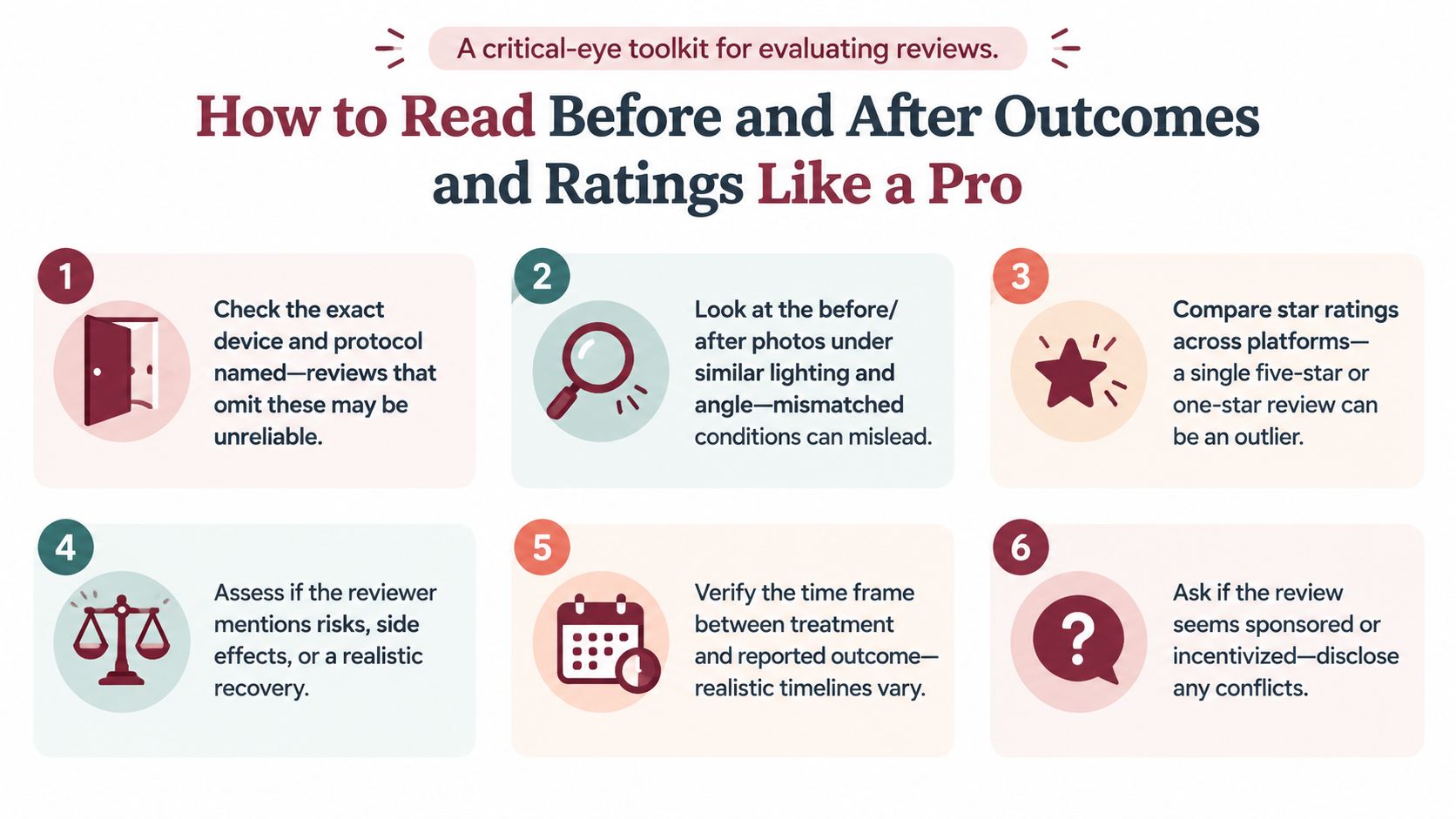
How to Read Before and After Outcomes and Ratings Like a Pro
A useful review gives you enough context to judge whether it applies to you. A weak review offers a star rating and a broad promise without identifying what happened between the first appointment and the reported result.
Start with the treatment details
Look for the exact procedure and device. “Laser rejuvenation” is less informative than a review that identifies the specific platform, treatment area, protocol, and reason for treatment. If the reviewer doesn't name the procedure, you can't reliably compare the experience with another review.
Next, check the treatment timeline. A person who reports improvement immediately after a session is describing an early impression. A later review may offer more information about durability, maintenance, delayed symptoms, or whether additional sessions were recommended.
Examine photos and ratings carefully
Before and after photographs can be affected by lighting, camera angle, distance, posture, grooming, and editing. Similar conditions don't prove that a treatment caused a change, but mismatched conditions make the comparison weaker.
Star ratings need context as well. A single five-star review or one-star complaint may be an outlier. Read the narrative, look for repeated themes across platforms, and separate comments about scheduling or staff from claims about medical outcomes.
Use this checklist when reviewing testimonials:
- Procedure: Is the exact treatment named?
- Goal: Does the reviewer identify a symptom or cosmetic objective?
- Timeline: How long after treatment was the review written?
- Limitations: Does the account mention discomfort, side effects, downtime, or incomplete improvement?
- Plan: Does it explain whether one session or multiple sessions were involved?
- Disclosure: Is there any indication that the review was sponsored, incentivized, or connected to a promotion?

At a consultation with Spa Black in San Antonio, ask how the proposed treatment relates to your specific symptom, what alternatives may be appropriate, what recovery or restrictions to expect, and how follow-up is handled. Multiple sessions may be recommended depending on the patient, but a provider should explain the reasoning rather than present a fixed promise.
Choosing Your Next Step With Confidence at Spa Black
Use reviews to prepare, then make the decision through clinical context. Start by writing down your main concern, such as dryness, discomfort during sex, perceived laxity, urinary symptoms, or an external appearance goal. Add the details that reviews often omit, including how long the concern has been present, whether it began after childbirth or menopause, and what treatments you've already tried.
A sound consultation should address:
- Candidacy: Whether the proposed treatment fits your health history and concern.
- Expected benefit: What improvement is realistic, and what the treatment isn't designed to do.
- Risks: Possible discomfort, irritation, burns, scarring, pain, or other complications.
- Alternatives: Whether evaluation, hormone-related care, pelvic-floor support, surgery, or another option deserves consideration.
- Follow-up: What happens if symptoms persist, return, or change after treatment.
Spa Black in San Antonio provides non-surgical care under physician oversight, with online booking and membership options. That convenience can help you begin the conversation, but it shouldn't replace questions about evidence, candidacy, and alternatives.
The most confident choice isn't automatically the one supported by the most enthusiastic reviews. It's the option that matches your symptom, has clearly explained limitations, includes a realistic follow-up plan, and feels appropriate after qualified medical guidance.
Spa Black offers non-surgical vaginal rejuvenation services, including IntimaLase® education and consultation, for eligible patients seeking to understand their options. Bring the reviews you found and your specific symptom priorities to an appointment, then visit Spa Black to explore the next step.