


You've tried calming skincare, switched foundations, and learned which foods or situations bring on a flush. Yet after heat, wine, exercise, or stress, your cheeks stay pink long after the warmth fades, and makeup never quite covers it. IPL redness treatment may reduce some kinds of visible vascular redness, but it isn't a cure for rosacea or a universal fix for every red mark.
Facial redness can come from persistent diffuse erythema, flushing, visible superficial vessels, or pink marks left after acne. These patterns can look similar in a mirror, but they don't necessarily respond to the same settings or treatment plan. A medically supervised assessment helps clarify whether the concern is vascular redness, post-acne discoloration, another skin issue, or a mix.
Table of Contents
- Why Facial Redness Keeps Coming Back
- How IPL Redness Treatment Targets Vessels
- What a Typical IPL Course Looks Like
- Redness Patterns and Realistic Results
- Side Effects, Downtime, and Aftercare
- How IPL Compares with Other Redness Options
- When a Medically Supervised Visit Makes Sense
Why Facial Redness Keeps Coming Back
Think of someone whose cheeks turn pink after a warm workout, a glass of wine, or a stressful day. The immediate flush may settle, but a background redness remains, and thin red lines around the nose or cheeks show through makeup. That person may have several different features at once: flushing, persistent redness, and visible capillaries.
Those features matter because not every red area has the same cause. Rosacea-related erythema can appear as lasting background redness; telangiectasia describes visible small vessels; acne-related post-inflammatory erythema is pink or red discoloration left after a blemish. A clinician can help distinguish these patterns from other causes rather than assuming all redness is rosacea. For an overview of symptoms that can accompany rosacea, see Spa Black's guide to rosacea symptoms.
IPL, short for intense pulsed light, uses filtered broadband light in a photofacial-style treatment to target superficial vascular color. It may reduce visible redness for some people, but it doesn't cure rosacea, remove every mark, or suit every skin tone. The right approach depends on what's causing the redness, skin type, device settings, and the provider's technique.
At Spa Black in San Antonio, a supervised consultation can help match the redness pattern to an appropriate approved light or laser option. The useful questions aren't just “Will IPL work?” but “What kind of redness is this, what changes are realistic, and what trade-offs should I consider?” The answers shape treatment choices, expectations, and whether IPL is a sensible next step.
How IPL Redness Treatment Targets Vessels
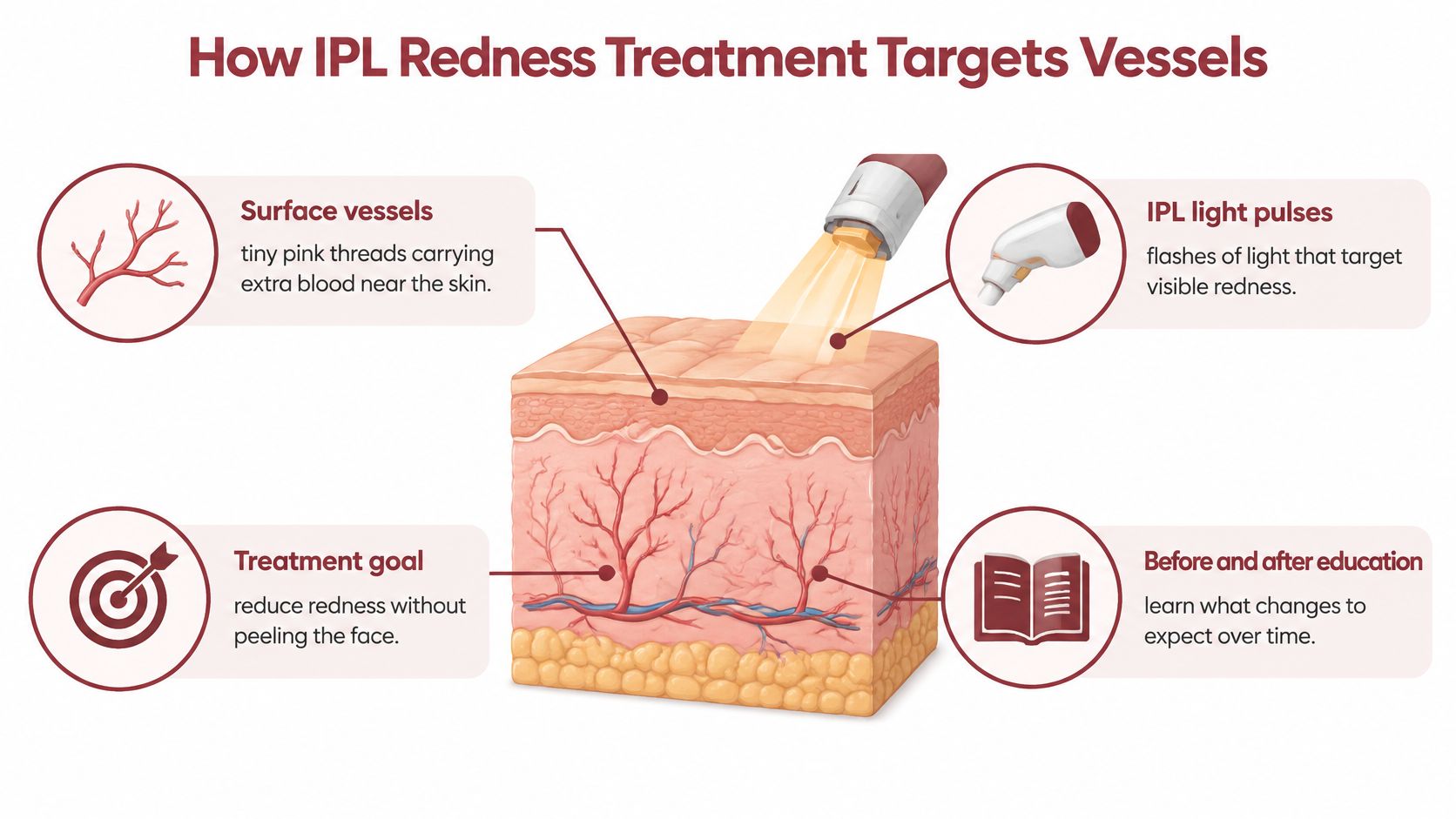
Superficial dilated vessels are fine pink threads that carry extra blood near the skin's surface. IPL works below the surface: it uses selected wavelengths of light to heat a target beneath the skin without peeling the face.
Selective targeting in plain language
The process is called selective photothermolysis. A filter allows certain wavelengths through, and oxyhemoglobin, the oxygen-carrying pigment in blood, absorbs some of that light inside superficial vessels. The absorbed energy converts to heat, which can reduce blood flow in the targeted vessels and soften the redness they create at the surface. The vessel's pigment works like a catcher for that light, which is why the filter choice matters: the goal is to warm the vascular target while sparing the tissue around it.
A randomized split-face comparison reported approximately 60% redness reduction with short-pulse IPL versus 45% with pulsed-dye laser, and a separate measurement in the same review found that a 515-nanometer IPL filter reduced rosacea-associated facial blood flow by 30% on scanning laser Doppler and lowered erythema intensity by 21% (clinical review of light-based treatments for rosacea). Both numbers reflect specific devices, filters, and study conditions, so they describe what those settings achieved rather than what any individual should expect.
Why the target changes the plan
Persistent diffuse redness, telangiectasia, episodic flushing, acneiform inflammation, and post-inflammatory redness can each respond differently. A visible vessel, a broad flush, and a pink spot left behind by acne call for different settings, which is why an assessment should name the pattern before a provider picks energy levels. One universal IPL recipe does not exist for "redness" as a single problem.
The provider individualizes wavelength or filter, pulse duration, fluence, cooling, skin phototype, and the visible endpoint during a session. Too much vascular heating can increase post-treatment redness or pigmentary risk, particularly in darker phototypes. Published percentages describe what studied settings achieved; a provider still has to translate them into an individual plan.
What a Typical IPL Course Looks Like
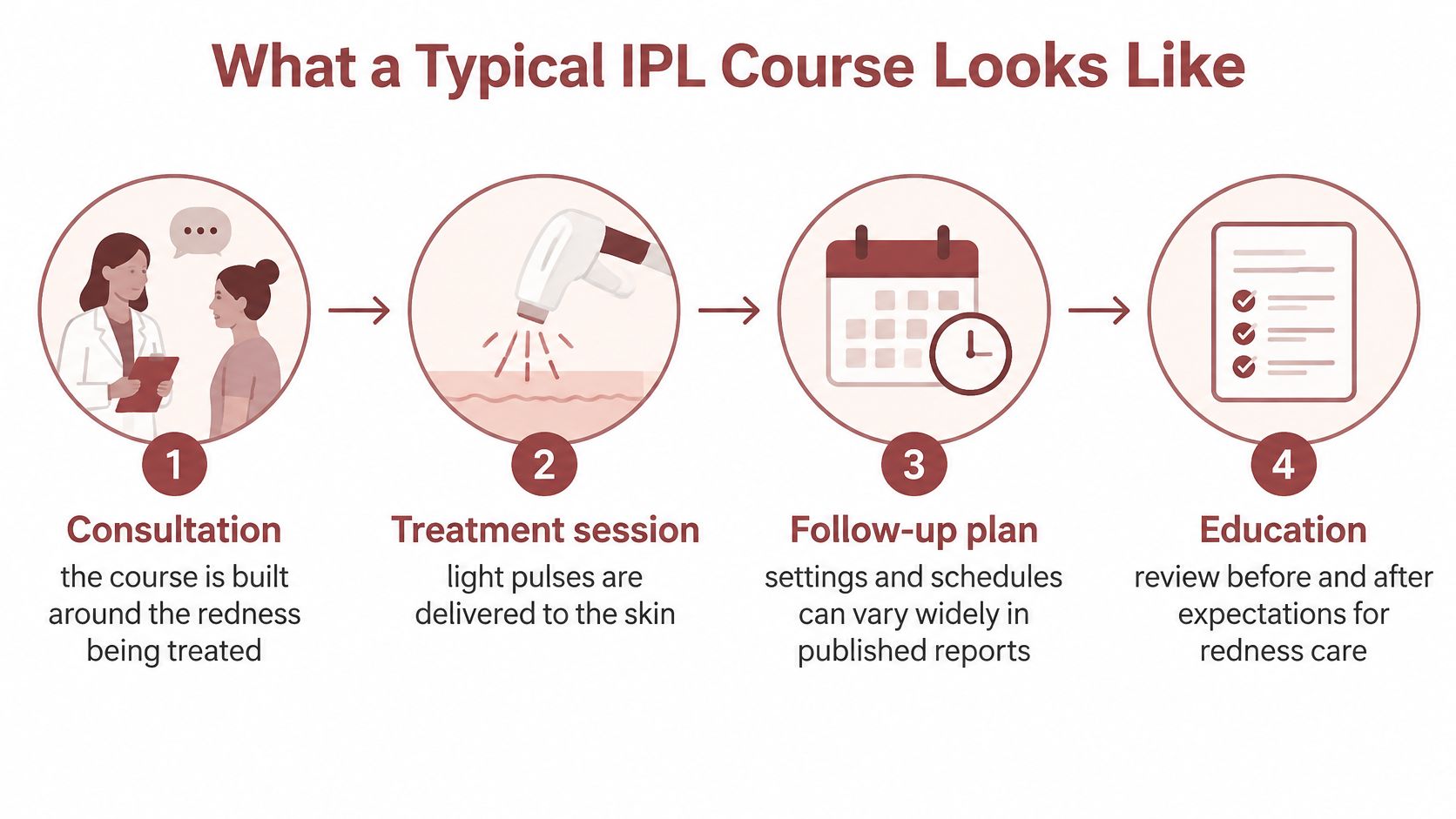
An IPL course is planned around the concern being treated. There isn't one universal filter, energy level, appointment spacing, or session count that fits every kind of redness.
For acne-induced post-inflammatory erythema, one study used a 560-nanometer vascular filter at three-week intervals for three to six sessions. Among 33 patients, the mean erythema score decreased from 2.57 ± 0.66 before treatment to 1.21 ± 0.48 afterward; 78.78% achieved more than 50% improvement, with results consistent at a 12-week follow-up. Treatment fluence ranged from 25 to 46 J/cm², pulse width was 4.5–5 milliseconds, average fluence was 38.994 J/cm², and the average course involved 4.93 sessions (study of IPL for acne-induced post-inflammatory erythema).
Different settings can mean different outcomes
In a separate study of 60 patients treated for acne-related redness and discoloration, 49 patients, or 81.7%, had complete or partial clearance of erythema and hyperpigmentation. A split-face study using 8 J/cm², a 10-millisecond pulse width, a 7-millimeter spot, and two treatments spaced two weeks apart didn't reproduce the same positive outcomes (study of IPL for acne-related redness and discoloration).
The contrast matters. Wavelength, fluence, pulse width, spot size, number of sessions, and spacing can all affect whether redness improves. A provider shouldn't present one fixed dose or schedule as the IPL redness treatment. For a patient-friendly overview of appointment expectations, IPL treatment expectations at Skinsation Aesthetics offers another perspective on what to discuss before treatment.
Redness Patterns and Realistic Results
Persistent rosacea-related redness and pink marks left after acne are measured against different endpoints in the research. Studies of IPL for rosacea generally examine facial erythema and visible vessels, while acne-related studies assess post-inflammatory redness or discoloration. Two people can both describe their skin as “red” and still need different targets.
A 2024 systematic review identified 14 eligible studies among 233 records and found that IPL generally improved facial erythema and telangiectasia, although devices, settings, outcome definitions, and follow-up varied. In one reported series, 80% of patients had reduced redness, 78% reported less flushing and improved skin texture, and 72% had fewer acneiform breakouts. These figures come from one series, so they describe that group rather than a typical patient (2024 systematic review of IPL for rosacea-related redness).
The same word can describe different targets
A separate study treated 63 patients with erythematotelangiectatic rosacea using two filter combinations, 555–950 nanometers and 530–750 nanometers. One pass used 20–25-millisecond pulses and 10–12 J/cm² fluence; a second pass used 2.5–3-millisecond pulses and 6.0–6.3 J/cm² fluence. The investigators reported overall efficacy of 90.47%, with 57 of 63 patients meeting the study's criteria. In that study, 88.9% of patients reached fair, good, or excellent clearance after one session, though later treatments were needed for further change (clinical study of IPL for erythematotelangiectatic rosacea).
Persistent erythema, flushing, broken capillaries, and post-acne marks each respond on their own timeline. A cluster of visible vessels may reach its endpoint before widespread flushing does, and residual acne marks behave differently from rosacea-associated erythema. That is why no single session count covers every redness pattern. Follow-up weeks later shows the vascular change more reliably than how the skin looks right after a flash.
Side Effects, Downtime, and Aftercare
IPL can cause temporary discomfort during the pulses, swelling, warmth similar to sunburn, minimal bruising, or a burning sensation. Short-term reactions vary between people, even when the expected effects are mild. A medically supervised provider should explain which reactions are expected for the settings selected.
What to watch during recovery
Mild pinkness or warmth can occur as the skin settles. Contact the provider if you notice blistering, increasing pain, or unexpected dark or light patches rather than treating those changes as routine recovery.
Nonpurpuric settings limit visible bruising. They do not make treatment painless, and they are not suitable for every phototype.
Follow the aftercare instructions you receive. In general, protect treated skin from sun exposure, avoid heat while it remains reactive, and pause harsh exfoliants or active skincare until your provider says they are appropriate again. Avoid saunas and hot showers for the first few days if your provider advises it.
Darker phototypes are more likely to develop post-treatment pigment changes, so the provider should set conservative settings and check the skin at follow-up. Photosensitivity and certain medications may also affect candidacy. Before treatment, a provider should review your diagnosis, skin type, sun exposure, and relevant medication history. For more on these considerations, see Spa Black's information about IPL for dark skin.
How IPL Compares with Other Redness Options
A patient with a permanent flush across both cheeks and a patient with pink spots left behind by last year's acne can describe the same complaint: my face looks red. Those are two different problems, which is why "IPL or laser?" is the wrong first question. The better question is which kind of redness you have, because persistent erythema, flushing, broken capillaries, and post-acne marks each respond differently.
When the diagnosis is rosacea-type vascular redness, the main comparison is between IPL and pulsed-dye laser (PDL). A 2024 meta-analysis of four studies totaling 141 participants found no statistically significant difference between the modalities for more than 50% clearance; its reported relative-risk estimate was -0.07, with a 95% confidence interval from -0.19 to 0.05. More-than-50% clearance was 88.89% with IPL and as high as 100% with PDL, while for more than 75% clearance the pooled figures were 77.78% with IPL and 66.67% with PDL, a statistically significant advantage for IPL at that threshold (2024 IPL-versus-PDL meta-analysis for rosacea).
Erythema index changes were similar between the two devices in the pooled analysis, while reported pain scores ran higher with PDL. A split-face comparison using nonpurpuric settings also found similar redness reduction on both sides of the face, with follow-up assessments at about 30 and 90 days (split-face comparison study). With an evidence base this small, these numbers frame a conversation with your provider rather than crowning a universal winner.
Match the concern to the first question
| Redness pattern | First question | Where IPL tends to fit | When to ask about another option |
|---|---|---|---|
| Persistent background redness | Is this ongoing vascular redness or rosacea-related erythema? | IPL is a common first option when diffuse vascular color dominates and the diagnosis is confirmed. | Ask for a fuller assessment if the diagnosis is uncertain or redness arrives with other features. |
| Flushing episodes | Does the redness surge and fade with triggers? | IPL targets the vessels that stay visible between flushes, while trigger management addresses the surges themselves. | Ask about lifestyle and trigger strategies when the flushing itself is the main complaint. |
| Discrete visible vessels | Are individual broken capillaries the main concern? | IPL suits fine superficial vessels spread across an area. | Ask whether a focused vascular treatment fits better when larger or deeper vessels dominate. |
| Pink marks after acne | Are the marks vascular redness, pigment, or both? | IPL fits when a clinician confirms the marks are vascular rather than pigment-based. | Ask about other options if texture, scarring, or pigment is the larger concern. |
| Redness with texture or pigment concerns | Which issue should treatment address first? | IPL addresses the vascular component when color is part of a mixed picture. | Other laser or microneedling approaches may be discussed for pigment or remodeling concerns. |
| Skin needing supportive care | Is the goal general skin support? | Routine skincare supports healthy skin but does not treat vascular redness. | Supportive facial treatments may be discussed alongside treatment of the vascular component. |
If you are also weighing topical approaches, this overview of evidence on CBD and facial redness can help you frame questions about supportive care to raise during a consultation. For the device choice itself, Spa Black's page on IPL versus laser treatment explains how a provider thinks through which category of treatment fits a given concern.
When a Medically Supervised Visit Makes Sense
Pink marks that have not faded three months after a breakout, or flushing that returns after each glass of wine, are examples worth raising at a supervised visit. Repeated flares, capillaries that stay visible through makeup, and uncertainty about whether you are seeing rosacea-related erythema, pigment, or texture change all point the same way. The type of redness matters as much as its presence, because a pigment mark and a dilated vessel respond to different light. Guessing the category at home can send you toward the wrong session count or the wrong platform entirely.
A consultation under physician oversight is where the redness pattern, skin tone and sun history are checked against the available platforms. At Spa Black in San Antonio, that review covers which approved light or laser platform may fit, whether a course is appropriate, and how recent sun exposure could affect risk. It is also a chance to ask how the provider will tell an expected short-term reaction from a change that needs follow-up.
Come prepared. Bring a list of your current products, and list any photosensitizing medications, such as certain antibiotics or retinoids, because they can change how the skin responds to light.
Candidacy depends on diagnosis, skin type and recent sun exposure, so the provider reviews these before any treatment is scheduled. If you decide to book through Spa Black's online scheduling, ask how improvement will be assessed several weeks after treatment rather than on the day of the visit.
Spa Black offers IPL and other medically supervised aesthetic options for people exploring care for facial redness in San Antonio. Visit Spa Black to review services and book a consultation to discuss your redness pattern, skin type, and realistic treatment expectations.